“Cathay Pacific Airways Ltd will cancel some passenger flights in January because of operational and travel curbs at a time when the Asian financial centre has tightened quarantine requirements, the airline said on Wednesday.”
We are proud to be the first Asian carrier to bring @hbomax to every seat starting from 1 Jan 22! With our latest offering of 4K content and Bluetooth headphone pairing capabilities on our @airbus#A321neo fleet , we hope you find your next new binge-worthy show on next flight! pic.twitter.com/LygfnmSaI0
Cathay Pacific has released its traffic figures for November 2021 that continued to reflect the airline’s substantial capacity reductions in response to significantly reduced demand as well as travel restrictions and quarantine requirements in place in Hong Kong and other markets amid the ongoing global COVID-19 pandemic.
Cathay Pacific carried a total of 70,047 passengers last month, an increase of 85.2% compared to November 2020, but a 97.3% decrease compared to the pre-pandemic level in November 2019. The month’s revenue passenger kilometers (RPKs) rose 87.1% year-on-year, but were down 96% versus November 2019. Passenger load factor increased by 8.2 percentage points to 26.8%, while capacity, measured in available seat kilometers (ASKs), increased by 29.5%, but remained 88.2% down on November 2019 levels. In the first 11 months of 2021, the number of passengers carried dropped by 86.4% against a 65.1% decrease in capacity and an 82.1% decrease in RPKs, as compared to the same period for 2020.
The airline carried 135,350 tons of cargo last month, an increase of 15.8% compared to November 2020, but a 23.9% decrease compared with the same period in 2019. The month’s cargo revenue tonne kilometers (RFTKs) rose 15.5% year-on-year, but were down 14% compared to November 2019. The cargo load factor increased by 4.3 percentage points to 82.6%, while capacity, measured in available cargo tonne kilometers (AFTKs), was up by 9.5% year-on-year, but was down 28.6% versus November 2019. In the first 11 months of 2021, the tonnage decreased by 1.1% against a 12.5% drop in capacity and a 2.3% decrease in RFTKs, as compared to the same period for 2020.
Cathay Pacific has released its traffic figures for August 2021 that continued to reflect the airline’s substantial capacity reductions in response to significantly reduced demand as well as travel restrictions and quarantine requirements in place in Hong Kong and other markets amid the ongoing global COVID-19 pandemic.
Cathay Pacific carried a total of 135,353 passengers last month, an increase of 278.4% compared to August 2020, but a 95.3% decrease compared to the pre-pandemic level in August 2019. The month’s revenue passenger kilometers (RPKs) rose 294.1% year-on-year, but were down 92.4% versus August 2019. Passenger load factor increased by 26.5 percentage points to 46.4%, while capacity, measured in available seat kilometers (ASKs), increased by 68.9%, but remained 86.9% down on August 2019 levels. In the first eight months of 2021, the number of passengers carried dropped by 92.2% against a 76.2% decrease in capacity and an 89.7% decrease in RPKs, as compared to the same period for 2020.
The airline carried 124,278 tons of cargo and mail last month, an increase of 21.7% compared to August 2020, but a 23% decrease compared with the same period in 2019. The month’s revenue freight tonne kilometers (RFTKs) rose 20.7% year-on-year, but were down 15.4% compared to August 2019. The cargo and mail load factor increased by 2.3 percentage points to 77.7%, while capacity, measured in available freight tonne kilometers (AFTKs), was up by 17.2% year-on-year, but was down 33.8% versus August 2019. In the first eight months of 2021, the tonnage decreased by 8.7% against a 21.8% drop in capacity and a 10.9% decrease in RFTKs, as compared to the same period for 2020.
Passenger
Chief Customer and Commercial Officer Ronald Lam said: “While the COVID-19 situation continues to present us with considerable challenges, we did see some improvement in the performance of our passenger business in August. Overall, passenger capacity increased 81% compared with July, although we still only operated about 13% of our August 2019 pre-pandemic levels. Load factor reached 46.4% – the highest it’s been since March 2020.
“August’s passenger performance was driven primarily by student traffic, in particular from the Chinese Mainland to the US. We cautiously increased capacity on these services, with our Shanghai flights notably increasing to three times per day from mid-August, while our New York, San Francisco and Los Angeles flights also saw capacity increases. We also resumed flights to Chicago and Boston, which generated strong demand.
“Meanwhile, demand for student travel from Hong Kong and the Chinese Mainland to the UK also gradually picked up from mid-August. This included not only our London flights, but our newly resumed Manchester services. Other newly resumed services in August included Paris, Phuket and Qingdao.
“From early August, we were able to resume flights from the UK to Hong Kong, although the inbound demand was relatively weak. In general, inbound traffic slowed down after 20 August when the Hong Kong SAR Government tightened quarantine requirements for travelers arriving in Hong Kong from 16 overseas places.
Cargo
“While August is traditionally a quieter month for cargo due to the summer holiday period in the Northern Hemisphere, this was not the case this year and demand continued to be buoyant both from our home market, Hong Kong, and from across our network. Cargo capacity increased about 9% month-on-month, reaching approximately 66% of our August 2019 pre-pandemic levels.
“Towards the end of the month our freighter schedule ramped up to peak season levels, with transpacific flights notably increasing to 39 flights per week. Two additional Boeing 777 “preighters” have also now entered into service, bringing our total to six, providing us with additional capacity for carrying cargo.
“At the same time, our teams have been agile in responding to the constantly changing operating environment brought on by the COVID-19 outbreaks in various parts of our network. This has particularly impacted our services to Shanghai, where authorities have increased quarantine requirements for ground staff to contain the situation.
Outlook
“Our August passenger performance, with capacity at about 13% of pre-pandemic levels, was an improvement over previous months. We had hoped to operate as much as 30% of pre-pandemic capacity by the fourth quarter of 2021. However, operational and passenger travel restrictions remain in place, continuing to constrain our ability to operate more flights. As such, we now only expect to maintain similar passenger capacity levels to August 2021 for the remainder of the year, whilst remaining responsive to any unexpected changes in travel restrictions. We maintain our focus on prudent cash management, targeting cash burn of less than HK$1 billion per month for the rest of 2021.
“For cargo, market indicators suggest a strong peak season driven by the need for inventory replenishment, against a backdrop of ongoing air capacity constraints and disruptions to supply chains due to seaport congestion. We are planning for this, whilst remaining vigilant regarding changes to the COVID-19 situation that could impact operations.
“Despite our short-term challenges, we remain committed to keeping our home city connected to the world via the Hong Kong international aviation and logistics hub.”
AIRLINES COMBINED TRAFFIC
AUG
2021
% Change
VS AUG 2020
Cumulative
AUG 2021
%
Change
YTD
RPK (000)
– Chinese mainland
72,325
1,179.3%
153,370
-80.1%
– North East Asia
10,670
95.0%
45,771
-97.7%
– South East Asia
17,596
5.4%
128,577
-94.5%
– South Asia, Middle East & Africa
7,638
–
16,446
-98.9%
– South West Pacific
18,479
-21.3%
105,968
-96.6%
– North America
609,751
563.4%
1,123,978
-79.6%
– Europe
140,598
77.2%
388,373
-90.0%
RPK Total (000)
877,057
294.1%
1,962,483
-89.7%
Passengers carried
135,353
278.4%
346,589
-92.2%
Cargo and mail revenue tonne km (000)
783,031
20.7%
4,838,080
-10.9%
Cargo and mail carried (000kg)
124,278
21.7%
795,366
-8.7%
Number of flights
1,844
59.4%
9,800
-45.6%
AIRLINES COMBINED CAPACITY
AUG
2021
% Change
VS AUG 2020
Cumulative
AUG 2021
%
Change
YTD
ASK (000)
– Chinese mainland
127,887
291.9%
450,864
-65.6%
– North East Asia
58,451
69.9%
347,128
-88.6%
– South East Asia
97,559
2.3%
629,461
-83.7%
– South Asia, Middle East & Africa
28,144
–
76,348
-96.6%
– South West Pacific
313,691
174.7%
1,529,852
-66.8%
– North America
951,932
62.3%
3,032,518
-65.5%
– Europe
314,100
22.4%
1,036,403
-82.7%
ASK Total (000)
1,891,764
68.9%
7,102,574
-76.2%
Passenger load factor
46.4%
26.5pt
27.6%
-36.4pt
Available cargo/mail tonne km (000)
1,007,351
17.2%
5,986,775
-21.8%
Cargo and mail load factor
77.7%
2.3pt
80.8%
9.9pt
ATK (000)
1,187,577
22.9%
6,662,881
-36.5%
Top Copyright Photo: Cathay Pacific Airways Airbus A350-1041 B-LXJ (msn 286) AMS (Ton Jochems). Image: 955154.
Cathay Pacific Airways is reaffirming its commitment to reaching net-zero carbon emissions by 2050 by pledging to use Sustainable Aviation Fuel (SAF) for 10% of its total fuel consumption by 2030.
Cathay Pacific has made pioneering efforts in supporting SAF development for more than a decade. In 2014, it was the first airline investor in Fulcrum BioEnergy, from which the airline has already committed to purchasing 1.1 million tonnes of SAF over 10 years, which will cover around 2% of its pre-COVID-19 fuel requirements on an annual basis. Cathay Pacific expects to begin taking delivery of SAF produced by Fulcrum and using it on a wider basis for its flights departing the US from 2024 onwards, when Fulcrum can scale up its production.
The airline was also the first to partner with Airbus to use SAF on new aircraft delivery flights from its facility in Toulouse, France. Since the partnership started in 2016, Cathay Pacific has taken delivery of over 40 brand new aircraft using blended SAF.
Chief Executive Officer Augustus Tang said: “The use of Sustainable Aviation Fuel (SAF) is key to decarbonizing our operations over the next few decades. Cathay Pacific already has a head start in this space with our investment and off take agreement with Fulcrum BioEnergy. Our new commitment to have SAF comprise 10% of our total fuel consumption by 2030 is a clear signal of our determination to achieve our net-zero emissions target and to be a leader in the fight against climate change.
“The ability to achieve this target does not rest with airlines alone. We are calling on support from various stakeholder groups to help make it a reality, from policy makers, the energy sector, aircraft and engine manufacturers, and even our customers, who are keen to reduce their carbon footprint. Only by joining hands can we meet this ambitious goal together.”
Cathay Pacific is undertaking a multi-pronged approach towards a green recovery and long-term transition towards net-zero carbon emissions. Apart from its increased usage of SAF, other key components of Cathay Pacific’s carbon reduction roadmap include fleet modernization, operational efficiency improvements, aviation and carbon capture technology innovations, and carbon offsets through its Fly Greener program – which has offset over 300,000 tonnes of carbon emissions since 2007.
Additionally, Cathay Pacific has already pledged to cut its absolute ground emissions by 32% from the 2018 baseline by 2030, through enhancing energy-saving measures and exploring renewable energy options in its premises and ground operations.
Cathay Pacific Airways is celebrating its 75th Anniversary with this announcement:
Customers can join the celebrations with limited-edition memorabilia and first-class dining experiences that commemorate the past, present and future.
Cathay Pacific celebrates an important milestone in its history as it marks 75 years of creating meaningful human connections.
Over the past three-quarters of a century, Cathay Pacific has grown from a small regional airline to one that has thrust its way out across the globe from its energetic home city, Hong Kong. Throughout it all, Cathay Pacific’s enduring purpose has been to connect customers to the people, places and experiences they love the most. To mark this special occasion, Cathay Pacific is unveiling a variety of exciting opportunities for customers to join it in marking 75 years of bringing people together, from paying homage to history, celebrating the power of connection or looking forward to a re-energized future.
Chief Executive Officer Augustus Tang said: “Cathay Pacific has seen exhilarating successes over the past incredible 75 years. We’ve connected people to many new destinations, welcomed the arrival of state-of-the-art aircraft and introduced exciting customer experience enhancements, to name a few. We have also experienced unprecedented challenges, such as the global pandemic, which we are all still overcoming. What these over seven decades have shown is that we are a resilient brand.
“What has never changed is our unyielding commitment to our loyal customers, our dedicated people and our wonderful home city, Hong Kong. We wouldn’t be the company we are today without the enduring support they have shown us, and we are incredibly grateful to each and every one of them. We hope they will join us in marking our 75th anniversary, and we look forward to many more journeys together.”
Own a piece of history
Cathay Pacific has created a special series of limited-edition merchandise commemorating more than seven decades of connection.
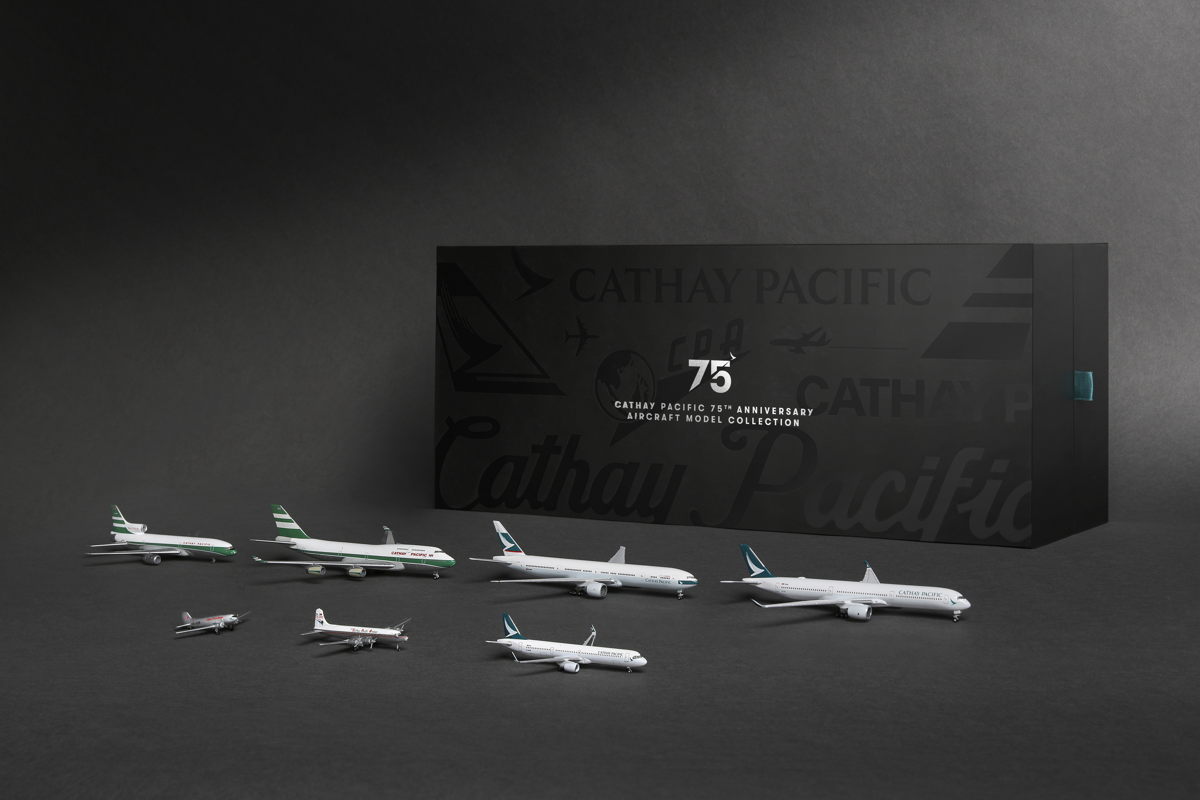
Customers have the opportunity to get one of 1,000 special collector’s box sets each featuring seven aircraft models, from the airline’s very first Douglas DC-3 aircraft, “Betsy”, to the newest member of its fleet, the Airbus A321neo.
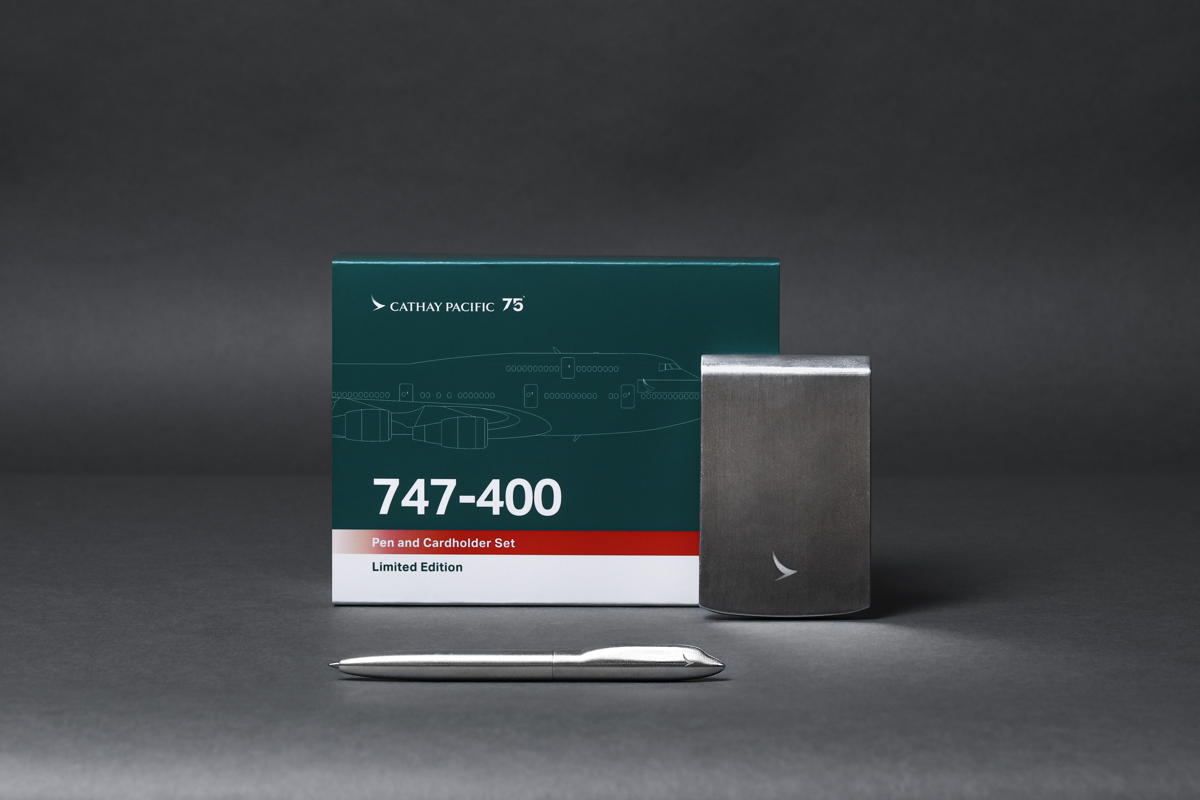
Meanwhile, 435 limited-edition pen and cardholder sets have been crafted out of aluminium reclaimed from B-HUJ, the airline’s final Boeing 747-400 passenger aircraft, and engraved with a unique serial number.
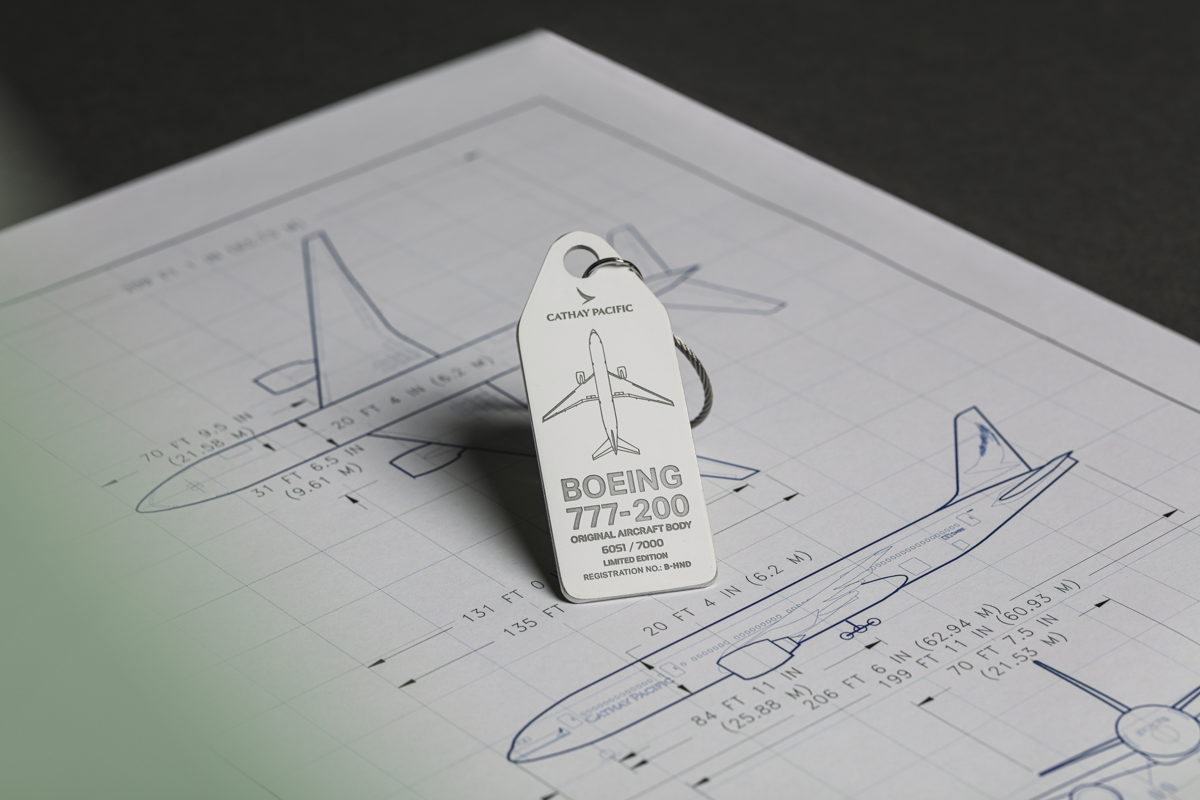
Customers can also give their luggage a touch of history with limited-edition aviation-themed luggage tags. Each has been formed from the body of Cathay Pacific’s Boeing 777-200 B-HND aircraft – affectionately called the “Haneda Jet” – which joined the fleet on 13 June 1996 and carried more than six million passengers over her lifetime.
Cathay Pacific has also partnered with Hong Kong lifestyle brand G.O.D. to upcycle uniforms from its crew into a selection of accessories and homewares, from stylish patchwork cushion covers to cross-body bags, pouches and teddy bears.
All 75th anniversary memorabilia is available exclusively on the new Cathay shopping platform: please click here.
A taste of celebration
Cathay Pacific is also launching its first-ever cocktail collection, created in collaboration with award-winning craft-bottled cocktail brand LAIBA and available exclusively in Hong Kong. The four creations – Hong Kong Lemon Tease, Shanghai Spicy Martini, London Ginger Snap and Osaka Kanpai Sour, are inspired by some of our signature routes.
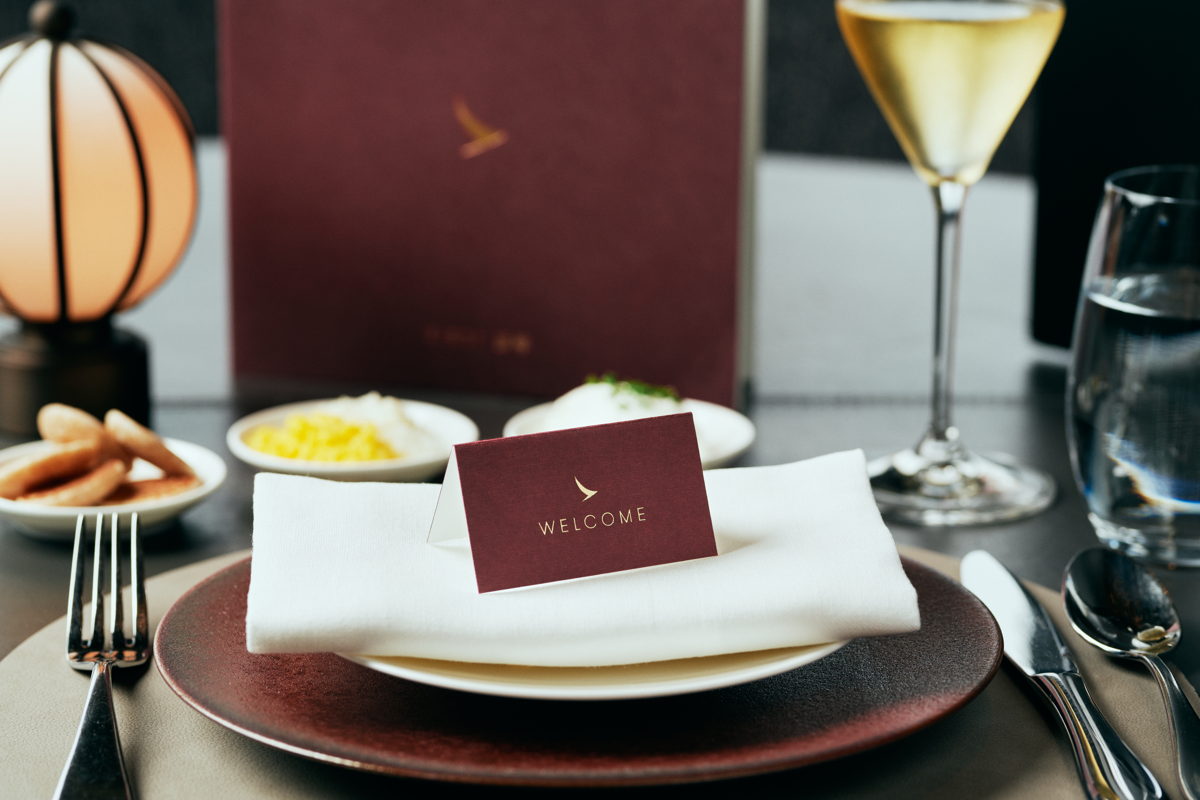
Meanwhile, customers wishing to discover the quintessential Cathay Pacific First Class experience can do so at Salisterra at The Upper House in Hong Kong, which is offering an exclusive celebration menu between 20 September and 17 October 2021. The menu features Cathay Pacific’s signature Imperial caviar paired with Krug Grande Cuvée, Champagne, France, NV and Château Lynch Bages, Bordeaux, France, 2008 from its legendary wine cellar – all served with Cathay Pacific’s signature tableware.
Reservations must be made through the new Cathay shopping platform: please click here.
Bringing the future to the present
While Cathay Pacific celebrates the past, it continues to bring innovation to every aspect of its offering. Earlier this year, Hong Kong’s home airline launched “Cathay”, a premium travel lifestyle brand that is designed to offer more for our customers, whether that’s in dining, shopping, events, wellness, flights or hotel getaways. The first of these offers, a new Standard Chartered Cathay Mastercard Credit Card, has already been launched, followed by an upgraded Cathay app combining one-stop dining and digital payment.
Cathay Pacific is also innovating in the air with the launch of its new Airbus A321neo aircraft, which offers customers the world’s most enjoyable short-haul experience. The A321neo offers new levels of comfort, privacy and storage space, not to mention world-first inflight entertainment upgrades.
These fuel-efficient aircraft also help Cathay Pacific’s continued pursuit of greener aviation as it aims to reach its target of net-zero carbon emissions by 2050. This commitment makes Cathay Pacific one of the first airlines in Asia to establish a timeline for making carbon neutrality a reality.
Own a piece of history
Explore our range of limited-edition merchandise, created especially for this anniversary. Aluminium reclaimed from B-HUJ, our record-breaking, final Boeing 747-400 plane, has been moulded into sleek pen and cardholder sets. Aviation tags have been crafted from B-HND, our loyal Boeing 777-200. And pre-loved cabin and cockpit crew uniforms have been revamped by Hong Kong lifestyle brand G.O.D. into stylish accessories, teddy bears and more.
We’ve also created a selection of special 75th anniversary collector’s aircraft models, spanning each era of Cathay Pacific. And for a modern twist on history, we’ve collaborated with LAIBA to design cocktails exclusively available in Hong Kong, inspired by four of the routes that helped put Cathay Pacific on the map.
Cathay Pacific Airways history:
In 1946, Roy Farrell and Sydney de Kantzow – two ex-Air Force pilots known for flying ‘The Hump’ over the Himalayas – had the idea to fly much-needed goods from Australia into post-war China. From there came Cathay Pacific, an airline fuelled by its founders’ passion for flying and love of the region.
In fact, our very name originates from Roy Farrell’s sense of ambition – that the new airline would one day cross the vast Pacific Ocean from China. This progressive thinking and optimism for the future was proven right less than thirty years later with our first transpacific flight.
Cathay Pacific released its traffic figures for July 2021 that continued to reflect the airline’s substantial capacity reductions in response to significantly reduced demand as well as travel restrictions and quarantine requirements in place in Hong Kong and other markets amid the ongoing global COVID-19 pandemic.
Cathay Pacific carried a total of 54,092 passengers last month, an increase of 25.8% compared to July 2020, but a 98.4% decrease compared to the pre-pandemic level in July 2019. The month’s revenue passenger kilometres (RPKs) rose 22.6% year-on-year, but were down 97.6% versus July 2019. Passenger load factor increased by 5.1 percentage points to 28.5%, while capacity, measured in available seat kilometres (ASKs), increased by 0.7%, but remained 92.9% down on July 2019 levels. In the first seven months of 2021, the number of passengers carried dropped by 95.2% against an 81.9% decrease in capacity and a 94.3% decrease in RPKs, as compared to the same period for 2020.
The airline carried 121,600 tonnes of cargo and mail last month, an increase of 19.1% compared to July 2020, but a 28.4% decrease compared with the same period in 2019. The month’s revenue freight tonne kilometres (RFTKs) rose 17.8% year-on-year, but were down 20.8% compared to July 2019. The cargo and mail load factor increased by 5.4 percentage points to 81.8%, while capacity, measured in available freight tonne kilometres (AFTKs), was up by 10.1% year-on-year, but was down 38.9% versus July 2019. In the first seven months of 2021, the tonnage decreased by 12.7% against a 26.7% drop in capacity and a 15.2% decrease in RFTKs, as compared to the same period for 2020.
Passenger
Chief Customer and Commercial Officer Ronald Lam said: “Our passenger capacity in July dropped slightly by 3% month-on-month. We operated only 7.1% of our July 2019 pre-pandemic passenger capacity. We did see some improvements in demand. We carried a total of 54,092 passengers in July, averaging 1,745 per day. On 29 July, we carried 2,585 passengers, the most in a single day so far in 2021. Meanwhile, our passenger load factor of 28.5% was the highest it’s been over the past 12 months.
“Transit traffic from the Chinese Mainland to the US and Canada remained robust. On top of that, we captured a few pockets of demand for flights from the Chinese Mainland to Southeast Asia, in particular to Jakarta and Hanoi. The increase in demand compensated for the loss of traffic from flights that remained suspended last month, notably from the UK, the Philippines and Indonesia. Meanwhile, we resumed passenger services to Auckland, Hanoi, Phnom Penh, Tel Aviv and Wuhan.
Cargo
“Cargo capacity in July increased 12.1% month-on-month, driven by the full resumption of our freighter schedule and a 33% increase in cargo-only passenger flights. All sales regions and route groups recorded healthy tonnage growth proportional to the increase in capacity, ensuring we sustained a high load factor of 81.8% across the month.
“We saw more active movement of vaccines in July and we have now surpassed the milestone of 50 million doses of COVID-19 vaccines carried to locations around the world.
Outlook
“We welcome the Hong Kong SAR Government’s latest simplifications to the entry requirements for passengers into Hong Kong. However, COVID-19 and the associated travel restrictions and quarantine requirements that are in place both in Hong Kong and around the world continue to dampen passenger demand for air travel. Furthermore, our ability to service our passenger and cargo markets remains affected by quarantine and other COVID-19-related requirements impacting our aircrew.
“We hope to be able to operate approximately 30% of our pre-pandemic passenger capacity by the fourth quarter of 2021. However, this is highly dependent upon operational and customer travel restrictions being relaxed. As governments around the world have said, this will only be possible when sufficiently high vaccination rates are achieved.
“We are incredibly grateful to the 88% of our Hong Kong-based employees, including 99% of pilots and 91% of cabin crew, who have already booked or received their vaccinations. Furthermore, all of our aircrew continue to show exemplary professionalism in adhering to stringent anti-pandemic measures while overseas. So far this year, there have been zero positive tests among the more than 75,700 tests that our operating Hong Kong-based aircrew have taken in the days following their arrival in Hong Kong.
“Looking ahead on the passenger front, student traffic to the US and the UK is expected to give us a slight boost to our business in August and September, respectively. Flights on peak dates are already full, and flights on earlier departure dates are also likely to see increased bookings as demand continues to come in. We also marked the inaugural flight of our new Airbus A321neo to Shanghai (Pudong) earlier this month, as we progressively resume more flights to the Chinese Mainland and the region.
“On the cargo side, overall demand is trending upwards despite us entering the traditionally quieter summer months for cargo. As such, there is good momentum building up as we move towards the cargo peak season.
“Nevertheless, we are still facing many challenges to both our passenger and our cargo business as the COVID-19 situation in different parts of the world continues to evolve.”
Pittsburgh International Airport made this announcement:
Cargo operations at Pittsburgh International Airport will get another boost with the return of twice weekly flights from Cathay Pacific Airways.
Cathay Pacific starts service on August 2, 2021, with its Boeing 777-300ER passenger planes that have been converted for cargo, with plans to serve PIT through the end of the year.
Planes will arrive on Mondays and Fridays and depart the next day. Cargo onboard the aircraft is for the garment industry.
The aircraft will start their flights from Hanoi, Vietnam, stopping at Cathay Pacific’s Cargo Terminal at Hong Kong International Airport before flying nonstop to PIT. Cathay Pacific initially started cargo service to PIT in September 2020 with 20 flights.
Cathay Pacific Airways (Hong Kong) has told its remaining flight crews it must be vaccinated or they risk losing their jobs. The airline has given them a August 31 deadline.
90% of its pilots and 65% of its cabin crew have been vaccinated according to the airline.
“Cathay Pacific, Airbus collaborating on single-pilot project
Program targets 2025 launch on Cathay A350s – sources
Airlines stand to save on long-haul crew costs
Cathay Pacific is working with Airbus to introduce “reduced crew” long-haul flights with a sole pilot in the cockpit much of the time, industry sources told Reuters.”
Cathay Pacific has released its traffic figures for March 2021 that continued to reflect the airline’s substantial capacity reductions in response to significantly reduced demand as well as travel restrictions and quarantine requirements in place in Hong Kong and other markets amid the ongoing global COVID-19 pandemic.
Cathay Pacific carried a total of 18,539 passengers last month, a decrease of 94% compared to March 2020. The month’s revenue passenger kilometers (RPKs) fell 95.7% year-on-year. Passenger load factor dropped by 28 percentage points to 21.2%, while capacity, measured in available seat kilometers (ASKs), decreased by 90%. In the first three months of 2021, the number of passengers carried dropped by 98.4% against a 91.7% decrease in capacity and a 98.2% decrease in RPKs, as compared to the same period for 2020.
The airline carried 83,329 tonnes of cargo and mail last month, a decrease of 30.1% compared to March 2020. The month’s revenue freight tonne kilometers (RFTKs) fell 32.4% year-on-year. The cargo and mail load factor increased by 8.9 percentage points to 86.4%, while capacity, measured in available freight tonne kilometers (AFTKs), was down by 39.4%. In the first three months of 2021, the tonnage fell by 29.6% against a 39.6% drop in capacity and a 26.5% decrease in RFTKs, as compared to the same period for 2020.
Passenger
Cathay Pacific Group Chief Customer and Commercial Officer Ronald Lam said: “Our passenger business continues to face significant challenges. With the tightened crew quarantine requirements in Hong Kong, we only managed to maintain a skeleton schedule in March, operating passenger services to just 18 destinations. That represented a capacity decline of 47% when compared with February. Average daily passenger numbers decreased even further to just 598, compared to 755 in February.
Cargo
“Our overall cargo capacity was constrained by the stringent crew quarantine requirements in Hong Kong, resulting in a 39.4% year-on-year reduction in capacity. This was despite our efforts to operate more cargo-only passenger flights as well as chartered freighter flights from our subsidiary, Air Hong Kong.
“Cargo demand was strong in March, particularly from Northeast Asia and the Americas, while demand from Hong Kong and the Chinese mainland also ramped up during the latter half of the month. Load factor improved to an all-time high of 86.4%, whilst the revenue share for our Priority LIFT product continued to increase as customers sought express solutions for their critical shipments.
“Just this week, the Government announced that it would lift the mandatory quarantine requirement for fully vaccinated Hong Kong-based aircrew on freighters and cargo-only passenger flights from today. This will have a positive impact on our cargo business while also progressively reducing our monthly operating cash burn.
“Health and safety remain our top priority; we will remain vigilant and our aircrew will continue to adhere to our stringent risk-mitigation measures. Vaccinated aircrew will add a further layer of protection and risk mitigation against the spread of COVID-19.
“Our tight overseas layover control measures, and our crew’s professionalism in adhering to them, have been very effective in safeguarding the health and wellbeing of our customers, our people and the public. As a result so far this year, there have been zero positive tests among the more than 18,500 tests that our operating Hong Kong-based aircrew have taken in the days following their arrival in Hong Kong.
Outlook
“We welcome and support the government’s plan to use ‘vaccine bubbles’ as the basis for introducing further relaxation measures, including those relating to cross-boundary travel. This provides a framework under which fully vaccinated people could benefit from shorter or no quarantine requirements when traveling, such as via an Air Travel Bubble, which we are eagerly anticipating.
“Community-wide vaccination is pivotal to the global COVID-19 recovery. We have recently launched a campaign to encourage all of our employees, including aircrew, to get vaccinated as soon as possible, and we are very pleased to see that this has already received a positive response. We are grateful to all of our people who have already received or booked their vaccination, and we will continue with our efforts. This will not only help facilitate the return of regular international air travel and preserve vital connections between Hong Kong and the rest of the world, but most importantly it will also safeguard the health and wellbeing of them and their families.
“We’ve also continued to build on the momentum in moving vaccines both to Hong Kong and across our network, and earlier this week we passed the significant milestone of having so far shipped 15 million doses of COVID-19 vaccines.”
AIRLINES COMBINED TRAFFIC
MAR
% Change
Cumulative
%
Change
2021
VS MAR 2020
MAR 2021
YTD
RPK (000)
– Chinese mainland
9,649
-69.5%
24,710
-96.7%
– North East Asia
3,466
-93.0%
14,051
-99.3%
– South East Asia
11,501
-94.8%
46,643
-97.9%
– South Asia, Middle East & Africa
–
-100.0%
–
-100.0%
– South West Pacific
2,914
-99.1%
35,277
-98.8%
– North America
34,146
-94.2%
161,569
-96.8%
– Europe
15,245
-96.6%
40,882
-98.9%
RPK Total (000)
76,921
-95.7%
323,132
-98.2%
Passengers carried
18,539
-94.0%
70,083
-98.4%
Cargo and mail revenue tonne km (000)
503,057
-32.4%
1,687,540
-26.5%
Cargo and mail carried (000kg)
83,329
-30.1%
274,556
-29.6%
Number of flights
961
-48.3%
3,176
-73.6%
AIRLINES COMBINED CAPACITY
MAR
% Change
Cumulative
%
Change
2021
VS MAR 2020
MAR 2021
YTD
ASK (000)
– Chinese mainland
36,680
-39.9%
119,834
-89.8%
– North East Asia
29,681
-77.9%
118,040
-95.9%
– South East Asia
55,187
-89.5%
251,296
-92.7%
– South Asia, Middle East & Africa
–
-100.0%
–
-100.0%
– South West Pacific
19,759
-96.9%
508,493
-88.0%
– North America
185,288
-83.9%
940,682
-86.9%
– Europe
35,480
-95.8%
247,530
-95.3%
ASK Total (000)
362,075
-90.0%
2,185,875
-91.7%
Passenger load factor
21.2%
-28.0pt
14.8%
-54.5pt
Available cargo/mail tonne km (000)
582,431
-39.4%
2,072,724
-39.6%
Cargo and mail load factor
86.4%
8.9pt
81.4%
14.5pt
ATK (000)
616,888
-52.7%
2,280,650
-61.7%
Top Copyright Photo: Cathay Pacific Airways Airbus A321-251NX WL D-AZAD (B-HPE) (msn 10171) XFW (Gerd Beilfuss). Image: 953389.






You must be logged in to post a comment.