I have started the ultimate digital photo library of the fascinating world of airliners and airlines. The goal is to have the complete history of all airlines and the various aircraft operated. I have been photographing airplanes since 1965. Join us in this adventure.
Since entering service on Oct. 26, 2011, the 787 Dreamliner has carried more than 1.3 billion passengers and helped airlines connect cities and continents in new ways. Yet talk to those who know the airplane best, and they’ll describe a jetliner that, in many ways, still feels new.
“The technology that was put into that airplane, in the design, was so advanced at the time that even now, 15 years later, you feel like you’re dealing with new technology,” said Jordan Becroft, senior fleet engineering manager for Jetstar Airways.
For operators, that technology has translated into greater versatility in how they plan and grow their networks.
Zoom into the 787 global fleet: The 787 Dreamliner is the world’s bestselling passenger widebody in history, with more than 2,450 orders from 91 customers – many of whom marked the airplane’s 15th anniversary at this year’s 787 Fleet Team Conference in Huntington Beach, Calif.
The 787 has enabled airlines to open more than 550 new nonstop routes between city pairs that were never previously served. In total, the 787 global fleet connects more than 530 destinations around the globe, enabling some of the longest nonstop routes in commercial aviation, including London–Perth at 7,829 nautical miles, Dallas–Melbourne at 7,811 and Auckland–New York at 7,670.
In 2025, the 787 flew 28% of all long-haul routes (4000 nmi – 8000 nmi) for airlines around the world.
The 787 is also proving its value on high-frequency, high-demand routes across Asia and beyond.
Becroft said the 787 “has fundamentally changed what’s possible,” by enabling Jetstar to operate long-haul international routes as a low-cost carrier.
“Initially, we expected revolutionary fuel savings and a superior passenger experience. But the 787 is so much more. It has completely reshaped ANA’s global network,” said Shinchiro Ohya, ANA’s director and 787 fleet chief. “Its range and efficiency are used to open brand new direct routes to midsize markets that simply weren’t profitable before. The 787 truly changed the game for ANA.”
But launching a new airplane came with some expected growing pains and learning opportunities for both ANA and Boeing.
“Operating the 787 first and longest means we were the very first to encounter the brand new technological challenges,” Ohya described. “With the 787, there was no prior history. So, our engineering record was the only outlet to find answers. This experience taught us the critical value of our own data and accelerated our shift toward real-time monitoring by using Boeing’s Airplane Health Management and Monitoring system (AHM).”
Today, ANA operates one of the largest 787 fleets in the world, with 92 airplanes in service, making up a large share of the carrier’s operations.
ANA JA817, the 59th 787 ever assembled, leads the 787 fleet worldwide with roughly 20,600 flight cycles (one takeoff and the following landing) as of October 2026.
“The 787 makes up 40% of ANA’s entire fleet. So, it is not just part of our network — it is absolutely our backbone,” Ohya said.
He emphasized the importance of the relationship between Boeing and ANA.
“Our relationship has evolved into a true partnership, built on transparency and shared problem-solving,” Ohya said. “Together, we have shown how an airline and an OEM can collaborate to overcome technical challenges and improve fleet reliability.”
ANA was recognized at the 787 Fleet Team Conference in 2026 for its role as the 787 launch customer, helping bring the airplane into service and working closely with Boeing as the fleet developed.
15 years and beyond: As the 787 fleet has matured, Boeing program leaders say the airplane’s value has shifted to proving how much more it can do.
“When we designed this airplane, we set it up for multiple generations of service. There’s so much capability yet to unlock,” said John Sims, Boeing’s 787 fleet chief.
Over the last decade and a half, customer needs have evolved along with the global market. Sims said the 787 continues to deliver on its promise of fuel efficiency at a time when fuel prices remain a major concern, while also helping operators open new routes and expand their capabilities.
“Our customers have always had a big voice in what we do here,” said John Murphy, the 787 chief project engineer. “That was true from the beginning with ANA, and it’s still true today — but now we have more than 90 customers on this airplane, from operators with just a few airplanes to airlines like United and ANA with more than 90. Their perspectives are very diverse, and our job is to listen and sort out what we can do to help the greatest good for all of them.”
Operators say the 787 still feels like the future
The 787 Dreamliner continues to open routes, expand networks and show how much more it can do 15 years after entering service.Play Video
Boeing leaders and customer representatives with Jetstar and ANA share their perspectives on the opportunities still ahead for the 787 Dreamliner fleet.
In many ways, program leaders say the 787 jets being delivered today are different than those that launched the program, building on lessons learned from the fleet and continuous improvement.
Since 2011, Boeing has completed more than 500 projects to improve airplane reliability. Additional enhancements have included performance improvements, such as this year’s largest-ever increase in maximum takeoff weight, as well as ongoing cabin updates that have helped make the airplane a flagship for many carriers. Boeing has also continued to advance the industry’s most sophisticated cockpit.
That evolution is part of what program leaders say makes the 787’s 15-year milestone so significant.
“It’s remarkable to me what we’ve done in 15 years. None of us could have imagined the success the airplane has had, the way it’s changed aviation and the way people fly and how they feel when they fly,” Murphy said.
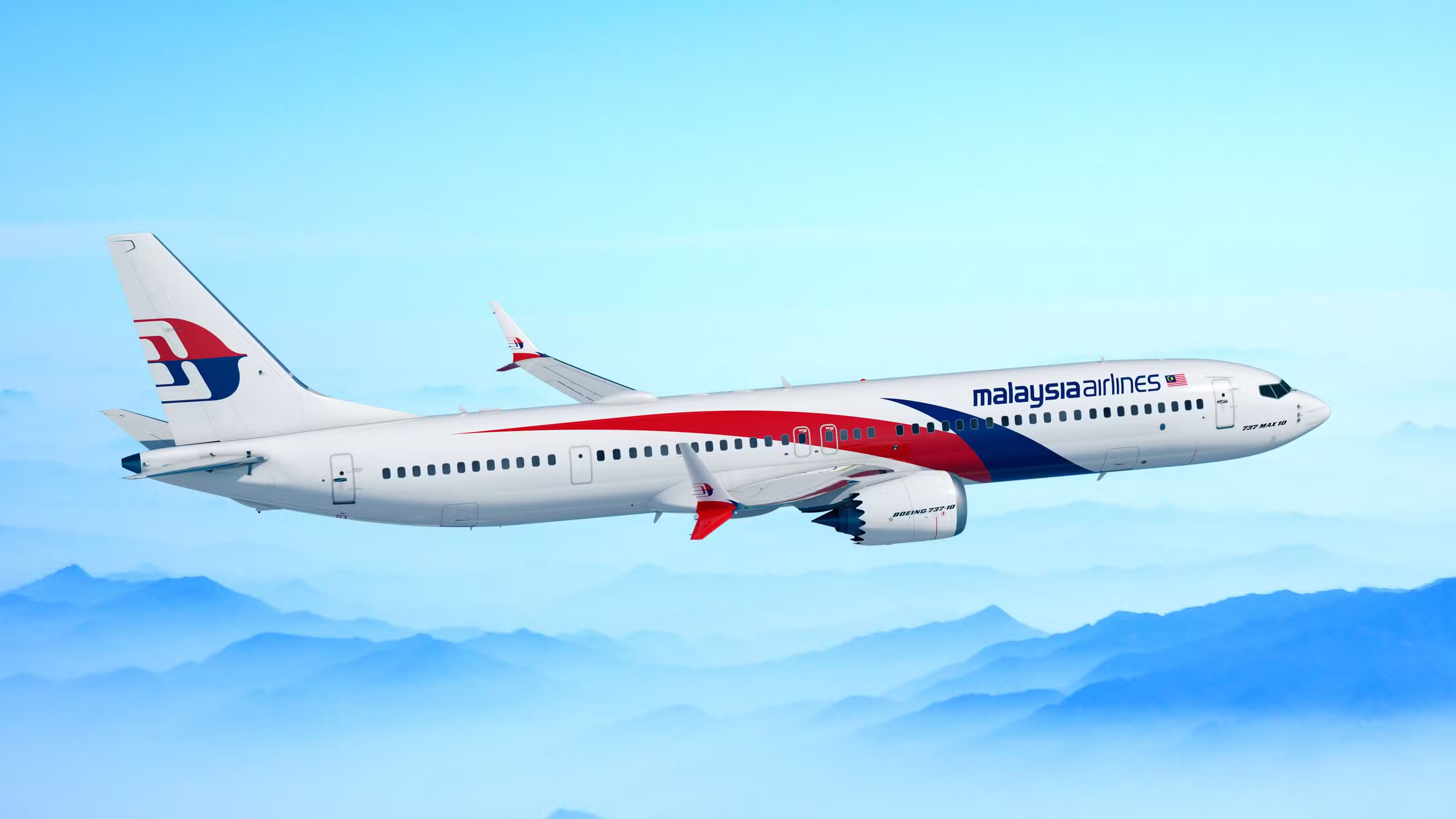
Malaysia Airlines plans to equip selected Boeing 737-10 MAX 10s with lie-flat business class seats, its CEO of Airline Business, Bryan Foong, said in an interview published November 15, 2026, setting out how the airline will deploy its 12 MAX 10s among a planned fleet of 55 MAX aircraft, with Kuala Lumpur–Delhi given as a planned example for the type and a target of an approximately equal balance of narrowbody and widebody aircraft by 2030.
The MAX 10, the largest member of Boeing’s single-aisle family, was certified by the Federal Aviation Administration on October 20, 2026 and is not yet in service anywhere.
Philippine Airlines signed contracts on November 10, 2026 with Boeing and GE Aerospace for 15 Boeing 787-10 Dreamliners, with the opportunity to purchase five more, powered by GE Aerospace GEnx-1B engines, and announced the agreements in a press release dated November 15. The contracts firm up a commitment first announced at the Farnborough International Airshow in July 2026, when Boeing said the airline had committed to up to 20 Dreamliners. The airline said the aircraft are scheduled for delivery in the next decade.
Magnifica Air is one of the most ambitious luxury airline startups to emerge in the United States in recent years, and Airbus’ confirmation that it is the previously unnamed customer behind an order for ten ACJ220-300s significantly expands the scale of the project. Airbus announced the deal on November 10, 2026, revealing that the Florida-based carrier had placed a firm order for ten ACJ220-300 aircraft while also signing up for Airbus Skywise operational software and analytics services. The order had already been sitting in Airbus’ backlog under an undisclosed customer designation.
Airbus
The new order increases Magnifica Air’s planned fleet to 17 aircraft, consisting of fourteen ACJ220s and three ACJ321neos. The airline first unveiled its plans during NBAA-BACE 2025 and has steadily refined its business model since then. Earlier plans involved leased A220s and A321neos from Air Lease Corporation and other partners, but the newly identified Airbus order dramatically expands the number of aircraft that Magnifica expects to operate.
What makes the airline unusual is that it is not attempting to compete directly with either traditional airlines or private jet operators. Instead, CEO Wade Black describes the concept as “Private Class,” a new category positioned between commercial first class and private aviation. The goal is to provide many of the conveniences of private flying while retaining the economics of scheduled airline service. Airbus quoted Black as saying the airline is focused on creating a highly personalized travel experience built around individual passengers rather than a traditional airline product.
The aircraft themselves are central to that strategy. A standard Airbus A220-300 typically seats around 130 to 150 passengers, depending on configuration. Magnifica’s version will carry only 54 passengers. The planned cabin includes a private suite plus lie-flat premium seating throughout the remainder of the aircraft. Recent disclosures indicate the latest layout includes one private suite, whereas an earlier concept displayed in 2025 had featured two suites. The reduced passenger count allows substantially more personal space and premium amenities than would be possible on a conventional airline.
The airline’s service model goes well beyond the cabin. Magnifica plans to use private aviation terminals rather than conventional airline terminals where possible. The carrier has also discussed chauffeur transportation to and from flights, concierge services, expedited baggage delivery after arrival, premium dining, and personalized ground handling. These features are intended to remove many of the pain points associated with traditional airline travel while avoiding the extremely high costs of chartering a private jet.
Operationally, the ACJ220-300 offers Magnifica significant flexibility. Airbus says the aircraft can fly approximately 4,000 nautical miles (4,603 mi.), allowing nonstop service on many transcontinental and international routes from the United States. The carrier has previously discussed serving major U.S. business markets along with select Caribbean and leisure destinations. Early planning materials highlighted routes linking South Florida and New York as key markets.
On Friday afternoon, November 13, 2026, the Federal Aviation Administration (FAA) issued a rare nationwide ground stop halting all departing commercial and civilian flights at airports across the United States. In its official air traffic advisory, the agency stated that traffic was being held on the ground until further notice “due to extraordinary circumstances and for reasons of safety,” adding that international flights entering U.S. airspace would be managed on a case-by-case basis while aircraft already airborne continued safely to their destinations.
Transportation Secretary Sean Duffy and FAA spokespeople confirmed that the halt was triggered by a widespread communications failure impacting Air Route Traffic Control Centers (ARTCCs)—the regional en-route control facilities responsible for guiding high-altitude air traffic across the continental United States. According to initial FAA reports and internal agency documentation, the breakdown involved a “rolling frequency outage” across multiple parts of the country that disrupted air-to-ground radio communications between controllers and aircraft in flight.
FAA technicians launched an immediate investigation to isolate and restore the affected telecommunications and radio frequency infrastructure, though officials noted in the initial hours of the outage that the underlying root cause of the communications failure had not yet been determined. The November 13, 2026 order marks only the third nationwide U.S.ground stop in modern aviation history, following the January 2023 outage of the FAA’s Notice to Air Missions (NOTAM) pilot alert system and the total closure of U.S. airspace in the aftermath of the September 11, 2001 terrorist attacks.
From Cirium:
Data is as of 4:40 PM Eastern time November 13, 2026.
Flights Today
There are 26,284 flights scheduled to depart today from the US.
At this time 481 have been canceled or no fly nationally, representing 1.83%. This will grow today.
After 4pm Eastern time today, there were still some 11,000 flight scheduled to depart from U.S. airports today.
The data below may include cancellations earlier in the day unrelated to the ground stop, for example, due to weather. No fly refers to a flight scheduled to depart, but had not yet departed within 180 minutes of the scheduled departure time. We anticipate that number will grow today.
Major airports with Cancellations/No Flies
Airport
Flights
Cancelled or No Fly
Cancelled or No Fly %
(JFK) New York John F. Kennedy International Airport
533
30
5.63%
(LGA) New York LaGuardia Airport
533
26
4.88%
(SFO) San Francisco International Airport
588
19
3.23%
(BOS) Boston Logan International Airport
547
23
4.20%
(FLL) Fort Lauderdale-Hollywood International Airport
354
16
4.52%
(ATL) Atlanta Hartsfield-Jackson International Airport
1,130
11
0.97%
(LAX) Los Angeles International Airport
750
7
0.93%
(EWR) Newark Liberty International Airport
519
8
1.54%
(PBI) President Donald J. Trump International Airport
98
8
8.16%
(MCO) Orlando International Airport
547
8
1.46%
(SAN) San Diego International Airport
356
7
1.97%
(PHX) Phoenix Sky Harbor International Airport
614
7
1.14%
On behalf of Cirium, the aviation analytics company, we are monitoring developments this hour related to a full ground stop in the U.S.
After 4pm Eastern time today, there were still some 11,000 flights and over 1.5 million passengers were still scheduled to depart from U.S. airports today.
Data below is as of 5:50 PM Eastern time November 13, 2026.
Diversions
600 diverted flights for Nov. 13.
496 of those 600 flights (82.7%) returned to their origin airport. The other 104 diverted to a different airport.
Most diversion airports overall: Chicago O’Hare (ORD), 28; Denver (DEN), 26; Dallas/Fort Worth (DFW), 19; Washington National (DCA), Charlotte (CLT) and Los Angeles (LAX), 16 each.
Among flights that diverted somewhere other than their origin, Cincinnati (CVG) received the most, with six, followed by San Jose (SJC) with five.
Update from Cirium:
Data is as of 7:05 PM Eastern time November 13, 2026.
Flights Today
There are 26,284 flights scheduled to depart today from the US.
At this time 4,103 flights have been canceled or no fly nationally, representing 15.61%. This will continue to grow today.
After 4pm Eastern time today, there were still some 11,000 flights and over 1.5 million passengers were still scheduled to depart from U.S. airports today.
Diversions
The table lists 827 diverted-flight records for Nov. 13.
670 of those 827 flights (81%) returned to their origin; 157 diverted elsewhere.
Most frequent diversion airports overall: Chicago O’Hare (ORD), 59; Charlotte (CLT), 34; Denver (DEN), 30; Dallas/Fort Worth (DFW) and Houston (IAH), 27 each. These totals include flights returning to their origin.
Among flights diverted to a different airport, Washington Dulles (IAD) led with 10; Los Angeles (LAX), Cincinnati (CVG) and Nashville (BNA) had six each.
Cancellations/No Fly
The data below may include cancellations earlier in the day unrelated to the ground stop, for example, due to weather. No fly refers to a flight scheduled to depart, but had not yet departed within 180 minutes of the scheduled departure time. We anticipate that number will grow today.
US
Airport
Flights
Cancelled or No Fly
Cancelled or No Fly %
(ORD) Chicago O’Hare International Airport
1,293
205
15.85%
(ATL) Atlanta Hartsfield-Jackson International Airport
1,130
195
17.26%
(DFW) Dallas Fort Worth International Airport
1,044
158
15.13%
(DEN) Denver International Airport
958
110
11.48%
(CLT) Charlotte Douglas International Airport
760
102
13.42%
(LAX) Los Angeles International Airport
750
99
13.20%
(IAH) Houston George Bush Intercontinental Airport
624
100
16.03%
(PHX) Phoenix Sky Harbor International Airport
614
73
11.89%
(SFO) San Francisco International Airport
588
125
21.26%
(LAS) Las Vegas Harry Reid International Airport
570
64
11.23%
(SEA) Seattle-Tacoma International Airport
558
61
10.93%
(MCO) Orlando International Airport
547
66
12.07%
(BOS) Boston Logan International Airport
547
130
23.77%
(MIA) Miami International Airport
540
72
13.33%
(LGA) New York LaGuardia Airport
533
151
28.33%
(JFK) New York John F. Kennedy International Airport
533
114
21.39%
(EWR) Newark Liberty International Airport
519
61
11.75%
(DTW) Detroit Metropolitan Wayne County Airport
446
69
15.47%
(DCA) Ronald Reagan Washington National Airport
440
58
13.18%
(MSP) Minneapolis-Saint Paul International Airport
428
68
15.89%
(PHL) Philadelphia International Airport
381
43
11.29%
(BNA) Nashville International Airport
371
44
11.86%
(IAD) Washington Dulles International Airport
364
69
18.96%
(SAN) San Diego International Airport
356
72
20.22%
(FLL) Fort Lauderdale-Hollywood International Airport
354
45
12.71%
CAN
Airport
Flights
Cancelled or No Fly
Cancelled or No Fly %
(YYZ) Toronto Pearson International Airport
463
65
14.04%
(YVR) Vancouver International Airport
297
30
10.10%
(YUL) Montreal-Trudeau International Airport
224
30
13.39%
(YYC) Calgary International Airport
213
17
7.98%
(YEG) Edmonton International Airport
95
6
6.32%
(YOW) Ottawa Macdonald-Cartier International Airport
82
5
6.10%
(YTZ) Billy Bishop Toronto City Airport
62
12
19.35%
(YLW) Kelowna International Airport
50
10
20.00%
Update:
The FAA has now lifted the nationwide ground stop that halted departures across the United States for more than four hours on November 13, 2026. Departures are resuming, but the aviation system remains heavily disrupted and airlines are warning that recovery will take at least several operational cycles and potentially days before schedules fully normalize.
As of the latest official briefings, the problem appears to have originated within the FAA’s air traffic control communications infrastructure. Transportation Secretary Sean Duffy said the FAA began experiencing instability in radar and communications systems around 3:36 p.m. Eastern Time. According to Duffy, overloaded switches and routers in the aging analog telecommunications network began producing inconsistent data, forcing the FAA to shut down portions of the system as a safety precaution and issue the ground stop.
Homeland Security Secretary Markwayne Mullin stated that there is currently no evidence of a cyberattack or other malicious activity. Officials characterized the event as a telecommunications or communications-system outage rather than a security incident.
There are still some conflicting reports regarding the exact technical trigger. Reuters and FAA briefing comments point to a communications failure and overloaded infrastructure, while other reports citing officials involved in the investigation indicate a software or technology update may have contributed to overwhelming parts of the system. Federal investigators are still determining the precise root cause.
The ground stop was lifted at approximately 8:15-8:30 p.m. Eastern Time after FAA technicians restored the affected systems and verified operational stability.
The operational impact has been massive. Latest figures show:
More than 4,700 flights canceled.
More than 10,000 flights delayed.
Hundreds of additional cancellations already posted for November 14.
Roughly 15,000 flights either delayed or canceled during the event, according to flight-tracking services.
Airline status as of this evening:
United Airlines stated that aircraft already airborne continued operating, but new domestic departures were halted during the ground stop. United is now restarting operations but faces significant network dislocations.
JetBlue reportedly canceled most of its remaining evening schedule following the outage and will be rebuilding operations overnight.
Major carriers including American, Delta, Southwest, Alaska, Hawaiian, United, and JetBlue are expected to operate on revised schedules through at least tomorrow as crews, aircraft, and passengers are repositioned. Airlines for America has advised travelers to monitor their carrier’s updates closely.
For travelers, the immediate issue is no longer the FAA shutdown itself but the downstream effects. Aircraft and crews are now out of position throughout the network, meaning cancellations and delays are expected to continue throughout November 14 even though the national airspace system is again open. Aviation analysts quoted by Reuters believe full schedule recovery could take several days.
This is being described as the most significant nationwide FAA shutdown since the January 2023 NOTAM outage and only the second nationwide ground stop since the September 11, 2001 attacks.
November 14, 2026 update from Cirium:
On behalf of Cirium, the aviation analytics company, we are monitoring developments related to the full ground stop in the U.S.
This data is as of 8:30AM Eastern Time, November 14, 2026.
SCHEDULED FLIGHTS NOVEMBER 14, SATURDAY
There are 22,232 flights scheduled to depart from U.S. airports today Saturday — around 4,000 fewer flights than yesterday.
Upwards of 3M passengers would be typically scheduled to fly from U.S. airports.
CANCELLATIONS
According to data from Cirium, 14% of flights departing the U.S. are canceled today, Saturday. There are 15 cancelations at this time for tomorrow Sunday, which is low.
Date
Flights
Cancelled or No Fly
Cancelled or No Fly %
2026-11-13
26,284
9,266
35.25%
2026-11-14
22,232
3,262
14.67%
Grand Total
48,516
12,528
25.82%
CANCELLATIONS BY AIRLINE TODAY NOV 14
Airline
Flights Scheduled
Cancelled or No Fly
Cancelled or No Fly %
(AA) American Airlines
5,702
880
15.43%
(UA) United Airlines
4,409
728
16.51%
(DL) Delta Air Lines
4,205
821
19.52%
(WN) Southwest Airlines
3,139
314
10.00%
(AS) Alaska Airlines
1,379
137
9.93%
(B6) JetBlue
671
271
40.39%
(F9) Frontier Airlines
471
29
6.16%
(MXY) Breeze Airways
258
20
7.75%
(AC) Air Canada
151
35
23.18%
(G4) Allegiant Air
148
0
0.00%
(Y4) Volaris
72
10
13.89%
(AV) Avianca
48
3
6.25%
(BA) British Airways
42
1
2.38%
(AM) Aeromexico
38
2
5.26%
(WS) WestJet
35
9
25.71%
(PD) Porter Airlines
35
2
5.71%
(SY) Sun Country Airlines
34
0
0.00%
(XP) Avelo Airlines
28
0
0.00%
(LH) Lufthansa
26
2
7.69%
(AF) Air France
25
0
0.00%
INTERNATIONAL FLIGHTS TO THE U.S.
Date
Flights
Cancelled or No Fly
Cancelled or No Fly %
2026-11-13
2,160
451
20.88%
2026-11-14
2,269
267
11.77%
Grand Total
4,429
718
16.21%
INTERNATIONAL FLIGHTS TO THE U.S.; CANCELLATIONS BY DEPARTURE COUNTRY NOV. 14
American Airlines is expanding dining choices for premium customers with new light bites offered in First Class on select flights. Beginning this month, customers traveling in First Class on flights between Chicago O’Hare International Airport (ORD) and John F. Kennedy International Airport (JFK) or LaGuardia Airport (LGA) in New York will enjoy a selection of light morning and afternoon offerings designed for customers looking for fresh, flavorful meal choices.
Customers can choose from two light bite options, with menus rotating regularly throughout the year to provide customers with variety and choice.
“Our light bites menu provides an elevated experience on one of our most popular routes,” said Vice President of Culinary Strategy and Operations Raphael Girardoni. “We want to exceed the expectations of even our most discerning customers, and this new, more substantial menu offering is designed to do just that.”
Tropical chia overnight oats
Prosciutto and melon
Whipped burrata
Poached shrimp with noodle salad
Smoked salmon
Tropical chia overnight oats
Prosciutto and melon
Fruit and cheese plate
Prosciutto and brie
Apple cinnamon chia pudding
Curry chicken salad
Thai noodle salad
Turkey and Gouda sandwich
Whipped burrata
Poached shrimp with noodle salad
Mezze plate
Blackened chicken
Grilled vegetable wrap
Light bites will be available exclusively on board and will not be offered through preorder.
Continuing to elevate the inflight dining experience
In recent months, American has continued to elevate the customer dining experience across the travel journey. The airline introduced a refreshed lineup of complimentary Main Cabin snacks, expanded its popular partnership with Pecan Lodge to all eligible First Class flights departing from Dallas Fort Worth International Airport (DFW), reopened its redesigned Flagship® Dining at Los Angeles International Airport (LAX), and enhanced food and beverage offerings across its Flagship®and Admirals Club® lounges. Together with ongoing investments in premium dining, lounges and onboard service, these enhancements reflect American’s commitment to delivering a more thoughtful, elevated travel experience for customers at every stage of their journey.
Emirates was recognised as the first-ever winner of the Best Travel, Leisure & Experience Campaign award for its work to transform its affiliate marketing programme in Asia Pacific (APAC) – one of the world’s most competitive travel markets where online travel agencies, airlines and travel agents all compete for the same affiliate partners.
The airline rebuilt its affiliate marketing programme by shifting from broad publisher volumes to a refined partner base that works harder without sacrificing efficiency, strengthening direct relationships, and focusing on investments that delivered the greatest impact, along with expanding into new affiliate partner categories. As a result, the airline’s revenue growth from performance marketing in APAC rose 31% in a single year.
At Emirates, performance marketing operates as a strategic engine for customer growth, not only as a marketing channel. An internal team of specialists combine channel expertise with advanced analytics, attribution, customer insights and rich first-party data, and keep a consistent focus on driving incremental revenue, customer quality and lifetime value.
Emirates’ performance marketing at a glance
A core team in Dubai covers affiliate marketing, paid search and metasearch, supported by over 60 digital marketing colleagues and hundreds of partners globally. Together, these three channels delivers more than a third of new customers acquired through emirates.com.
The team manages strategy and execution for more than 5,000 always-on campaigns worldwide across search engines, flight search websites and affiliate marketing partners. Big data from partners powers this always-on engine and guides strategic investment decisions supporting more than 4,000 routes in 80 markets.
High levels of automation and strict processes allow the team to operate at this scale while keeping decisions consistent, with dedicated specialists across each discipline ensuring best-in-class execution and governance.
Exclusive partnerships enable Emirates to bring industry-first and industry-leading advertising solutions to market.
About the awards
The Global Performance Marketing Awards recognise work that drives measurable growth across performance and partnership marketing, and represent the collaborative efforts of brands, agencies, publishers and technology platforms. Entries are scored independently by multiple senior judges from brands, agencies and publishers across the industry, assessing each entry on strategic clarity, quality of execution, partnership collaboration and measurable commercial impact.
This latest win follows Emirates’ shortlisting at the Global Search Awards for Best Use of Search (Travel/Leisure).
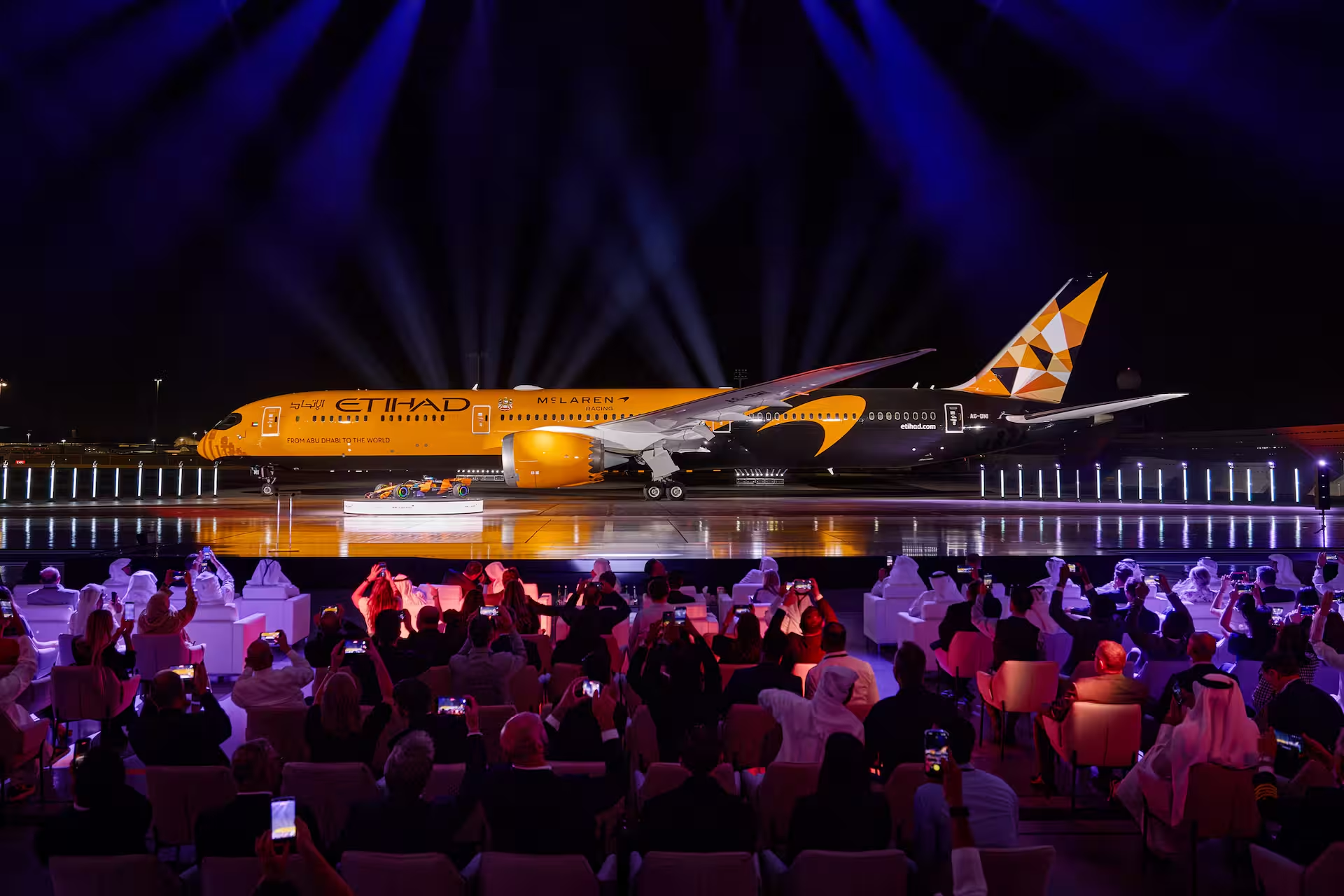
Etihad Airways, the national airline of the United Arab Emirates, has unveiled a striking new livery carrying the distinctive branding of partner McLaren Racing, marking the first time a Formula 1 team has been featured on a wide-body aircraft. Guests stepping onboard the Etihad Dreamliner will be a part of Formula 1 history.
The specially designed aircraft celebrates the partnership between Etihad Airways and McLaren Racing, creating one of the most prominent motorsport liveries ever carried by a commercial aircraft and a new way for guests and fans to connect with McLaren Racing.
Bringing together two globally recognised brands, the design transforms one of Etihad’s flagship Boeing 787-10 Dreamliners (A6-BMI) with McLaren’s distinctive identity and papaya color. The aircraft will take the partnership around the world as it operates across Etihad’s extensive global network, connecting Abu Dhabi with destinations from Dublin, Milan and Vienna to Bali, Bangkok and Delhi.
The livery was revealed in a record-breaking event at the Etihad Engineering facility in Abu Dhabi, featuring the record title for the largest single piece kabuki reveal, independently verified by Guinness World Records.
The livery is the latest expression of the partnership between Etihad Airways and McLaren Racing announced earlier this year. Etihad is an Official Partner of the McLaren Mastercard Formula 1 Team and the McLaren Hypercar Team for the 2026 season and beyond.
The relationship reflects the shared characteristics of two industries shaped by technology, teamwork and high performance. As McLaren competes around the world, Etihad’s network connects Abu Dhabi with many of the sport’s major destinations including Australia, China, Japan, Singapore, the UK, Spain, Italy and the United States.
Alongside the new aircraft livery, Etihad branding features prominently on the McLaren Mastercard Formula 1 Team race cars including the MCL40’s rear wing and halo, as well as McLaren Mastercard F1 Team driver helmets.
The partnership builds on Etihad’s long-standing commitment to racing, including its role as title sponsor of the Formula 1 Etihad Airways Abu Dhabi Grand Prix since 2009. Abu Dhabi will host the season finale this December.