In tough times, tough people rise and transcend. The past year, so many people rolled up their sleeves and went above and beyond to help others. Now Brussels Airlines thinks it is time to thank those everyday heroes, as heroes deserve a vacation too. Therefore, Brussels Airlines calls on everyone to share the story of their own hero. The Belgian airline will then thank 250 of those big and little heroes with a voucher worth €250 for a flight of their choice. Brussels Airlines got inspired for the campaign by its own staff, after many of the company’s employees began volunteering during their temporary technical unemployment.
On its social media channels, Brussels Airlines puts two of its own corona heroes in the spotlight: Dominique Jacobs, a volunteer in a residential care center and with Nicola Bové, who is committed to neglected animals. The coronavirus pandemic caused a historically low market demand for air travel last year, resulting in temporary technical unemployment for staff. Soon, the company noticed a great drive among its staff to roll up their sleeves elsewhere, ranging from crisis volunteer at the Belgian Red Cross, steward at a vaccination or testing center, to teaching online language classes to children and adults at home and abroad.
Videos:
With vaccination programs underway in many countries and demand for travel slowly starting to pick up for summer offering perspectives for the travel sector, Brussels Airlines wants to thank 250 corona heroes with this symbolic action, giving them a voucher worth €250 for a flight of their choice, on a date of your choice. The airline is looking for positive stories from the past year. Whether it is someone who made a difference in the framework of a profession, someone who spent time volunteering or a friendly neighbor who helped with the grocery shopping; all stories are welcome and everyone can nominate a corona hero via brusselsairlines.com regardless of the function or heroic deed of the person.
As it is currently not easy for many people to plan a trip, Brussels Airlines continues to focus on its great flexibility. The voucher can be used until December 31, 2021. Tickets booked until 31 May can be rebooked free of charge for a later date and/or another destination. Participation in the contest is possible until May 3, 2021, winners will be contacted at the end of May.
With vaccination programs underway in many countries and demand for travel slowly starting to pick up for summer Brussels Airlines prepares its operations for a gradual build up of its flight offer.
At an airline, such a buildup does not happen overnight and it takes several months to prepare. We not only need to get our planes ready to hit the skies again, but we also need to get our cabin and cockpit crew and our Ground Operations colleagues back up to speed and fully trained after a period of inactivity.
Training our pilots, crew and ground staff
In aviation, nothing is left to chance and safety is at all times the highest priority. Therefore, our Training department worked out a very thorough and intensive training program to make sure we fully prepare our pilots to take off again. The first group started their training at the beginning of April. For each pilot, the program takes approximately one month to complete and includes 14 hours of theoretical training, including self-study and classroom trainings to review all flight and aircraft procedures, 12 hours of simulator and 10 to 20 flights with an instructor, depending on the experience of the pilot. Last but not least, every pilot performs a line check before they are released to fly on their own again. In total 150 pilots need to go through this complete training and we expect to finish the training program by summer. Our 400 other pilots have continuously been trained during the past months.
As for our cabin crew, as of 1 May, 130 cabin colleagues who have been in full temporary unemployment will gradually be retrained for flying duties with seven to ten days of refresher courses, depending on the type of flights they operate (short haul or long haul), and several familiarization flights to have all safety procedures and Corona-related hygiene measures fresh in mind when they welcome our passengers on board again.
Also on the ground, we prepare our airport colleagues for their duties. They get refresher courses and work in pairs with colleagues on their first day back on the job so they are ready to welcome our guests again.
Getting our aircraft ready
Today, 21 of our 38 aircraft are operational. In order to increase our flight offer, we of course also need to get more and more aircraft back in the air to prepare for summer.
As aircraft are made to fly, not to stand on the ground, we have kept busy meticulously maintaining our birds while they were inactive, in order to keep them in great shape once we could reactivate them. To reactivate an aircraft after such a long period (some have been parked since March 2020), our Maintenance teams go through thorough procedures, checking every nook and cranny of the fuselage and moving parts, checking every valve and tube, and test-running all electronic systems. They test the engines, replace life vests and other safety equipment if they are expired, and getting the cabin ready with a thorough cleaning. Finally, they run a test flight to give the aircraft a final GO for operations. The entire de-storage process takes approximately 200 man hours per aircraft.
Hygiene measures
Welcoming more passengers means that it is important to emphasize that we continue to apply the same Corona measures as before. These include a mandatory face mask during the entire flight (as of arrival at the airport) for every passenger as of six years old, row by row boarding and de-boarding to avoid queues in the aircraft, extra disinfection of the aircraft and of course proper hand hygiene. All our aircraft are equipped with HEPA filters that continuously supply clean air on board. See the complete overview or our measures here.
As usual, we ask passengers who feel unwell not to travel, to protect the health of other passengers and our crew. As many countries still have specific restrictions, we ask our passengers to check the requirements before they travel.
Above Copyright Photo: Brussels Airlines Airbus A320-214 OO-SNE (msn 4243) (Pieter Bruegel – we fly you to home of Bruegel) LHR (Tony Storck). Image: 947177.
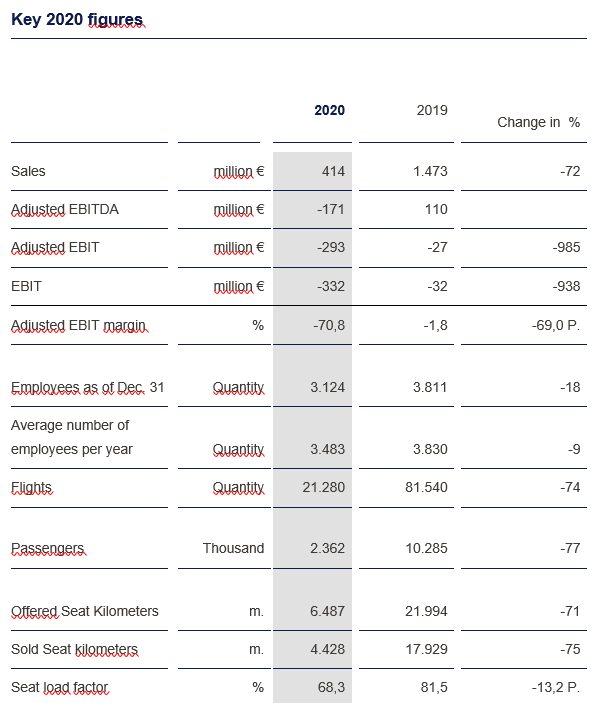
Brussels Airlines closes 2020 with an Adjusted EBIT of EUR -293 million:
In line with expectations due to the Covid-19 crisis, Brussels Airlines booked a loss of EUR 293 million in the financial year 2020.
Losses and cash-out limited by stringent cost-saving and cash management measures.
Revenue down by 72% to 414 EUR million and operating expenses decreased by 53%, mainly due to lower production.
Passenger numbers decreased by 77% to 2.4 million.
Transformation plan Reboot was intensified and accelerated to counteract the impact of the crisis and lay the basis for profitability by 2023.
2021 foresees a gradual capacity build-up, but will remain a challenging year. Summer season is essential.
2020 was an unprecedented year for the airline industry, including for Brussels Airlines. With a restructuring plan already ongoing at the beginning of 2020, Brussels Airlines was off to a good start in January and February, when suddenly demand began to crumble fast as the Coronavirus found its way to Europe. The second quarter was marked by a worldwide lockdown, when at the end of March Brussels Airlines decided to ground its fleet during 12 weeks, with only repatriation and cargo flights still operating. On 15 June, the airline resumed a reduced flight schedule, with very tight steering and a very flexible capacity management, in order to guarantee cash positive operations and preserve its cash position from further deterioration. Every week so far since the restart in June, Brussels Airlines succeeded to obtain cash-positive operations, i.e. covering all flight related cash-outs with respective revenues. Nevertheless, fixed costs such as aircraft loans, personnel expenses, rent etc. still remain and are not covered by the current low level of flying.
Summer 2020 showed a promising resumption of traffic with strong demand on the European leisure network, as well as on the African network. However, a second wave of Covid-19 slowed down demand again after summer. As a result of the restrictive travel regulations worldwide and to meet the cash-positive flying target, the capacity decreased further in October and November and reached a level of -78% vs the same period in 2019. As demand remained much more stable on the African segment than on the European sector, the airline shifted its focus toward its African portfolio, in combination with its European feeder flights for the rest of the winter season. Around the end of year holiday period another peak in demand was recorded on the European leisure segment and on the African network. The full year capacity was severely impacted by the crisis, with 74% less flights compared to the previous year.
Brussels Airlines’ revenue fell by 72% to EUR 414 million (previous year: EUR 1,473 million) as a result of the Coronavirus crisis. Operating revenue was 71% below the previous year’s level at EUR 456 million (previous year: EUR 1,555 million).
Brussels Airlines’ Adjusted EBIT fell to EUR -293 million in the 2020 financial year (previous year: EUR -27 million – IFRS standard). The Adjusted EBIT margin decreased by 69.0 percentage points to -70.8% (previous year: -1.8%). EBIT decreased to EUR -332 million (previous year: EUR -32 million). The difference compared with Adjusted EBIT was mainly due to impairment losses on rights of use for aircraft amounting to EUR 33 million.
With 2.4 million passengers, Brussels Airlines carried 77% fewer passengers in the reporting year than in the previous year (previous year: 10.3 million). Capacity had to be reduced by 71% and sales fell by 75%. At 68.3%, the seat load factor was 13.2 percentage points lower than in the previous year (81.5%). Average yields increased by 1.0% after adjusting for foreign exchange effects. Traffic revenue fell by 72% to EUR 384 million (previous year: EUR 1,386 million).
New CEO
Since 1 March, Peter Gerber is the new CEO of Brussels Airlines. Next to his role as CEO and CCO of Brussels Airlines, Peter Gerber also acts as the Lufthansa Group Chief Representative for European Affairs. His focus will be on guaranteeing continuity at the airline, further implementing the Reboot Plus plan to create a profitable future for the company and steering the airline through the crisis in a sustainable manner.
„2020 confronted Brussels Airlines and the entire aviation industry with the largest crisis in its history. I want to thank everyone involved for their support during this difficult time: employees, partners and our customers. Rapidly changing travel restrictions and hygiene measures along with unprecedented drops in demand and production formed great challenges for everyone at Brussels Airlines. Since the beginning of the crisis, our employees have shown incredible resilience, even throughout the large-scale temporary unemployment still ongoing today in the company. I intend to foster the passionate spirit at Brussels Airlines to continue to turn the company into profitability.”
Peter Gerber, CEO Brussels Airlines
Reboot Plus lays the foundation for a profitable future
In order to respond to the crisis and the expectation of a slow recovery of the demand, as well as to lay the basis for a resilient and sustainable company after the crisis, Brussels Airlines intensified and accelerated its Reboot transformation plan, reducing its fleet by 25% and its workforce by 20%, thanks to the financial support of Lufthansa (EUR 170 million cash injection, of which 70 million for the restructuring). As part of the fleet adjustment, the usage rights of two Airbus A330-200s and eight Airbus A319s were written off. Thanks to an agreement with its social partners, the airline was able to keep 80% of its workforce on board. Through alternative measures to voluntarily leave the company forced dismissals were kept to a minimum. 18% of the 20% workforce reduction is in place today and all agreements have been reached to reduce the fleet. In addition, new collective labour agreements were negotiated with all employee groups. Furthermore, a government loan of EUR 290 million to overcome the crisis was granted by the Belgian government, from which Brussels Airlines has withdrawn a first slice in December and a second one in February.
“In 2020, the focus of the Reboot Plus plan was on the restructuring. In 2021, the second phase of the plan starts, i.e. the improvement phase. Indeed, the transformation plan does not only focus on cost cutting, but also on changing our way of working and on strategic investments, like digitization projects – e.g. new booking platform, digitization at ground operations,… Within our transformation towards a profitable future, we also want to continue more than ever our efforts at the level of sustainability, like fleet rejuvenation, CO2 reduction and waste reduction.” Peter Gerber, CEO Brussels Airlines
Outlook 2021
Brussels Airlines currently plans to gradually increase its capacity towards summer, reinforcing its position as the home carrier of Belgium with a strong focus on leisure and its Africa network. However, flexibility remains key as the crisis remains very unpredictable and the travel restrictions have thoroughly changed the booking pattern of customers, shifting towards very last minute bookings. For the entire year, the airline plans to operate almost double the capacity it operated in 2020.
„Although we have a limited view on the demand recovery due to the very last minute booking behaviour of the market during the crisis, we are hopeful that 2021 will see a gradual positive trend in demand as soon as the vaccination programme advances on a larger scale and travel restrictions are gradually lifted. A reliable testing and vaccination strategy remains essential for a recovery for the whole aviation and tourism industry. It is therefore of utmost importance that the Belgian government takes into account the aviation industry in its economic relaunch plan. It is key to us to offer perspective to our employees. The summer season will prove to be very important and we remain cautious, as this year will remain very difficult. We will continue to focus on our very strict cash and cost management, including cash-positive flying, temporary unemployment and very limited cash-outs, as well as on implementing our Reboot Plus plan to meet our business plan and create a profitable future.” Nina Öwerdieck, Chief Financial Officer Brussels Airlines
As the demand for holiday travel is expected to rise towards the summer months, Brussels Airlines wants to offer its customers attractive holiday destinations, together with its partners and tour operators. With a wide offer of holiday flights, the airline wants to provide its customers a positive outlook for the coming summer.
Next to 18 intercontinental destinations in Africa and North America, Brussels Airlines plans to operate 60 short and medium haul routes with a focus on holiday hotspots such as Greece, Portugal and Spain.
Today, Brussels Airlines operates flights to nearly all of its African destinations, while offering only a small capacity on Europe, limited to feeder flights for the African network. As of April, Brussels Airlines will progressively reopen its European network, with a focus on holiday travel. The first routes to re-join the network will be Alicante, Athens, Barcelona, Bilbao, Bologna, Budapest, Catania, Faro, Gran Canaria, Heraklion, Kos, Krakow, Lisbon, Madrid, Malaga, Napoli, Nice, Oslo, Porto, Prague, Rome, Stockholm, Tel Aviv, Tenerife, Valencia, Vilnius and Warsaw.
As of May also Dubrovnik, Edinburgh, Ibiza, Milan Linate, Moscow, Palermo, Palma de Mallorca, Rhodes, Split and Vienna will be added. From June onwards, Brussels Airlines will add more flight frequencies to these destinations as well as open new ones, including Bari, Birmingham, Corfu, Florence, Goteborg, Saint Petersburg, Yerevan, and Zakynthos on the medium haul network.
Africa and North Atlantic
Washington DC and New York are planned to be operated as of June 14, Montreal joins the network on June 15. These will be the first North-Atlantic flights of Brussels Airlines since March 21st, 2020.
As for the African network, Brussels Airlines gradually increases its flight frequencies to all its African destinations towards a peak as of mid June, when West African destinations Abidjan (Ivory Coast), Accra (Ghana), Banjul (Gambia) and Dakar (Senegal) are planned to be offered on a daily basis. In Central and East Africa Douala and Yaounde (both in Cameroon), Kinshasa (Democratic Republic of Congo) and Entebbe (Uganda) are also planned to be served daily. Luanda joins the network again after more than a year. As of June 15, the Angolan city will be served three times weekly. Compared to today, weekly frequencies on the long haul network will triple.
New route: Brussels – Frankfurt
In addition to the reopening of a large part of its network, Brussels Airlines is also thrilled to add a new destination to its portfolio: Frankfurt. Lufthansa currently serves the connection between Brussels Airport and Frankfurt. As of August, Brussels Airlines will take over 2 flights per day. The connection to the Lufthansa hub in Frankfurt offers great transfer possibilities to the entire Lufthansa network, while passengers departing in Frankfurt enjoy access to the African network the Belgian airline is known for.
The first Brussels Airlines flight to Frankfurt will take off on August 2.
Following the bankruptcy of its handling partner Swissport Belgium in June 2020, Brussels Airlines initiated a procedure to search for a new ground handler in its home base at Brussels Airport. As the bankruptcy vacated the second handling license at the airport, several contenders entered the Belgian market to run for a permanent license. In December, the second permanent operating license was granted to Alyzia, a French company serving over 80 airlines in 8 French airports.
After a thorough tender process that took several months and which was based on quality, performance and cost criteria, Brussels Airlines decided to appoint Alyzia as its new ground handling provider at Brussels Airport as of 1 April 2021. The contract foresees a cooperation until at least 31 March 2024. The contract includes ramp handling (including baggage handling, tarmac handling and de-icing, among other services) and the management of Brussels Airlines’ Lost&Found service. Until the end of March 2021, Brussels Airlines’ ground handling continues to be managed by Aviapartner, the other license holder.
After a difficult 2020, Brussels Airlines is looking cautiously ahead to the summer of 2021. Traditionally, December and January are the months in which Belgians start planning their summer vacations, that’s why the airline now launches its leisure offer for the summer season.
“2020 was a very difficult year for tourism and aviation. We hope that in 2021, we will be able to expand our world again as we look forward to start traveling again. For our holiday makers, we have already added a nice selection of summer destinations to our portfolio, meeting the demand we expect in the market. With this, we show that we remain a strong player in the leisure market.” – David Lyssens, Head of Network and Planning Brussels Airlines.
Puglia, a hidden gem in Italy
This summer season, Brussels Airlines will fly to Bari, in the southern Italian region of Puglia. The new summer destination will be served on Wednesdays and Saturdays between May and September.
Out of Bari, you can discover all of Puglia, the region known as the heel of the boot-shaped peninsula. Here you will find the old Italy with its simple and ancient Italian cuisine as well as the incredibly beautiful azure blue coastline that never bores you and takes you all the way to the southernmost point. Hard, rough and breath-taking landscapes are awaiting you. Puglia is the region with the largest olive oil production in Italy and that translates into endless vistas of olive groves. Lecce, with its baroque buildings known as the Florence of the south, the beautiful white town of Ostuni, La Grotta Delle Poesia and the traditional Trulli are just some of the fascinating places to visit.
More flights to holiday destinations
In addition to Bari, the flight offer to Belgians’ favorite holiday destinations will be gradually increased starting from March – the start of aviation’s summer season – leading to a peak offer during the summer months (June to September).
For example, the Greek islands of Corfu, Kos, Crete (Heraklion), Rhodes and Zakynthos will be served several times a week and the offer to the Spanish islands of Ibiza, Las Palmas, Mallorca, Tenerife, will also be enlarged.
Athens will be served 6 times a week and on the Spanish mainland Alicante, and Valencia will be offered up to 5 times a week during the peak period.
Two key destinations continue to be offered multiple times per day throughout summer: Nice will be offered three times a day and Malaga will be flown 15 times a week.
In Italy, there will be several weekly flights to Catania, Florence, Naples, Olbia and Palermo next summer, and in Portugal, Lisbon and Porto will continue to be served twice a day. Faro will be offered once daily.
Brussels Airlines will also fly to Dubrovnik and Split in Croatia next summer, twice and once a week respectively.
In the first three quarters of the year, Brussels Airlines recorded a loss of EUR 233 million, due to the unprecedented impact of the coronavirus on travel demand. Revenue fell by 70% to EUR 339 million compared to last year. Brussels Airlines transported 73% fewer passengers between January and September and the seat load factor dropped by 11.4 percentage points to 70.6%. Next to the structural review of its overall cost position, Brussels Airlines accelerates the implementation of its restructuring programme Reboot Plus through various short- and long term measures to reduce variable and fixed costs to counter the effects of the coronavirus crisis.
The coronavirus has a dramatic impact on aviation worldwide. Brussels Airlines adjusted its flight schedule to the collapsed travel demand and the different travel restrictions, leading to a twelve-week flight suspension in spring and a reduced flight schedule during summer. The airline resumed its flight operations to Africa in July, re-establishing the important travel link between Europe and the African continent.
After the restart in June, the summer months were stronger than anticipated, with leisure demand picking up. This led to an increased offer to touristic destinations in July and August. Due to the rapidly changing travel restrictions and demand, however, Brussels Airlines needed to adapt its flight capacity in the most flexible way after the summer, to make sure that the capacity offered is as close as possible to the market demand in order to safeguard its cash position. Thanks to this very proactive and restrictive capacity management, Brussels Airlines was able to maintain cash-positive flight operations every week since its restart on 15 June.
As a result of the collapse of demand and capacity, the airline reports an Adjusted EBIT of EUR -233 million for the first nine months of the financial year (previous year: EUR 1 million). The EBIT reached EUR -256 million (previous year: EUR 0 million). The difference with the Adjusted EBIT stems mainly from write-downs of EUR 23 million on right-of-use assets for two Airbus A330-200 and eight Airbus A319 for the necessary fleet resizing.
Revenues were down by 70%, from EUR 1.137 million to EUR 339 million. Brussels Airlines transported 2,107,954 passengers between January and September, compared to 7,905,953 last year (-73%). 18,757 flights have been operated, a 70% decline compared to the 62,683 flights in the first three quarters of 2019. The seat load factor dropped 11.4 percentage points from 82% to 70.6%. Operating expenses decreased by 49% to EUR 607 million, primarily due to the volume-related decline in the cost of materials and services.
The coronavirus outbreak urged Brussels Airlines to intensify and accelerate its existing turnaround programme, which was launched in the third quarter of 2019 and which will now be implemented for 90% by the end of 2020. Following the adaptation of its network, the new plan Reboot Plus will reduce the fleet by 30% and the workforce by 25%. The turnaround programme, which has been agreed upon with the social partners and is in full implementation, will create the basis for a sustainable future for the company. At the end of September 2020, the number of employees already dropped by 14% compared to 2019.
Due to the still volatile and highly unpredictable situation worldwide, it is not possible to make any forecast for 2020 as a whole.
“We continue to focus on the timely implementation of our Reboot Plus plan in 2020, in order to start 2021 as a leaner Brussels Airlines. On the commercial side, contrary to many European competitors, we will continue our strict capacity management to ensure cash-positive operations. As travel restrictions, quarantines and complexity continue to put a heavy burden on travel demand, we plead for a Europe-wide approach for travel regulations in combination with a comprehensive quick testing approach as part of the travel journey. As a first step in this direction, we are working on trials with rapid COVID-19 antigen tests soon on specific flights.”
COVID-19 pandemic caused unprecedented volumes of refund request
31% of refund requests filed so far have been processed
Pending refund requests expected to be resolved by the end of October
Every customer who is entitled to a refund will be reimbursed
Brussels Airlines sincerely apologizes for the long waiting time
The COVID-19 pandemic caused an unprecedented crisis that touches nearly all industries worldwide. The aviation and tourism sector is unfortunately no exception. Since the start of the crisis, Brussels Airlines was forced to cancel on average 83% of its scheduled flight program, impacting the travel plans of three million of its passengers. The pandemic and the worldwide travel restrictions caused a three month grounding of the airline’s fleet (from March 21st until June 14th), and urged Brussels Airlines to adapt its offer to the continuously low travel demand.
As a result, Brussels Airlines had to cancel more than 36,000 flights in total since the start of the crisis, which led in that same period to more than one million calls to the airline’s service centre. For comparison, in the entire year of 2019, the Brussels Airlines service centre handled 400,000 calls. Unfortunately, despite a maximum number of service agents and the 24/7 call centre service, the airline regrets that it wasn’t able to provide its guests with the service level they are used to receive at Brussels Airlines and customers requesting a refund are facing long waiting times. In total, the airline received so far refund requests of a value of 122 million euro.
Brussels Airlines has worked on a solution to speed up the process of the refund handling and is now paying out several thousands of refunds per day. So far, 31% percent of all refund requests have been processed and the airline expects to resolve the bulk of the refund backlog by the end of October, with the exception of the more complex requests, such as bookings involving several airlines.
“We are well aware that the last weeks and months have been extremely difficult for our passengers affected by schedule changes or flight cancellations and we sincerely apologize for the inconveniences caused by overloaded call centres and delays in terms of our response time, especially for the processing of ticket refunds. But rest assured, every passenger who is entitled to a refund and who applied for it, will be reimbursed within the coming weeks”, explains Dieter Vranckx, CEO of Brussels Airlines.
Brussels Airlines kindly asks customers who have already submitted reimbursement requests to please not call the airline on this matter, in order to keep the telephone lines open for customers who would like to travel in the near future.
Passengers holding a Brussels Airlines ticket booked before August 25th, who wish to postpone their travels or whose flight was cancelled, have maximum flexibility to use the value of their ticket later. They have the time until January 31, 2021 to contact the airline to book a new flight. The new journey can take place until 31 December of 2021. Since 25 August, all newly booked tickets remain flexible and can be changed multiple times free of charge.
Passengers whose flights were cancelled and who do not want to make use of the rebooking options can apply for a refund using the online form on the Brussels Airlines website. All information on rebooking and refund options can be found on www.brusselsairlines.com.
On July 24, 2020 Brussels Airlines announced that it had reached an agreement with the Belgian Federal Government and Lufthansa to secure the future of Belgium’s home carrier and herewith the long-term development of the airline through a stabilization package. On August 17, 2020 the package was approved by the German Economic Stabilization Fund (WSF).
Today the EU Commission has also given its approval.
The stabilization package of 460 million euro – €290 million from the Belgian Federal government and €170 million from Lufthansa – covers in part the losses incurred by Brussels Airlines due to the crisis and secures at the same time tens of thousands of direct and indirect jobs that are linked to the activities of Brussels Airlines. Thanks to the package, the airline can finance its turnaround plan and herewith create a long-term and structurally profitable future.
Dieter Vranckx, CEO of Brussels Airlines: “With this news, we finally conclude the three pillars of our survival and long-term competitiveness. We are relieved that the execution of the financial transaction can take place. We will now shift all our focus towards a timely implementation of our turnaround plan Reboot Plus. Thanks to the support and trust we receive from our shareholder Lufthansa, the Belgian government and from all our employees, we can create a strong and competitive Brussels Airlines with long-term perspectives, an important engine for the Belgian economy. For that, I sincerely thank all involved parties.”
As a result of the coronavirus pandemic and its unprecedented impact on the aviation sector, Brussels Airlines reports a loss of EUR -182 million in the first six months of 2020, despite the drastic cost-control measures taken to combat the crisis. First half revenues fell to EUR 252 million, 63% below their prior-year level. (H1 2019: EUR 684 million). Brussels Airlines transported 67% fewer passengers between January and June and the seat load factor dropped by 7.4 percentage points to 72.4%.
The coronavirus, which brought aviation worldwide to a standstill within a few weeks’ time, had a dramatic impact on the financial results of Brussels Airlines in the first half year of 2020.Brussels Airlines temporarily suspended all scheduled flights from 21 March to 14 June 2020. Minimal flight capacities were maintained for repatriating Belgian and German citizens, to transport medical equipment to Africa and to bring medical masks from China. On 15 June, the airline finally relaunched its commercial flights again, with a limited network.
As a result, the airline reports an adjusted EBIT of EUR -182 million for the first six months of the year (H1 2019: EUR -36 million). The EBIT decreased to EUR -211 million (previous year: EUR -36 million). The difference compared with the adjusted EBIT is due to write-downs of EUR 29 million on right-of-use assets consisting of two Airbus A330-200s and eight Airbus A319s already in the first quarter.
Revenues were down by 63%, from EUR 684 million to EUR 252 million. Brussels Airlines transported 1,590,448 passengers between January and June, compared to 4,854,603 last year. 14,114 flights were operated, a 64% decline compared to the 39,267 flights in the first half of 2019. The seat load factor dropped 7.4 percentage points from 79.8% to 72.4%.
In response to the crisis, Brussels Airlines took immediate and drastic actions not only to reduce variable costs but also to reduce fixed costs (technical unemployment for staff; stopping all temporary contracts; supplier negotiations; stop of all projects and investments…). The total operating expenses decreased by 39% to EUR 463 million, primarily due to the volume-related decline and measures in the cost of materials and services.
The turnaround program Reboot Plus, which was already planned before the coronavirus crisis hit, is now being further intensified as a result of the coronavirus outbreak. With Reboot Plus, Brussels Airlines is structurally tackling its cost structure and optimizes its network by cutting marginally profitable and unprofitable routes, resulting in a fleet reduction of 30%. The overall size of the company, and as a consequence of its workforce, will become 25% smaller. At the same time, the airline focuses on structural profitability in order to enable solid growth. The carrier therefore needs to reduce its overall costs, increase efficiency and productivity. To reach its target of increased competitiveness and structural profitability, Brussels Airlines takes several measures; such as negotiations with lessors to reduce its fleet size; cost reductions through supplier negotiations; simplification and automation of processes; increase of efficiency at the level of operations and product alignment with the Lufthansa Group network airlines.
In line with its restructuring plan, and to overcome the current crisis, the company recently reached two major milestones. First, an agreement could be reached with its social partners concerning the turnaround of the company, which foresaw the reduction of 1000 jobs within the company. Thanks to alternative measures, to which the employees could subscribe, the number of forced dismissals is limited to 60. Secondly, the Belgian Government and Lufthansa agreed on a stabilization package to help Brussels Airlines overcome the unprecedented crisis and to become structurally profitable.
Since resuming flight operations on 15 June, the airline has slowly and gradually been increasing its flight operations again for both holidaymakers and business travellers, in line with market demand and taking into account the constantly changing travel restrictions.
Due to the still volatile and highly unpredictable situation worldwide, it is not possible to make forecasts for 2020 as a whole.
Brussels Airlines
Jan-Jun 20
Jan-Jun 2019
Change
in %
Revenue
€m
252
684
-63
Operating expenses
€m
463
757
-39
Adjusted EBITDA
€m
-119
32
Adjusted EBIT
€m
-182
-36
-406
EBIT
€m
-211
-36
-486
Employees as of 31.06
number
3,729
3,875
-3
Flights
number
14,114
39,267
-64
Passengers
thousands
1,590
4,855
-67
Available Seat-kilometres
millions
3,834
10,528
-64
Revenue Seat Kilometres
millions
2,776
8,402
-67
Passenger Load Factor
%
72.4
79.8
-7.4 pts
These figures are excluding the Brussels Airlines operations out of Düsseldorf.




You must be logged in to post a comment.