Monthly Archives: July 2021

Air France prepares for the arrival of the first Airbus A220

Air France issued this statement:

  • The companyโ€™s first Airbus A220 has left the paint shop sporting the Air France livery,
  • This aircraft embodies the airlineโ€™s sustainability commitments with 20% less fuel used compared with the aircraft it is replacing and a 34% reduced noise footprint,
  • All the Air France crews are preparing to welcome this aircraft in September at Paris-Charles de Gaulle.

Air France is continuing to renew its fleet. At the end of September, the airline will take delivery of the first of the 60 Airbus A220-300s it has ordered to replace its Airbus A318s and A319s on the short and medium-haul network.

The first Airbus A220 designed for Air France recently left the Airbus paint shop in Mirabel, near Montreal. It sports the new Air France colors and notably features the winged seahorse, the airlineโ€™s historical symbol embodying its rich history, at the front of the fuselage.

As it is made with lighter composite materials, the Airbus A220 uses 20% less fuel than previous generation aircraft, and has a 34% reduced noise footprint. It will play a decisive role in achieving Air France’s sustainable development objectives, including a 50% reduction in CO2 emissions in absolute terms on the domestic network from Paris-Orly and on inter-regional routes by 2024 (1), and a 50% reduction in CO2 emissions per passenger/km by 2030(2).

Tests and crew training – flight safety of key importance in the preparation for the A220โ€™s arrival

Before joining Paris to carry Air France customers, the aircraft will undergo a series of ground and in-flight tests. On its arrival, it will be used for more than a month to train the airline’s flight crews, some of whom began the so-called “type rating” process last summer.

As with every new type of aircraft entering the fleet, the company has set up two core groups, one made up of pilots and the other of flight attendants. These already qualified crew members will then be responsible for training their colleagues within the framework of in-house programs validated by the authorities.

Last September, eight instructor pilots attended an 8-week theoretical and practical training course at the Airbus training centre in Montreal. They are currently training their colleagues โ€“ including another 28 instructors who complete the pilot launch team โ€“ notably using a Full Flight Simulator (FFS) mounted on jacks, and assembled at Air France’s flight simulation centre at Paris-Charles de Gaulle. Once Air France takes delivery of the first aircraft, this simulator training will be supplemented by approximately 20 flights in real conditions, with a view to obtaining the A220-300 type rating. Close to 700 Air France pilots will eventually be qualified on this aircraft.

The same core group system is being used for cabin crews, with 14 flight attendants trained in Zurich between September and December 2020. They are currently finalizing the training manuals and content that they themselves will be responsible for providing as from September 2021. The core group has selected and trained a group of 37 flight attendants to complete the practical flight training of cabin crews as soon as the A220 enters service. Two A220 door models have been installed at the Air France Crew Academy at Paray Vieille-Poste, near Paris-Orly, to train some 2,500 flight attendants.

In addition to the pilots and flight attendants, the entire company is preparing to welcome the Airbus A220. From maintenance to station staff, all operational sectors are getting ready for the arrival of this latest-generation aircraft.

The Air France Airbus A220 will be able to welcome 148 passengers in a 3-2 cabin configuration. Each seat will be equipped with type A and type C USB ports and all passengers will enjoy Wi-Fi access from their personal devices.

Video:

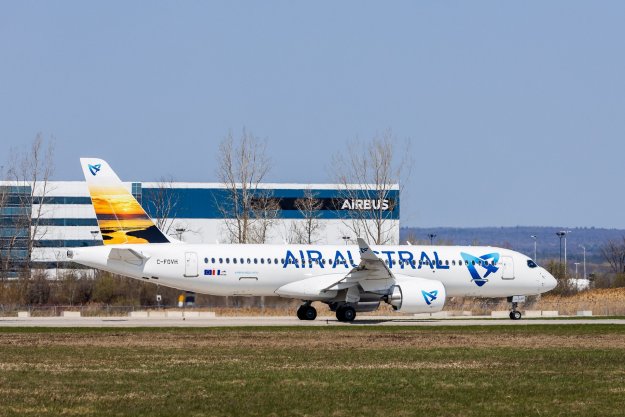
Indian Ocean based Air Austral becomes first French Airbus A220 operator

Airbus made this announcement:

The first of the three Airbus A220s for Air Austral, Franceโ€™s La Rรฉunion Island-based airline, has been delivered from the Airbus A220 Final Assembly Line (FAL) in Mirabel, Canada. The second and third aircraft are expected to join the Air Austral fleet in the coming days.

Airbus is delighted to welcome Air Austral as a new Airbus customer and operator. This A220 will be the first of the type to be operated by a French airline in the Indian Ocean region.

Air Austral has selected the Airbus A220-300 as part of its medium and short-haul fleet modernization plan in order to boost its operational efficiency, offering an enhanced passenger experience in a comfortable two-class cabin layout with 132 seats: 12 in business class and 120 in economy-class.

Bearing the airlineโ€™s distinctive livery representing La Reunion Islandโ€™s beautiful landscapes, Air Austral will strengthen its regional network with three A220-300s, flying on routes between La Rรฉunion Island and Mauritius, Mayotte, Seychelles, South Africa, Madagascar, and as far as India.

Powered by latest-generation geared turbofan engines, Pratt & Whitney PurePower PW1500G, the A220 is the quietest and most eco-friendly aircraft in its category. The aircraft features a 50% reduced noise footprint compared to previous generation aircraft, 25% lower fuel burn and CO2ย emissions per seat as well as 50% lower NOx emissions than current industry standards.

To date over 160 A220s have been delivered, operating routes in Asia, North America, Europe and Africa, proving the great versatility of Airbusโ€™ new generation single-aisle family member.

Chileโ€™s SKY takes delivery of its first Airbus A321neo

SKY, a Chilean-based low-cost carrier, has taken delivery of its first Airbus A321neo leased from Air Lease Corporation (ALC), becoming the first airline in Chile to operate the A321neo.

SKYโ€™s A321neo aircraft are powered by CFM Leap-1A engines and can seat up to 238 passengers in a two-class layout. SKY is the first airline in South America to operate the A321neo with a high density cabin configuration.

The A321neo has a 95 percent airframe commonality with Airbusโ€™ A320 Family, fitting seamlessly into SKYโ€™s existing fleet of 19 A320neo. This aircraft incorporates new generation engines and Sharklets, which together deliver more than 20 percent fuel and CO2 savings, as well as a 50 percent noise reduction. Additionally, The A321neo shares a common type rating with other members of the Airbus A320 Family, which allows A320 Family pilots to fly the aircraft without additional training.

SKY has been an Airbus customer since 2010 and became an all-Airbus operator in 2013. The A321neo will allow SKY to further expand their route offering in Latin America in the near future.

Airbus has sold over 1,100 aircraft and has a backlog of nearly 430 aircraft to deliver in Latin America and the Caribbean. Currently, Airbus has over 660 aircraft in operation throughout the region, representing approximately 60 percent market share of the in-service fleet. Since 1994, Airbus has secured nearly 70 percent of net orders in the region.


Airbus delivers first A350 from its widebody completion and delivery center in China

Airbus has delivered the first A350 from its widebody completion and delivery center in Tianjin (C&DC), China, taking additional steps in the expansion of its global footprint and long-term strategic partnership with China.

The A350-900 aircraft was delivered to China Eastern Airlines, the largest Airbus operator in Asia and second largest in the world. At the end of June 2021, China Eastern Airlines operated an Airbus fleet of 413 aircraft, including 349 A320 Family aircraft, 55 A330 Family aircraft and nine A350 aircraft.

โ€œIโ€™m proud that Airbus successfully extended the capability of the widebody C&DC in Tianjin to the A350, the latest new generation aircraft, at such a difficult time of global aviation,โ€ said George Xu, Airbus Executive Vice President and Airbus China CEO. โ€œThis is a new milestone in the long-term cooperation between China and Airbus, which further demonstrates Airbusโ€™ commitment to the country. Congratulations to China Eastern Airlines, our long-term strategic partner, for receiving the first A350 delivered from China, and I appreciate their trust in Airbus and in our products as always.โ€

Located at the same site as the Airbus Tianjin A320 Family Final Assembly Line and the Airbus Tianjin Delivery Centre, the widebody C&DC covers the aircraft completion activities, including cabin installation, aircraft painting and production flight test, as well as customer flight acceptance and aircraft delivery.

The centre was inaugurated in September 2017 with its capability on A330s. Then, during the visit of French President Emmanuel Macron to China in 2019, a Memorandum of Understanding on the Further Development of Industrial Cooperation was signed in Beijing by He Lifeng, Chairman of the National Development and Reform Commission (NDRC) of China, and Guillaume Faury, Airbus Chief Executive Officer, announcing the C&DC would extend its capability to A350 aircraft.

The A350 features the latest aerodynamic design, a carbon-fibre fuselage and wings, plus new fuel-efficient Rolls-Royce engines. Together, these features translate into unrivalled levels ofย operational efficiency with a 25 per cent reduction in fuel burn and CO2ย emissions. The A350โ€™s โ€˜Airspace by Airbusโ€™ cabin is the quietest of any widebody aircraft and offers passengers and crews the most modern in-flight products for the most comfortable flying experience.

At the end of June 2021, the A350 Family had received 915 firm orders from 49 customers worldwide, making it one of the most successful widebody aircraft ever.

flyadeal takes delivery of its first Airbus A320neo

flyadeal, the low-cost Jeddah-based airline owned by Saudi Arabian Airlines, has taken delivery of a brand new A320neo, the first out of 30 to be delivered in the next 3 years.

The aircraft is the first out of 65 A320neo family aircraft ordered by Saudi Arabian Airline at the Paris Airshow 2019, and will join flyadealโ€™s all Airbus fleet.

Powered by CFM LEAP-1A engines, the A320neo will offer flyadeal outstanding operational, economic and environmental performance.

flyadealโ€™s A320neo is configured with 186 seats in a comfortable all economy class layout. Passengers onboard the aircraft will benefit from the widest cabin of any single-aisle aircraft in the sky, as well as the latest cabin feature offering optimum passenger comfort.

The A320neo is the ideal aircraft for flyadeal to grow and expand its domestic and regional network. Demonstrating the operational flexibility of the A320neo, the aircraft will allow the airline to efficiently enhance its operations to additional networks and foster closer links with countries across the region and beyond.

The A320neo Family incorporates the very latest technologies including new generation engines, Sharklets and aerodynamics, which together deliver 20% in fuel savings and CO2 reduction compared to previous generation Airbus aircraft. The A320neo Family has received more than 7,400 orders from over 120 customers.

JetBlue reports GAAP pre-tax earnings ofย $57 millionย in the second quarter of 2021

"O Beautiful For Spacious Skies"

JetBlue Airways Corporation today reported its results for the second quarter of 2021:

  • Reported GAAP diluted earnings per share ofย $0.20ย in the second quarter of 2021 compared to diluted earnings per share ofย $0.59ย in the second quarter of 2019. Adjusted loss per share was ($0.65)(1)ย in the second quarter of 2021 versus adjusted diluted earnings per share ofย $0.60(1)ย in the second quarter of 2019.
  • GAAP pre-tax earnings ofย $57 millionย in the second quarter of 2021, compared to a pre-tax income ofย $236 millionย in the second quarter of 2019. Excluding one-time items, adjusted pre-tax loss ofย ($309) million(1)ย in the second quarter of 2021 versus adjusted pre-tax income ofย $238 million(1)ย in the second quarter of 2019.

Operational and Financial Highlights from the Second Quarter

  • Reduced second quarter 2021 capacity by 15% year over two, which is in-line with our planning assumption.
  • Second quarter 2021 revenue declined 29% year over two. Adjusted for a 1.5 point benefit from a renewed co-branded credit card agreement, the result is at the better end of our prior expectations of a 30 to 33% decline year over two. This was driven primarily by continued momentum in leisure demand throughout the quarter
  • Operating expenses declined 27% year over two. Excluding special items, adjusted operating expenses declined 7%(1)ย year over two, which is in-line with our prior planning assumption. CASM ex-Fuel declined meaningfully from a 41% increase year over two in the first quarter, to a 19% increase in the second quarter.
  • JetBlueโ€™s Adjusted Earnings Before Interest, Taxes, Depreciation, Amortization and Special Items (Adjusted EBITDA) in the second quarter of 2021 wasย ($86) million(1), better than the ($115) toย ($165) millionย range previously expected. This was mainly the result of improving underlying revenue trends, the contribution from our co-branded agreement, and our discipline in controlling costs.

Balance Sheet and Liquidity

  • During the quarter, JetBlue significantly reduced net debt(1)ย byย $1.2 billionย toย $0.9 billion, which is now below pre-pandemic levels. As of June 30, 2021, JetBlueโ€™s adjusted debt to capital was 55%(1).
  • JetBlue ended the second quarter of 2021 with approximatelyย $3.7 billionย in unrestricted cash, cash equivalents, and short-term investments, or 46% of 2019 revenue.
  • JetBlue repaidย $89 millionย in regularly scheduled debt and finance lease obligations and fully repaid a term loan ofย $722 millionย during the second quarter of 2021.

Fuel Expense and Hedging

The realized fuel price in the second quarter 2021 wasย $1.91ย per gallon, a 12% decline versus second quarter 2019 realized fuel price ofย $2.16.

As of July 27, 2021, JetBlue has not entered into forward fuel derivative contracts to hedge its fuel consumption for the third quarter of 2021. Based on the forward curve as of July 19, 2021, JetBlue expects an average all-in price per gallon of fuel ofย $2.09ย in the third quarter of 2021.

JetBlue, Barclays, and Mastercard Renew Long-Term Partnership Agreement

Yesterday, JetBlue announced a multi-year extension of their co-branded credit card agreements with both Barclays and Mastercard. The partnership renewal will extend and expand JetBlueโ€™s consumer credit card portfolio. The agreements will center on the continued delivery of innovative, digital-centric card offerings that meet consumerโ€™s evolving needs and foster engagement and loyalty.

JetBlue currently estimates that the impact from the renewed agreement will deliver approximately an incremental one point to our annualized revenue and margin.

Our Recovery Plan and Actions Taken to Position JetBlue for Future Success

โ€œIn the second quarter, we saw strong signs that consumer confidence and travel demand is returning, with second quarter revenue doubling compared to the first quarter driven by pent-up demand,โ€ said Robin Hayes, JetBlueโ€™s Chief Executive Officer.

โ€œAs we turn to recovery, we continued to generate positive cash from operations in the second quarter, and we expect continued improvement in our operating performance as we progress towards a full recovery. We are creating a path to restore our earnings power to beyond 2019 levels and generate long-term value for our owners in the years ahead. Our attention is now squarely on rebuilding our margins and repairing our balance sheet.โ€

Revenue and Capacity

โ€œWe are pleased to see further month-on-month improvement into the peak summer months, with demand momentum across all of our geographies. We ended the quarter with load factors in the mid-80s with June capacity largely back to pre-pandemic levels, compared to an average load factor in the mid-60s in the first quarter,โ€ said Joanna Geraghty, JetBlueโ€™s President and Chief Operating Officer.

โ€œFor the third quarter of 2021, our planning assumption for revenue is a decline of between (4%) and (9%) year over two, another quarter of strong sequential improvement of approximately 20 points. We expect unit revenue to continue to improve on top of increasing capacity, with load factors in the mid-to-high 80s this summer. We have seen days with average load factors in the 90s.

For the third quarter of 2021, our planning assumption is for capacity to be between flat to down (3%) year over two, given the strong sequential improvement in demand. Throughout the pandemic, we have been nimble in adjusting our capacity deployment to the prevailing demand environment. Weโ€™ll maintain this approach given the continued uncertainty on the course of the pandemic caused by variants.โ€

Financial Performance and Outlook

โ€œOur second quarter Adjusted EBITDA(1)ย came in better than the range we anticipated in early-June. This was mainly the result of improving underlying revenue trends, the benefit from our renewed co-branded agreement, and our discipline in controlling costs,โ€ said Ursula Hurley, JetBlueโ€™s Acting Chief Financial Officer.

โ€œFor the third quarter, we estimate our EBITDA will range betweenย $75ย andย $175 million dollars, reflecting continued sequential improvement in demand partially offset by continued cost pressures from fuel prices, and airport rents and landing fees. We expect to remain in positive EBITDA territory through the end of the year, and expect to generate pre-tax profits in July and August.

We are committed to generating better than pre-pandemic earnings in the next few years by growing revenue and controlling costs, and we are confident that we are on the right path to expand margins in a sustainable way.

We are now squarely focused on repairing our balance sheet, lowering our total cost of debt, and growing our unencumbered asset base. We reduced our net debt by over 50% to underย $1 billion dollarsย at the end of June. Both our net debt and weighted average cost of debt now sit below pre-pandemic levels.โ€

Notes

(1) Non-GAAP financial measure; Note A provides a reconciliation of non-GAAP financial measures used in this release and explains the reasons management believes that presentation of these non-GAAP financial measure provides useful information to investors regarding JetBlue’s financial condition and results of operations.

(2) The Company has not reconciled its Adjusted EBITDA planning assumptions to net income because net income (loss) is not accessible on a forward-looking basis. Items that impact net income (loss) are out of the Company’s control and/or cannot be reasonably predicted. Accordingly, a reconciliation to net income (loss) is not available without unreasonable effort.

Top Copyright Photo: JetBlue Airways Airbus A321-271NX WL N2086J (msn 10032) FLL (Andy Cripps). Image: 952648.

JetBlue Airways aircraft slide show:

Mango Airlines to enter “business rescue” in South Africa, suspends operations

Mango (South African Airways) Boeing 737-8BG WL ZS-SJP (msn 32358) HLA (TMK Photography). Image:  920548.

Mango Airlines (subsidiary of South African Airways) will enter into a South African form of bankruptcy protection known locally as business rescue.

Parent SAA exited business rescue in April but Mango was not included.

Today the low-fare airline issued this statement on social media:

Mango Airlines apologizes for today’s flight interruptions and delays.

We can confirm that our services and all flights are temporarily suspended from today, July 27, 2021, until further notice due to outstanding payments to ATNS.

We plan to resume normal operations as soon as possible. We ask for calm and patience as we navigate these challenges. We will update the public as soon as possible. We apologize in advance for the inconvenience caused.

Top Copyright Photo: Mango (South African Airways) Boeing 737-8BG WL ZS-SJP (msn 32358) HLA (TMK Photography). Image: 920548.

Mango Airlines aircraft slide show:

WestJet to expand its codeshare agreement with KLM at Amsterdam

WestJet today announced the evolution of its long-standing codeshare relationship with KLM Royal Dutch Airlines through the placement of its “WS” codeshare on KLM-operated flights.ย  Through the expanded codeshare agreement, guests will now have convenient access via Amsterdam’s Schiphol Airport (AMS) to 18 cities across Austria, Belgium, France, Germany, Italy, Portugal, Spain and the United Kingdom.


The enhanced partnership builds on the airline’sย new non-stop 787 Dreamliner service between Amsterdam and Calgary and provides greater access between Canada and European points for travelers on both sides of the Atlantic.

WestJet’s inaugural service between Amsterdam Schiphol Airport (AMS) and Calgary International Airport (YYC) is set to depart on August 5, 2021. The airline’s new service will operate two-times weekly beginning August 5, 2021 and will increase to three-times weekly as of September 9.ย  All AMS flights will be on WestJet’s 787 Dreamliner, featuring WestJet’s Business Cabin including lie-flat pods, dining on demand and WestJet’s award-winning caring service.

Details of WestJet’s service between Calgary and Amsterdam:

Route Frequency Start Date
Calgary โ€“
Amsterdam
2x weekly Aug. 5 โ€“ Sept. 5, 2021
3x weekly Sept. 9 โ€“ October 31,
2021
Amsterdam โ€“
Calgary
2x weekly Aug. 6 โ€“ Sept. 6, 2021
3x weekly Sept. 10 โ€“ November 1,
2021

Details of WestJet’s codeshare with KLM via AMS:

Airport
Code
City Country
VIE Vienna Austria
BRU Brussels Belgium
TLS Toulouse* France*
LYS Lyon*
MPL Montpellier/Mauguio*
FRA Frankfurt Germany
MUC Munich
BER Berlin
HAJ Hanover
MXP Milan Italy
VCE Venice
LIS Lisbon Portugal
MAD Madrid Spain
GLA Glasgow UK
EDI Edinburgh
MAN Manchester
LCY London
LHR London

*Pending regulatory approval

British Airways and partners shortlisted for UK government funding to decarbonize aviation

British Airways made this announcement:

Airbus A350

  • Eight projects have been shortlisted for fundingย by the Department for Transport’s Green Fuels, Green Skies competition – part of the Prime Minister’s Ten Point Plan for a Green Industrial Revolution, announced in November 2020
  • The grants will drive meaningful progress towardsย the development ofย sustainable aviation fuel plants in the UK andย theย decarbonization of the aviation industry
  • Projects British Airways has invested inย includeย turning household waste and wood waste into sustainable aviation fuel and capturing carbon from the atmosphereย andย form part ofย the airlineโ€™sย plans to achieve net zero carbon emissions by 2050

Four aviationย decarbonization projects supported byย British Airwaysย andย designed to help the industry achieve its targets of net zero carbon emissions by 2050,ย haveย been shortlisted forย Government funding.

Theย Department of Transport’s Green Fuels, Green Skies (GFGS) competitionย has awarded theย fundingย to develop the UK’s first sustainable aviation fuel (SAF) production facility.ย In total the Governmentย shortlistedย eightย projectsย toย potentiallyย receive a share of ยฃ15 million in its competition, all of whichย have a clear potential to produce SAF capable of reducing emissions by more than 70% on a lifecycle basis when used in place of conventional fossil jet fuel.

British Airwaysย is directly involved inย fourย of thoseย projectsย which, pending the completion of grant agreements,ย canย allย press ahead with developing theirย feasibilityย and engineeringย plans.

The airlineย is partnering with technology companyย Velocysย on theย Altaltoย project to build a commercial waste-to-SAF plant inย Immingham, Lincolnshire.ย Altaltoย will takeย more thanย half a million tonnes per year of household and commercial waste and produce up to 80 million litres of cleaner burning SAF and naphtha. The project has already received planning consent fromย North Eastย Lincolnshire Council and is in the final stages of preparationย for Front End Engineering Design.

Projectย Speedbirdย is a collaboration between British Airways,ย LanzaJetย and Nova Pangaea, with a goal of producingย 100ย millionย litresย of sustainable fuel a year from 2025,ย sufficientย to powerย 2,000ย flightsย from London to New Yorkย operated by anย A350 aircraft.ย The technology is based on Novaย Pangaea’sย REFNOVAยฎ process of converting waste wood into alcohol.ย LanzaJet’sย alcohol-to-jet (ATJ) technology,ย which was developed byย LanzaTechย and the Pacific Northwest National Lab,ย then converts the alcohol to produce sustainable aviation fuel and renewable diesel.

British Airways is also working onย two further decarbonizationย projects withย LanzaTech andย LanzaJetย that, if successful,ย could each produce more than 100 millionย litresย aย year of SAF.ย The first would involve capturing carbon dioxide (CO2) from the atmosphereย and converting itย intoย SAF. The second would support the development of a SAF plant in Port Talbot, South Wales that would produce SAF from waste and industrialย gases, with the potential to support significant jobs in the area.

Ryanair reports a fiscal first quarter loss of โ‚ฌ273 million ($322 million)

Ryanair Boeing 737-8 MAX 8 (200) EI-HGP (msn 62330) PMI (Javier Rodriguez). Image: 954443.

Ryanair made this announcement:

Ryanair reported a fiscal first quarter loss of โ‚ฌ273 million, compared to a previous year first quarter loss of โ‚ฌ185 million. Features of this Q1 performance included:


  • Q1 traffic rebounded from 0.5m to 8.1m as capacity recovered in May & June.
  • 1stย B737-8200 โ€œGamechangerโ€ delivered in June (12 for peak S.21).
  • Strong June cash balance of โ‚ฌ4.06bn (up from โ‚ฌ3.15bn at 31 Mar.).
  • โ‚ฌ1.2bn 5-year unsecured bond issued in May at record low 0.875% coupon.
  • Net debt fell from โ‚ฌ2.28bn at 31 Mar. to โ‚ฌ1.66bn at 30 June (โ‚ฌ850m bond repaid in June).
  • 379 new routes & 10 new bases announced for 2021.
  • Customer Advisory Panel appointed โ€“ 1stย meeting in Sept.


Q1 โ€“ Group 30 Jun. 2020 30 Jun. 2021 Change
Customers 0.5m 8.1m +7.6m
Load Factor 61% 73% +12pts
Revenue โ‚ฌ125m โ‚ฌ371m +196%
Op. Costs โ‚ฌ313m โ‚ฌ675m +116%
Net Loss (โ‚ฌ185m) (โ‚ฌ273m) -47%

Ryanair Holdings Group CEO, Michael Oโ€™Leary, said:


โ€œCOVID-19:

Covid-19 continued to wreak havoc on our business during Q1 with most Easter flights cancelled and a slower than expected easing of EU Govt. travel restrictions into May and June.ย  Significant uncertainty around travel green lists (particularly in the UK) and extreme Govt. caution in Ireland meant that Q1 bookings were close-in and at low fares.ย  We kept aircraft and crews current throughout the quarter and recruited additional cabin crew to enable us recover quickly in Q2 as Covid restrictions ease.ย  The 1st July rollout of EU Digital Covid Certificates (โ€œDCCโ€) and the scrapping of quarantine for vaccinated arrivals to the UK from mid-July has seen a surge in bookings over recent weeks.ย  Pricing remains below pre Covid-19 levels and there will continue to be great value for Ryanair guests traveling this summer as we focus on recovering traffic, jobs and tourism across our European network.ย  Based on current (close-in) bookings, we expect traffic to rise from over 5m in June to almost 9m in July, and over 10m in Aug., as long as there are no further Covid setbacks in Europe.ย  We will continue our load active/yield passive strategy as we recover load factors over the course of FY22.

The Covid-19 crisis has triggered the collapse of many European airlines including Flybe, Norwegian, Germanwings, Level and Stobart and led to substantial capacity cuts at many others including Alitalia, TAP, LOT, SAS, etc.ย  The tsunami of State Aid from EU Governments to their insolvent flag carriers (Alitalia, AirFrance/KLM, LOT, Lufthansa, SAS, TAP and others) will distort EU competition and prop up high cost, inefficient, flag carriers for many years.ย  We expect intra-European capacity to be materially lower for the foreseeable future.ย  This will create growth opportunities for Ryanair to extend airport incentives, as the Group takes delivery of 210 new Boeing 737-8 MAX 8 โ€œGamechangerโ€ aircraft.ย  We are encouraged by the high rate of vaccinations across Europe.ย  If, as is presently predicted, most of Europeโ€™s adult population is fully vaccinated by Sept., then we believe that we can look forward to a strong recovery in air travel for the second half of the fiscal year and well into S.22 โ€“ as is presently the case in domestic US air travel.

THE ENVIRONMENT & CUSTOMER SERVICE:

Ryanair has repeatedly shown we can grow traffic while reducing our impact on the environment.ย  Every passenger that switches to Ryanair from Europeโ€™s legacy airlines reduces their COโ‚‚ emissions by almost 50% per flight.ย  Over the next 5-years our traffic will grow to 200m p.a. ย This will be achieved on a fleet that balances the demand for low fares with the need for sustainable flying.ย  Our new B737-8200ย โ€œGamechangerโ€ย aircraft (a $22bn+ investment) offers 4% more seats, but delivers 16% lower fuel burn and 40% lower noise emissions, helps to meaningfully lower Ryanairโ€™s COโ‚‚ and noise footprint over the next decade.

We continue to work actively with the EU, fuel suppliers and aircraft manufacturers to incentivize sustainable aviation fuel (SAF) use.ย  We are working with A4E and the EU Commission to accelerate reform to the Single European Sky, to minimize ATC delays and lower fuel consumption and COโ‚‚ emissions.ย  Last year Ryanair received an industry leading โ€œB-โ€ climate protection rating from CDP[1], and we are working to improve this to an โ€œAโ€ rating over the next 2 years.ย  In April, Ryanair established a Sustainable Aviation Research Centre partnership with Trinity College Dublin to accelerate the development of SAFs.ย  Ryanairโ€™s goal is to power 12.5% of our flights with SAF by 2030 (well ahead of the 5% recently mandated by the EU Fit for 55 Proposals).ย  Earlier this month we launched a new carbon calculator enabling customers to (voluntarily) offset their carbon footprint on every Ryanair flight that they book.ย  These initiatives will help Ryanair achieve our target of lowering COโ‚‚ per passenger/km by 10% to just 60 grams by 2030.

In July, Ryanair announced a 7 member Customer Advisory Panel.ย  Following over 10,000 applications from across 16 countries, the final panel represents a diverse cross-section of Ryanair customers (with members from Germany, Ireland, Italy, Poland, Spain and the UK).ย  We will welcome this Panel to Dublin in Sept. for our first Customer Advisory meeting, with future meetings to take place in other major European cities.ย ย  The advice and input from the Panel will help shape Ryanairโ€™s continuing customer improvements program, re-enforcing our commitment to delivering the lowest fares, on-time flights and a great customer experience as the Group returns to strong post Covid growth.

Q1 FY22 BUSINESS REVIEW:

ย 

Revenue & Costs

Q1 scheduled revenue increased 91% to โ‚ฌ192m due to a rise in traffic from 0.5m to 8.1m (at a 73% load factor). While traffic recovered significantly (compared to PY Q1), the cancellation of Easter traffic and the delayed relaxation of Govt. travel restrictions across the EU into May and June required significant price stimulation.ย  Ancillary revenue performed well, generating approx. โ‚ฌ22 per passenger, as more guests choose priority boarding and reserved seating.ย  As a result, total revenue increased by almost 200% to over โ‚ฌ370m in Q1.ย  A sevenfold increase in sectors saw operating costs increase 116% to โ‚ฌ675m, driven primarily by variable costs such as fuel, airport & handling and route charges.ย  The Groupโ€™s fuel requirements are just under 60% hedged for FY22 at $565 per metric tonne and approx. 35% hedged for FY23 at $600.ย  Carbon credits are fully hedged for FY22 and approx. 35% hedged for FY23 at under โ‚ฌ24 per EUA (compared to forward rates of over โ‚ฌ50).

During Q1 our Route Development team continued their work with airport partners across Europe, and have negotiated lower airport costs, recovery incentives and the extension of many low cost airport growth deals.ย  In addition to previously announced deals (with Billund, Riga, Stockholm, Zadar & Zagreb) and long term extensions of low-cost growth deals in London Stansted (to 2028), Milan Bergamo (to 2028) and Brussels Charleroi (to 2030), the Group has doubled its capacity in Rome (Fiumicino), added new routes to Helsinki and will launch new bases in Turin (Italy) and Agadir (Morocco) this winter.

In June Ryanair took delivery of our first 3 B737-8 (200) โ€œGamechangerโ€ aircraft from our 210 order book.ย  The Gamechangers have 4% more seats, 16% lower fuel burn and 40% lower noise emissions and will, we believe, further widen the cost gap between Ryanair and all other European airlines for the next decade.ย  While it is early days (and load factors have not yet recovered to pre Covid levels) we are very pleased with the operational performance and lower fuel burn recorded on these aircraft.ย  The feedback from our guests is resoundingly positive as they enjoy the extra leg room and 40% less noise.ย  We hope to increase our fleet of Gamechangers to over 60 in advance of S.22 and these new aircraft will drive our traffic growth to 200m p.a. by FY26.

Balance Sheet & Liquidity

Ryanairโ€™s balance sheet is one of the strongest in the industry with a BBB credit rating (S&P and Fitch), โ‚ฌ4.06bn cash and almost 90% of our B737 fleet unencumbered at quarter end. In May Ryanair issued a โ‚ฌ1.2bn 5-year, unsecured, bond at a record low coupon of 0.875%.ย  In June the Group repaid its maturing โ‚ฌ850m (2014) 1.875% bond.ย  Strong operating cashflows and supplier reimbursements drove a โ‚ฌ0.62bn reduction in net debt to โ‚ฌ1.66bn at 30 June (31 March: โ‚ฌ2.28bn).ย  This balance sheet strength enables the Group to capitalize on the many growth opportunities that will be available in Europe in the post Covid-19 recovery.


OUTLOOK:

FY22 continues to be challenging, with Covid-19 travel restrictions prolonging uncertainty.ย  Following the 1stย July rollout of EU DCCโ€™s (and the relaxation of the UKโ€™s quarantine rules) for fully vaccinated persons, our Group has seen Q2 bookings recover strongly (albeit at low fares).ย  With the booking curve remaining very close-in and fares well below pre Covid-19 levels, visibility for the remainder of FY22 is close to zero.ย  It therefore remains impossible to provide meaningful FY22 guidance at this time.ย  We believe that FY22 traffic has improved to a range of 90m to 100m (previously guided at the lower end of an 80m to 120m passenger range) and (cautiously) expect that the likely outcome for FY22 is somewhere between a small loss and breakeven.ย  This is dependent on the continued rollout of vaccines this summer, and no adverse Covid variant developments.

As we look beyond the Covid-19 recovery, and the successful completion of vaccination rollouts, the Ryanair Group expects to have a materially lower cost base, a very strong balance sheet and industry leading traffic recovery.ย  Our new B737 โ€œGamechangerโ€ aircraft will reduce fleet costs and unit costs (thanks to its attractive pricing, higher seat density and 16% lower fuel burn) for the next decade.ย  They will enhance revenue opportunities with 4% more seats, enabling the Group to fund lower fares and capitalise on the many growth opportunities that are now available across Europe, especially where competitor airlines have substantially cut capacity or failed. We are seeing a strong rebound of pent up travel demand into Aug. & Sept. and we expect this to continue into the second half of FY22, with pre Covid-19 growth planned to resume strongly in summer 2022.โ€

Top Copyright Photo: Ryanair Boeing 737-8 MAX 8 (200) EI-HGP (msn 62330) PMI (Javier Rodriguez). Image: 954443.

Ryanair slide show: