Sunclass Airlines resumes operations

Sunclass Airlines (Formerly Thomas Cook Scandinavia) on July 25 resumed operations after more than four months with its fleet completely grounded. It operated five flights from different Scandinavian cities to Palma de Mallorca, Spain.

Sunclass Airlines Airbus A321-211 WL OY-TCD (msn 6314) PMI (Javier Rodriguez). Image: 950731.

Copyright Photo: Sunclass Airlines Airbus A321-211 WL OY-TCD (msn 6314) PMI (Javier Rodriguez). Image: 950731.

Sunclass Airlines aircraft photo gallery:

Reuters: Boeing to delay 777X as demand drops for big jets

From Reuters:

“Boeing Companyย is preparing to delay its all-new 777X jet by several months or up to a year, three people familiar with the matter said, as the COVID-19 crisis exacerbates a drop in demand for the industryโ€™s largest jetliners.”

Read the full report.

New Boeing 777-9 (777X) with foldable wingtips

Above Copyright Photo: Boeing 777-9 (777X) N779XX (msn 64241) PAE (Nick Dean). Image: 949445.

Allegiant promotes its air quality

Allegiant Air has issued this report on its aircraft air quality:

We are setting a new standard for air purity. The air quality on our planes exceeds HEPA standards thanks to our VOC (volatile organic compound) filters, which remove even smaller contaminants.

On average, cabin air is changed every three minutes through a continuous flow of fresh and VOC-filtered air. Air enters the cabins through vents near the ceiling and flows downward, exiting through vents near the floor. Air doesnโ€™t flow toward the front or the back of the plane. This flow ensures the air is fresh and sanitary.

“Together We Fly” is more than a phrase, it’s our promise to you. That’s why we are taking important steps to protect the health and safety of you, your loved ones and our team members.

We work closely with the Centers for Disease Control and Prevention (CDC), World Health Organization (WHO) and other authorities and experts. Based on their direction, we ensure our actions not only follow current guidance, but exceed the recommended standards so you can fly with confidence.

American Airlines Group loses $2.1 billion in the second quarter

American Airlines Group Inc. reported its second-quarter 2020 financial results, including:

  • Second-quarter pretax loss of $2.7 billion. Excluding net special items1, second-quarter pretax loss of $4.3 billion.
  • Second-quarter net loss of $2.1 billion, or ($4.82) per share. Excluding net special items1, second-quarter net loss of $3.4 billion, or ($7.82) per share.
  • Boosted available liquidity by a net $3.6 billion in the quarter through offerings of common stock, convertible bonds and secured bonds.
  • Ended second quarter with approximately $10.2 billion of available liquidity. Additionally, signed term sheet with the U.S. Department of the Treasury for $4.75 billion secured loan, which is expected to close in the third quarter, and announced two senior secured note transactions totaling $1.2 billion. The companyโ€™s second-quarter pro forma liquidity balance including these transactions would be approximately $16.2 billion.

โ€œThis was one of the most challenging quarters in Americanโ€™s history,โ€ said American Airlines Chairman and CEO Doug Parker. โ€œCOVID-19 and the resulting shutdown of the U.S. economy have caused severe disruptions to global demand for air travel. In spite of these challenges, the American Airlines team has done a phenomenal job taking care of our customers and our fellow team members.

โ€œWe have moved swiftly to improve our liquidity, conserve cash and ensure customers are safe when they travel,โ€ Parker continued. โ€œThere is much uncertainty ahead, but we remain confident we will emerge from this crisis more agile and more efficient than ever before.โ€

Supporting team members, customers and communities

Caring for team members, customers and the communities it serves remains the top priority for American as it navigates the current environment.

To ensure the safety and well-being of team members and customers, American:

  • Updated its policies to make face coverings mandatory throughout the customer journey and for team members while at work.
  • Instituted temperature checks for team members across the system and began asking customers to certify they are symptom-free before traveling.
  • Created a Travel Health Advisory Panel, comprising internal leaders and outside experts in the field of infectious disease prevention, to advise on health and cleaning matters.
  • Started working with the Global Biorisk Advisory Council on GBAC STARTM Accreditation for cleaning and disinfection practices for its aircraft and lounges.
  • Further enhanced its cleaning and disinfection procedures throughout the operation, including the use of an electrostatic spray inside each aircraft every seven days, which kills 99.9999% of viruses and bacteria within 10 minutes.

To provide customers additional flexibility, American:

  • Waived change fees for customers who book new tickets for future travel by July 31, 2020.
  • Extended its change fee waiver for customers who have existing tickets for travel through Sept. 30, 2020.
  • Began notifying customers whose flights may be full, allowing them to move to more open flights when available at no cost.
  • Expanded flexible travel waivers and name changes for corporate customers.
  • Eliminated the reinstatement fee for AAdvantageยฎ award ticket changes made more than 60 days prior to travel.
  • Provided eligible AAdvantage elite members with a credit of up to $400 to use toward an American Airlines Vacations package.

To support the communities it serves, American:

  • Expanded its cargo service to transport critical goods between the United States and Europe, Asia and Latin America. American currently operates more than 310 weekly widebody and cargo-only flights and transported more than 100 million pounds of mail, goods and supplies critical to the global economy in the second quarter.
  • Announced a program to provide up to 1 million Business Extraยฎ points to small businesses and nonprofit organizations in need of travel support.
  • Worked with Deloitte to deliver more than 40,000 medical gowns to first responders at Mount Sinai Hospital in New York.
  • Partnered with Hyatt Hotels Corporation to give free vacations to thousands of employees at NYC Health + Hospitals/Elmhurst Hospital.
  • Donated more than 600,000 pounds of food to food banks, nonprofit organizations, schools and other groups fighting food insecurity.

Conserving cash

American continues to take steps to reduce costs and preserve cash. The airline estimates that it will reduce its 2020 total operating and capital expenditures by more than $15 billion, achieved primarily through cost savings resulting from less flying. In addition, the company implemented the following cost actions:

  • Retired four aircraft types, consisting of 20 Embraer 190s, 34 Boeing 757s, 17 Boeing 767s and nine Airbus A330-300s, along with a number of older regional aircraft. In addition, the company placed its Airbus A330-200s and certain older Boeing 737s into a temporary storage program. In aggregate, these changes remove more than 150 aircraft from the fleet and bring forward the cost savings and efficiencies associated with operating fewer aircraft types.
  • Introduced additional voluntary leave of absence and early-out programs to help right-size its frontline team. American anticipates having over 20,000 more team members on payroll than needed to operate its fall schedule. In total, more than 41,000 team members have opted for an early retirement, a reduced work schedule or a partially paid leave.
  • Consistent with the CARES Act, reduced its management and support staff team, including officers, by approximately 5,100 positions, or 30%.
  • Announced changes to its international schedule for 2021. American expects its summer 2021 long-haul international capacity to be down 25% versus 2019 and also plans to exit 19 international routes from six hubs. These changes will allow the airline to reset its international network for future growth as demand returns.
  • Reduced non-aircraft capital expense by $700 million in 2020 and another $300 million in 2021 through reductions in fleet modification work, the elimination of all new ground service equipment purchases, and pausing all noncritical facility investments and IT projects.

Bolstering liquidity

In addition to reducing its operating and capital expenditures, American has taken a number of steps to strengthen its liquidity position. The company:

  • Ended the second quarter with $10.2 billion of available liquidity, including a net $3.6 billion raised in the quarter through offerings of common stock, convertible bonds and secured bonds. The company also raised $360 million through municipal facility bonds, the net proceeds from which are included in its restricted cash and short-term investments.
  • Refinanced the delayed draw term loan credit facility the company entered into in March 2020, which was set to mature in March 2021. By refinancing this loan, American does not have any large non-aircraft debt maturities until its $750 million unsecured bonds mature in June 2022.
  • Signed a term sheet with the U.S. Department of the Treasury for a $4.75 billion secured loan under the CARES Act. The company expects the loan to be finalized in the third quarter.
  • Announced $1.2 billion of committed financing subject to final documentation and other closing conditions in the form of two senior secured note transactions to be collateralized by intellectual property and other assets with Goldman Sachs Merchant Bank. The company expects these notes to be issued in the third quarter.
  • Reduced its daily cash burn rate from nearly $100 million in April to approximately $30 million in June. This improvement was driven by higher than forecast revenue and larger savings resulting from the companyโ€™s cost-reduction initiatives. The companyโ€™s second-quarter cash burn rate2 was approximately $55 million per day vs. its previous forecast of $70 million per day.

Demand and capacity outlook

Passenger demand and load factors have improved since bottoming out in April, but continue to be significantly below 2019 levels. While May and June revenue trends were encouraging, demand has weakened somewhat during July as COVID-19 cases have increased and new travel restrictions have been put into place. The company will continue to match its forward capacity with observed bookings trends and presently expects its third quarter system capacity to be down approximately 60% year over year.

Notes

See the accompanying notes in the Financial Tables section of this press release for further explanation, including a reconciliation of all GAAP to non-GAAP financial information.

1ย The 2020 second quarter mainline operating special items, net principally included $1.8 billion of Payroll Support Program (PSP) financial assistance, offset in part by $332 million of salary and medical costs associated with certain team members who opted in to voluntary early retirement programs. Second quarter 2020 regional special items, net primarily included $216 million of PSP financial assistance, offset in part by $24 million of fleet impairment charges and $14 million of salary and medical costs associated with certain team members who opted in to voluntary early retirement programs.

Second quarter 2020 nonoperating special items, net principally included charges associated with debt refinancings and extinguishments.

2ย The company defines cash burn as the sum of all net cash receipts less all cash disbursements, but excluding the effect of new financings and new aircraft purchases.

KLM network: recovery of destination offer, capacity lags far behind

KLM has made this announcement:

KLM’s European network will grow in the coming months from 72 destinations in July to 91 destinations in August, September and October. The number of intercontinental destinations will increase from 51 in July, to 59 in August and 61 in September and October. As a result, KLM offers its customers the widest possible choice of destinations. Capacity in flights and seats, however, is still far below the level before COVID-19.

Compared to 2019, the European network is virtually at its pre-COVID-19 level in terms of number of destinations. Between August and October 2019, KLM offered 92 European destinations. However, the number of flights still lags far behind the level of 2019. In August, there were about 10,000 flights, in September 13,500 and in October more than 11,000. In 2019, there were more than 19,000, 18,800 and 14,700 flights respectively.

The intercontinental network is still slightly behind compared to last year, when 69 destinations were offered between August and October. Currently, one third of intercontinental flights only carry cargo. As soon as local travel rules allow, KLM will start carrying passengers on these flights again. The number of flights is also lagging behind: around 2,000 in August and September and just over 1,800 in October. Last year there were about 3,300, 3,200 and almost 2,600 flights respectively.

KLM has opted to expand the number of destinations first, so that customers have the widest possible choice. The next step is to increase frequencies or increase capacity by deploying larger aircraft on certain routes.

Safety remains paramount

Naturally, KLM has taken measures to ensure that flights are safe for both passengers and staff. For example, face masks are mandatory when boarding and during the flight, there are extra hygiene equipment on board, and KLM’s aircraft are cleaned extra thoroughly. The air on board is quickly refreshed using HEPA filters. For more information about the hygiene measures on board, please watch this video: https://youtu.be/frPO6b58kcU.

In addition, KLM naturally adapts to changing circumstances, with governments in various countries taking new measures.

New destinations

New destinations have also been added: Cork (Ireland), Southampton (United Kingdom) and Riyadh (Saudi Arabia). The corona crisis has impacted the airline industry heavily. Supply and demand are now subject to greater, more rapid change than before. This means that KLM must maintain an especially resilient network. Less demand on some routes is compensated for by opening up new routes. Additionally, KLM is strengthening its position in the market โ€“ in this case, Ireland, the United Kingdom and the Middle East.

Using Embraer 175 equipment, Cork and Southampton will be served daily with effect from 3 and 31 August respectively. Riyadh will be served four times a week using Airbus A330 equipment with effect from 28 September.

Ryanair sees a surge in bookings to Malta

Ryanair has announced that itโ€™s seen a surge in its Maltese Summer 20 bookings, with tens of thousands of passengers booking to the island since it was announced that travel restrictions were progressively lifted on July 1st and 15th.

Over the last two weeks, Malta has been one of Ryanairโ€™s strongest destinations proving to be a clear favourite thanks to its 300 days of guaranteed sunshine. Ryanair currently operates over 45 routes to/from Malta and its UK routes to the beautiful Mediterranean island rank among the most booked for the months of July and Aug 2020.

Malta Airโ€™s CEO Diarmuid Oโ€™Conghaile said:

โ€œMalta has progressively lifted its restrictions on EU arrivals since 1st July. Since then tens of thousands of European passengers have booked flights to Malta departing from 45 destinations such as Birmingham, Brussels, Edinburgh and Madrid, but with UK routes as clear winners for Jul & Aug bookings.

This surge in Malta flight bookings is a really encouraging trend and Ryanair is proud to re-boot the tourism sector of countries like Malta, which strongly rely on the health of this industry.

Airbus takes final step to end long-standing WTO dispute and U.S. tariffs

Airbus has agreed with the governments of France and Spain to make amendments to the A350 Repayable Launch Investment (RLI) contracts. After 16 years of litigation at the World Trade Organisation (WTO), this is the final step to stop the long-standing dispute and removes any justification for U.S. tariffs.

The tariffs imposed by the United States Trade Representative (USTR) are currently harming all targeted industry sectors, including U.S. airlines, and are adding to a very difficult environment as a consequence of the COVID-19 crisis. This is why Airbus has decided to make a final step to remove the last contentious point and amend the French and Spanish contracts to what the WTO considers the appropriate interest rate and risk assessment benchmarks. The WTO has already ruled that RLI is a valid instrument for governments to partner with industry by sharing investment risks. With this final move, Airbus considers itself in complete compliance with all WTO rulings.

โ€œWe have fully complied with all the WTO requirements. These additional amendments to the A350 RLIs demonstrate that Airbus has left no stone unturned to find a way towards a solution,โ€ said Airbus CEO Guillaume Faury. โ€œThis is a clear signal of support to those who are suffering from the severe impact of the tariffs imposed by the USTR, especially at a time when industries are hard hit by the consequences of the COVID-19 crisis.โ€

Vistara receives its first Airbus A321neo aircraft with flat-bed business class

Vistara, a joint venture between TATA group and Singapore Airlines Limited (SIA), took delivery of its first Airbus A321neo aircraft in New Delhi on July 24. The aircraft, arriving from Airbusโ€™ final assembly lines in Hamburg, Germany, features Indiaโ€™s most advanced aircraft cabin in the sky with fully flat beds in business class.

Overall, Vistaraโ€™s A321neo features a three-class layout with 12 seats in business class, 24 in premium economy and 152 in economy class. The aircraft is the first of six A321neo for the airline, on lease by Air Lease Corporation and part of the 50 A320neo Family aircraft order signed in 2018.

All Vistara A321neo will be powered by latest-generation CFM-Leap 1A engines. These aircraft will be supported by Airbusโ€™ Flight Hour Services Tailored Support Package (FHS-TSP) programme to optimise and secure Vistara fleet operations. The aircraft will complement Vistaraโ€™s current Airbus fleet of 32 A320 Family aircraft.

The A321neo is the largest member of the Airbusโ€™ benchmark A320 Family, seating up to 240 passengers, depending on cabin configuration. It incorporates the latest technologies, including latest-generation engines, aerodynamic advances and cabin innovations, delivering 20 percent fuel savings. The aircraft offers significant environmental benefits as at least 20 percent reduced emissions and a nearly 50 percent smaller noise footprint compared to previous generation aircraft. To date, the orderbook for the A320neo Family stands at 7,445 aircraft.

BER Airport to open on October 31, 2020

Flughafen Berlin Brandenburg made this announcement:

For the opening of the Berlin Brandenburg Airport (BER), the corporate communications department of the airport company is offering numerous media reporting opportunities between 25 October and 8 November.

Above Photo: Entrance hall, stairways to central check in at Terminal 1, Berlin Brandenburg Airport The photo may be used exclusively for editorial purposes. Graphical changes are not permitted, unless for the purpose of extracting the main motif. Usage is free of charge on quoting the reference “Photo: (Gรผnter Wicker)/Berlin Brandenburg Airport”

With the opening of BER Airport, all air traffic in the German capital region will be concentrated in one location. Berlin is a tourist magnet, a political centre and a trade fair city. Brandenburg is an up-and-coming economic region with global players such as Tesla and attracts holidaymakers from around the world with sights such as the Sanssouci Palace. The new airport location is thus an important hub for linking the strong economic and tourism region to more than 150 destinations worldwide.

In the period between 25 October and 8 November, there will be multiple press events surrounding the opening of BER Airport and the closure of Tegel Airport, which is rich in traditions. Trial operations at the new airport, the move from Tegel to BER, the start of airline flight operations and the reactions of passengers to the new terminal are other potential topics. In addition, we will also give you the opportunity to report on partners from all areas of the airport, such as gastronomy and shopping, airport services and mobility.

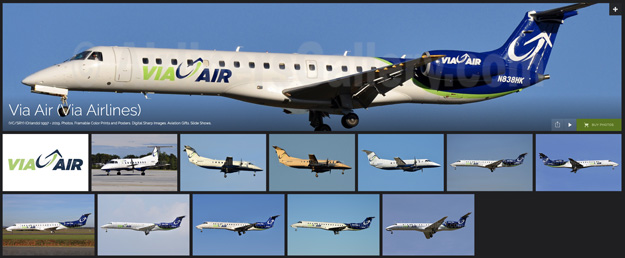
Wexford Capital acquires Via Airlines, will be rebranded

Wexford Capital has made this announcement:

Wexford Capital LP announced that it and certain affiliates received bankruptcy court approval to reorganize and acquire Via Airlines, Inc., a FAA Part 121 regional airline based in Maitland, FL. This transaction allows Via, which will be rebranded, to restart domestic operations, once approved by the DOT and recertified by the FAA. The new airline will be supported by a highly experienced management team.

The reorganized company intends to provide regional air services in strategic markets that have been crippled in the wake of COVID-19. The Companyโ€™s new management team will be led by former COO of Republic Airways, Wayne Heller who will serve as the Companyโ€™s CEO.

โ€œWe are evaluating initial launch markets and strategic partnerships, including, but not limited to, the Southeast, Midwest and Alaskan markets,โ€ said Heller.ย  โ€œAlthough the Pandemic has decimated and challenged the airline industry today, we believe that a quality regional air services provider will continue to be highly desired and vital for the transportation of people and goods throughout the U.S for the foreseeable future, and we intend to be part of that solutionโ€, Heller went on to say.

โ€œWe are excited to reenter the regional airline space. Leveraging our decades of experience investing in the airline industry, we are excited about the opportunity to create the next best-in-class regional airline,โ€ added Arthur Amron, a Partner of Wexford.

Wexford has a long track record of investing in the airline industry, such as founding and driving the transformation of Republic Airways into a regional airline with over 200+ modern regional jets.

Via Airlines on October 8, 2019 announced it was filing for Chapter 11 bankruptcy and ceased all operations.

Via Air aircraft photo gallery:

Via Air aircraft slide show:

https://airlinersgallery.smugmug.com/frame/slideshow?key=cSFm7g&speed=3&transition=fade&autoStart=1&captions=0&navigation=0&playButton=0&randomize=0&transitionSpeed=2