
The Emirates Group (Emirates Airline and Emirates SkyCargo) (Dubai) has announced its 27th consecutive year of profit. The profit for the fiscal year was $1.5 billion, up 34 percent from the previous year. The airline issued this statement:

The Emirates Group announced its 27th consecutive year of profit and steady growth across the company, ending the year in a strong position despite the many global and operational challenges during this period. The financial year ending March 31, 2015 also marked the achievement of new capacity milestones at both Emirates and dnata, as the Group continued to expand its global footprint, and strengthen its business through strategic investments.
Released in its 2014-15 Annual Report the Emirates Group posted an AED 5.5 billion (US$1.5 billion) profit, up 34% from last year. The Group’s revenue reached AED 96.5 billion (US$26.3 billion), an increase of 10% over last year’s results, and the Group’s cash balance remained strong, growing to AED 20.0 billion (US$5.5 billion).
“2014-15 was a turbulent year for aviation. The fall in oil prices provided cost relief in the second half of our financial year, however it did not offset the hit to our profitability caused by significant currency fluctuations, nor the hit to our revenue from operational adjustments in addressing the Ebola outbreak, armed conflicts in several regions, and the 80-day runway upgrading works at Dubai International airport (DXB). Achieving our 27th consecutive year of profit and one of our best performances to date, is testimony to the strength of our brands and business fundamentals, as well as the dedication and talent of our workforce,” said His Highness (H.H.) Sheikh Ahmed bin Saeed Al Maktoum, Chairman and Chief Executive, Emirates Airline and Group.
The strong rise of the US dollar against currencies in many of Emirates’ and dnata’s key markets had an AED 1.5 billion (US$412 million) impact to the Group’s bottom line, while the 80-day disruption at DXB had an estimated impact of AED 1.7 billion (US$467 million) on Group revenue.
“Every year brings a new set of challenges. In addressing these, we are always guided by the best interest of our people, our customers, and our long-term goals. As a Group, we keep a close eye on our top and bottom lines, but we never take our foot off the gas pedal when it comes to investing to enhance our business performance, and looking after our people. In 2014-15, the Group collectively invested over AED 20.2 billion (US$5.5 billion) in new aircraft and equipment, modern facilities, the latest technologies, and staff initiatives. This was the second highest amount ever in one financial year after last year’s record investment.”
The Group’s employee base across its more than 80 subsidiaries and companies increased by 11% to over 84,000-strong representing over 160 different nationalities.
“Looking ahead, the ongoing uncertainty for many currencies and economic markets around the world will continue to pose a challenge, as will the looming threat of protectionism in some countries. However, we move into the new financial year with confidence, and a strong foundation for continued profitability with our strong balance sheet, solid track record, diverse global portfolio, and international talent pool,” said Sheikh Ahmed. “We will continue on our journey of steady and rational growth, and work even harder to meet and exceed our customers’ expectations.”
In line with the overall profit increase, the Group declared a dividend of AED 2.6 billion (US$ 700 million) to the Investment Corporation of Dubai.
Emirates performance
In 2014-15, Emirates increased capacity by 4.0 billion Available Ton Kilometers (ATKMs). For the first time in the airline’s history, Emirates’ total passenger and cargo capacity crossed the 50 billion mark, to 50.8 billion ATKMs at the end of the financial year, cementing its position as the world’s largest international airline.
Emirates received 24 new aircraft during the year, including 12 A380s, ten Boeing 777-300 ERs and two Boeing 777Fs, bringing its total fleet count to 231. At the same time 10 aircraft were phased out, taking the average fleet age to 75 months or approximately half the industry average of 140 months. The airline remains the world’s largest operator of the Boeing 777 and A380 – both aircraft being amongst the most modern and efficient wide-bodied jets in the sky today.
With the delivery of new aircraft, Emirates launched five new passenger destinations: Abuja, Brussels, Budapest, Chicago, Oslo and four new additional freighter-only destinations: Atlanta, Basel, Mexico City, and Ouagadougou. It also added services and capacity to 34 cities on its existing route network across Africa, Asia, Europe, the Middle East, and North America, offering customers even greater choice and connectivity.
The 80-day runway closure at DXB necessitated the grounding of 19 Emirates aircraft, reducing the airline’s capacity by 9%, and causing the reduction of services to 41 destinations over this period. The estimated impact on airline revenue was AED 1.6 billion (US$ 436 million). The Ebola outbreak in Africa prompted route suspensions and increased health and safety screenings at other ports; and geopolitics resulted in the suspension of services and re-routing of flight paths to avoid overflying conflict zones.
Despite these challenges, Emirates revenue reached a new record of AED 88.8 billion (US$24.2 billion). The average price of jet fuel dropped significantly during the second half of the financial year and has supported Emirates’ bottom line improvement. Emirates’ fuel bill decreased by 7% over last year to AED 28.7 billion (US$7.8 billion). Fuel is now 35% of operating costs, down by 4%pts compared to last year. However, fuel remained the biggest cost component for the airline. Total operating costs increased by 6%, compared to a revenue increase of 7% over the 2013-14 financial year.
The airline successfully managed increased competitive pressure across all markets to record a profit of AED 4.6 billion (US$1.2 billion), an increase of 40% over last year’s results, and a healthy profit margin of 5.1%, the strongest margin since 2010-11.
Carrying a record 49.3 million passengers, up 11% from last year, Emirates managed to achieve a Passenger Seat Factor of 79.6%, an improvement compared with last year’s results (79.4%) in spite of a 9% increase in seat capacity byAvailable Seat Kilometres (ASKMs). This highlights thestrong consumer desire to fly on Emirates’ state-of-the-art aircraft, and via efficient routings through its Dubai hub.
Under pressure from the weakening of all major currencies against the USD, passenger yield dropped to 29.7 fils (8.1 US cents) per Revenue Passenger Kilometre (RPKM).
Emirates also improved its premium seat factor despite lingering economic uncertainty and strong competition in many markets. Premium and overall seat factor for the airline’s flagshipA380aircraft outperformed the network, underscoring the popularity of Emirates’ premium and A380 product amongst passengers. At 31 March 2015, Emirates had 59 A380 aircraft in its fleet, serving one out of every four destinations on its passenger network.
To fund its fleet growth, Emirates raised a total of AED 18.7 billion (US$5.1 billion), using a variety of financing structures. Emirates achieved a major landmark when it closed the first ever Japanese Operating Lease on an A380. It also entered into a Japanese Operating Lease with a Call Option (JOLCO) with respect to one A380-800 aircraft to expand the investor base of the A380 into the Japanese market. During the year, Emirates also successfully closed sale and leaseback transactions for five B777-300ERs and one B777-200ER aircraft.
The financing highlight of the year was the successful issuance of a UK Export Finance (UKEF) guaranteed Sukuk bond of AED 3.4 billion (US$913 million) to fund the acquisition of four A380 aircraft to be delivered in 2015. This deal marked the world’s first Sukuk financing supported by UKEF and the largest ever capital markets offering in the aviation space with an Export Credit Agency guarantee.
These deals align with Emirates’ strategy to seek diverse financing sources, and underscore its sound financials and the strong investor confidence in the airline’s business model. Emirates closed the financial year with a healthy AED 13.3 billion (US$3.6 billion) cash flow from operating activities.
Revenue generated from across Emirates’ six regions continues to be well balanced, with no region contributing more than 30% of overall revenues. Europe is the highest revenue contributing region with AED 25.2 billion (US$6.9 billion), up 7% from 2013-14. East Asia and Australasia follows closely with an increase of 3% and AED 24.6 billion (US$6.7 billion). The highest growth with 20% was recorded for the Americas to AED 11.0 billion (US$3.0 billion). Gulf and Middle East revenue increased 4% to AED 8.6 billion (US$2.3 billion).
Across the rest of the globe Emirates saw strong revenue increases from West Asia and Indian Ocean up 11% to AED 9.2 billion (US$ 2.5 billion) and Africa with AED 8.1 billion (US$2.2 billion) in revenue, up 5%.
In line with its customer-focused proposition, Emirates invested over AED 73 million (US$20 million) last year to equip its fleet with free Wi-Fi. By March 31, 2015, 107 of its Airbus A380 and Boeing 777 aircraft offered Wi-Fi services. The airline also opened new dedicated airport lounges in Glasgow and Los Angeles, taking to 37 the number of dedicated Emirates Lounges across the world. Emirates also opened a new 300-seat contact centre in Budapest to support its growth and supplement its language and response capability.
Looking forward to 2015-16, Emirates has to date announced two new routes including Denpasar and Orlando aside from a number of capacity upgrades to existing destinations.
The 2014-15 financial year has been a strong one for Emirates SkyCargo who reported a revenue of AED 12.3 billion (US$ 3.4 billion), a very remarkable 9% increase over last year. Contributing 15% of the airline’s total transport revenue Emirates SkyCargo continues to play an integral role in the company’s expanding operations.
Emirates SkyCargo’s tonnage strongly increased by 6% to reach 2.4 million tonnes in an airfreight market that remained challenging with fast-changing demand patterns. Emirates SkyCargo’s performance highlights its ability to grow revenues against the industry norm. This year, freight yield per Freight Tonne Kilometre (FTKM) decreased by 1%, and was also impacted by the weakening of major currencies.
On May 1, 2014, Emirates SkyCargo marked a major milestone with the move of its freighter operations to its new cargo terminal at Dubai World Central’s Al Maktoum International airport (DWC). Capable of handling 700,000 tons of cargo annually, the new terminal at DWC is equipped with state-of-the-art technology and has the potential for further expansion to handle 1 million tonnes annually, positioning the business for future growth.
At the end of the financial year, the Emirates SkyCargo freighter fleet had grown to 14 aircraft – 12 Boeing 777Fs, and 2 Boeing 747-400Fs.
Emirates’ hotels recorded revenue of AED 693 million (US$ 189 million), an impressive increase of 23% over last year. This positive development was supported by the opening of the second tower of the JW Marriott Marquis Hotel in Dubai, the world’s tallest hotel.
In other news, Emirates SkyCargo, the freight division of Emirates, has announced that Columbus, the State Capital of Ohio in the United States, will join its global freighter network with the launch of a weekly service to Rickenbacker International Airport from May 27, 2015.
The new freighter service to America’s 15th largest city will become Emirates SkyCargo’s 48th destination in its worldwide freighter network and sixth in the US. The announcement was made on the side lines of the 7th Air Cargo Europe Exhibition and Conference taking place in Munich, Germany, where Emirates SkyCargo is showcasing its products and services.
The flight will be operated by an Emirates SkyCargo Boeing 777 Freighter, which has the capacity to carry just over 100 tonnes of cargo, and with its main deck cargo door being one of the widest of any aircraft, enables it to uplift outsized cargo and carry larger consignments.
Top Copyright Photo: SPA/AirlinersGallery.com. Emirates added an even dozen new Airbus A380s during the year. A380-861 A6-EEX (msn 154) departs from Heathrow Airport in London.
Emirates aircraft slide show: 
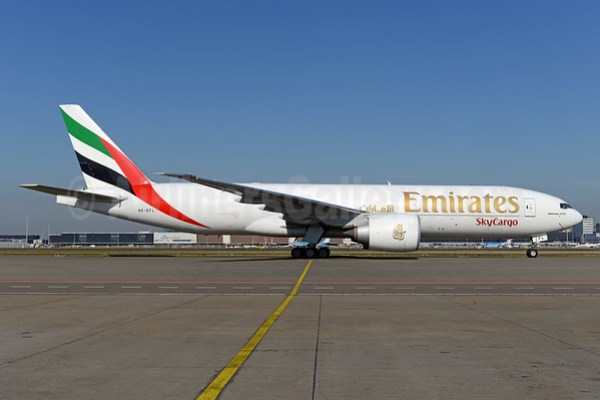
Bottom Copyright Photo: Ton Jochems/AirlinersGallery.com. Emirates SkyCargo is coming to Columbus, Ohio starting on May 27. Boeing 777-F1H A6-EFL (msn 42230) taxies at Amsterdam.




You must be logged in to post a comment.