Tag Archives: Piedmont Airlines

Jay Selman’s An Inside Look

An Inside Look –ย “Quite a career!”?

by Guest Editor Jay Selman.

Guest Editor Jay Selman

Guest Editor Jay Selman

It was exactly 33 years ago that I began my airline career with Piedmont Airlines. June 25, 1981 was a beautiful sunny day when I first stepped onto the ramp at Washington National Airport as an airline employee. I remember the ramp smelling of coffee, and I quickly discovered that there was an art to hoisting myself into the belly bin of a YS-11 without hitting my head on the bin ceiling. Every time a plane took off on what was then runway 36, I simply had to stop and take a look, I felt like I was the luckiest guy in the world!โ€

Copyright Photo: Bruce Drum/AirlinersGallery.com. NAMC YS-11A-205 N219P (msn 2109) of Piedmont Airlines taxies to the runway at Fayetteville, NC.

Those were halcyon days for me, and to be honest, I didnโ€™t realize how good I had it then. The captains usually found a way to take care of airline employees traveling on passโ€ฆoften in the cockpit. Man, I loved that! Heck, one time, I was one of seven people in the cockpit of a 727! The captain gave me his โ€œbrain bagโ€ and said, โ€œSon, this is your seat for the next two hours, so hang on!โ€, and I replied, โ€œThank you, sir!โ€

When I worked in Newark, we had three flights a day that went up to Boston and came right back. The pay wasnโ€™t that great in those days, so I thought nothing of flying up to Boston on the morning flight, enjoying a breakfast on board, and then flying back, having lunch along the way. For dinner, we could usually count on one flight canceling, and catering would unload the meals in the ops office, where I was working at the time. We could usually get free passes on other airlines, and I sure made the most of them. To date, I have set foot in over 40 countries on all six inhabited continents. (Some day, I will figure out a way to add Antarctica to that list!).

One day, I was flying from Heathrow to Kennedy on a Pan Am Boeing 747, and the check-in agent looked at my PI employee number on the pass and said, โ€œOh, you are P1 (one)โ€ฆwe can upgrade you to first class! I played dumb, and for the first time, experienced the luxury of a true intercontinental first class service, complete with caviar, plenty of vodka to wash it down, and a couple of glasses of Dom Perignon. I truly enjoyed that tripโ€ฆat least, the part I remember!

I started out working part time at Washington National Airport with no benefits other than travel. It didnโ€™t matterโ€ฆthere was never a shortage of people willing to work for $6 something an hour in exchange for being able to travel for free. After passing all my tests that were requirements for upgrading to full time, I transferred to Newark in 1983 as a full timer. Those were the days when PEOPLExpress (1st) was growing by leaps and boundsโ€ฆand Piedmont was vigorously defending its territory in the southeast. Newark grew to become the largest non-hub station on the Piedmont system, and working there was a great learning experience for me. 3 ยฝ years later, in April 1986, I transferred to Raleigh-Durham, where I spent the next 13 years. In 1999, I transferred again to Miami, which was like being reassigned to heaven. As an airplane enthusiast, I canโ€™t think of a better airport to have ramp access at. Being in Miami also allowed me to connect with some old friends, and opened the door to my becoming the editor of Airliners magazine for a couple of years..

Things changed, and I transferred to Charlotte in 2006, and, like Moses wandering in the desert for 40 years, I feel like I have finally reached the Promised Land. (The difference is, of course, that Moses never got to enter the Promised Land!). I am very happy in Charlotte, and plan to finish out my career here.โ€จThree mergers and two corporate bankruptcies after I started with Piedmont, I still have a job, unlike many of my colleagues at Pan Am, TWA, Eastern, and Braniff, to name a few. The merger between Piedmont and USAir represented the biggest change for usโ€ฆPiedmont was a way of life, and USAir was a job, although still a good one. Iโ€™ve lost track of how many different computer systems I have used over the years, as I get ready for yet another change of computer system, uniform, and name. The industry today is barely recognizable from the industry I began working for.

When I started, the Boeing 737-200 was the backbone of Piedmont’s fleet. Today, the last of the US Airways 737-400s are a few weeks away from leaving the fleet. Gone are meals on most domestic flights, and even on intercontinental flights, Iโ€™m not likely to get caviar and Dom. I can’t say I’m happy about the changes that have occurred in my industry, in general, and my company, specifically, but I still feel like I have one of the best jobs in the world.

Some days, you’re the big dog and some days, you’re the fire hydrant. I come to work with the attitude that I am going to have a good day, and I really do have more big dog days than fire hydrant days. I can wake up in the morning and decide to have dinner in New York, San Francisco, or London…as long as there is an empty seat on the plane, I’m all set.

Through my job, I met a wonderful kind-hearted woman who agreed to be my wife. I work in an airport environment, which to me is the equivalent of a young kid working in a candy store.

When I started 33 years ago, I could not begin to imagine where the journey was going to take me, but I have to admit it’s been a very good ride. There have been plenty of unforeseen twists and turns along the way, but all in all, I still consider myself blessed to be working in the industry that has been my lifelong passion.

Note: You can leave a note here for Jay.

Piedmont Airlines’ flight attendants ratify the new contract

Piedmont Airlines’ (2nd) (US Airways Express) (Salisbury) flight attendants, a wholly owned subsidiary of American Airlines Group, represented by the Association of Flight Attendants-CWA (AFA-CWA), have voted to ratify a new five-year collective bargaining agreement that was reached on March 6. The new contract was ratified by the airline’s 180 flight attendants who are based in Harrisburg, PA; Salisbury, MA; Charlottesville, VA; Roanoke, VA and New Bern, NC.

Copyright Photo: Bruce Drum/AirlinersGallery.com. Bombardier (de Havilland Canada) DHC-8-102 N908HA (msn 015) of Piedmont Airlines (2nd) taxies to the runway at the Charlotte Douglas International Airport (CLT) hub.

Piedmont Airlines-US Airways Express:ย AG Slide Show

Piedmont Airlines’ pilots ratify the new contract

Piedmont Airlines (US Airways Express) (2nd) (Salisbury), a wholly-owned subsidiary of US Airways (Phoenix), represented by the Air Line Pilots Association (ALPA), have voted to ratify a new five-year collective bargaining agreement that was reached on February 1. The new contract was ratified by Piedmont Airlines’ 375 ALPA-represented pilots who are based in Charlottesville, Virginia.; Harrisburg, Pennsylvania.; New Bern, North Carolina; Roanoke, Virginia and Salisbury, Maryland.

Copyright Photo: Bruce Drum.ย Piedmont Airlines’ (2nd) Bombardier DHC-8-102 N807EX (msn 292) taxies to the runway at the Charlotte-Douglas International Airport hub.

Piedmont Airlines:ย AG Slide Show

Map: US Airways keeps the historic name and logo in play with Piedmont although the aircraft are branded as US Airways Express (soon American Eagle). Piedmont operates the regional feeder routes for US Airways in the eastern United States mainly serving the Philadelphia and Charlotte hubs:

Piedmont (2nd) 3:2013 Route Map


Piedmont Airlines and the Air Line Pilots Association (ALPA) reach a tentative agreement on a new contract

Piedmont Airlines (2nd) (US Airways Express) (Salisbury), a wholly-owned subsidiary of US Airways (Phoenix), has announced that it has reached a tentative agreement with the Air Line Pilots Association (ALPA), which represents the airline’s 375 pilots. The tentative agreement is subject to language being finalized, which is expected to occur over the next few weeks.

Copyright Photo: Bruce Drum.ย Piedmont Airlines’ Bombardier DHC-8-102 N936HA (msn 145) taxies to the runway at the Charlotte hub.

US Airways Express-Piedmont Airlines (2nd):ย AG Slide Show

US Airways’ CEO Doug Parker makes his case for a merger with American Airlines before the National Press Club

US Airways Group, Inc. (Phoenix) announced its Chairman and CEO Doug Parker presented at yesterday’s (July 18) National Press Club Luncheon in Washington, D.C.ย  Mr. Parker discussed the current state of the airline industry, the positive impact of mergers for the industry and the benefits of a merger between US Airways and American Airlines.ย  Mr. Parker was joined at the head table at the National Press Club by the leadership of American Airlines’ three unions, representing 55,000 American Airlines employees: Captain David Bates, President of the Allied Pilots Association; Laura Glading, President of the Association of Professional Flight Attendants; and John Conley, International Vice President and Assistant to the International President, Jim C. Little, of the Transport Workers Union.

Mr. Parker discussed the benefits of mergers in the industry.ย  He noted how mergers have benefited United and Continental, Delta and Northwest, Southwest and AirTran, and America West and US Airways. ย In addition, Mr. Parker pointed out that there are real advantages to combining airlines for employees, customers and communities:

“All four combined airlines provide better networks and are now profitable. By combining complementary networks to provide more attractive and efficient service, mergers have led to increased traffic, cost reductions, and vigorous competition …ย The benefits of this trend extend way past the bottom line: there are real advantages to combining airlines for employees, customers and communities. Employees will benefit from greater job security and more long-term opportunities if they’re working for a successful airline. Customers will gain more flight options at better times to more places. And whenever two airlines combine, they open the communities that they serve to many more new travelers.”

Mr. Parker outlined the fundamental network challenges that stem from American Airlines’ “cornerstone” strategy, which focuses on five large cities instead of a comprehensive network.ย  Mr. Parker described how American Airlines has lost market share across the United States and why the cornerstone strategy does not address the network deficiencies of American Airlines versus United and Delta:

“Simply put, American has hubs in Dallas, Chicago and Los Angeles to connect people around the United States, and strong international gateways in both JFK and Miami. But that leaves a large hole in the network up and down the East Coast. This means American cannot easily serve the popular and highly lucrative East Coast region, which causes it to miss out on an enormous source of corporate business, as well as all the consumers who travel up and down the Eastern seaboard.”

Mr. Parker explained how a merger with US Airways solves American Airlines’ network challenges and creates a more comprehensive network. In particular, he noted that the networks are complementary and combining them would result in significant benefits to all stakeholders, including customers, communities, US Airways shareholders, American Airlines creditors and employees:

“A combination with US Airways would create such a network. We’ve taken a long, hard look at American, and we know that together we can build the greatest airline in the worldโ€”an airline that can compete more effectively with the networks of United, Delta and others. Together, American and US Airways can connect more communities and provide greater benefits for American’s creditors and US Airways’ shareholders than either airline could on a standalone basis. Furthermore, we would also save thousands of jobs and offer better compensation and long-term opportunities for employees of both airlines.”

Mr. Parker highlighted American Airlines’ merger protocol, which American Airlines recently announced it was ready to move forward with, and reiterated his desire to present US Airways’ plan to American Airlines:

“All that we want is a fair chance to present our plan, and to compare it to all others in a process that doesn’t disadvantage any of the options, and that determines the best plan based on what is best for the owners of AMRโ€”its creditors. We understand there may be as many as four other airlines included in this merger analysis project, and we welcome the competition. We are certain that any objective analysis will conclude that the best plan for the creditors, employees and customers of American is a merger with US Airways during the bankruptcy process.”

Mr. Parker praised the efforts of American Airlines’ three unions โ€“ the Allied Pilots Association, the Association of Professional Flight Attendants and the Transport Workers Union โ€“ to support the merger:

“The decision by those labor leaders to come out in support of a merger was an unprecedented move on their part, and I think is one of the great untold stories of this process so far. Some people improperly characterize their support as being driven by US Airways’ willingness to pay their members more. But as they will tell you, the gap between our proposals and American’s is not very large. Their support is not driven by short-term gains, but rather by the fact they have taken the time to study the long term strategic underpinnings of each plan. They have hired advisors to help them and they have listened and led. In the end, they have supported this merger because they understand the best thing for their members is a strong, competitive merged airline with a long-term strategic advantage.

The employees of American Airlines are lucky to have these forward-thinking leaders representing them and I’m proud to be working with them.”

A replay of the webcast is available atย http://www.press.org/events/npc-luncheon-doug-parker-ceo-us-airways. ย A copy of Mr. Parker’s speech, as prepared, is available athttp://www.usairways.com/en-US/aboutus/investorrelations/webcast.html.

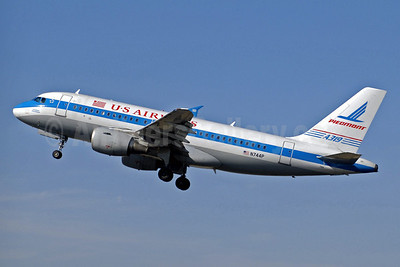
Copyright Photo: Jay Selman. US Airways has become what it is today through mergers of several local service airlines including Piedmont Airlines. The company honors its colorful past with its legacy logojets. Airbus A319-112 N744P climbs aways from the Charlotte hub dressed in Piedmont Airlines 1974 color scheme.

US Airways:ย 

Piedmont Airlines’ fleet and passenger service employees ratify the contract

Piedmont Airlines (2nd) (subsidiary of US Airways) (US Airways Express) (Salisbury) fleet and passenger service employees have voted to ratify the new collective bargaining agreement previously announced on May 31. The new four and a half year agreement was ratified by Piedmont Airlines’ more than 3,000 employees who are represented by the Communications Workers of America (CWA).

Copyright Photo: Bruce Drum.

US Airways Express-Piedmont Airlines:ย