Spirit Airlines announces additional pilot and flight attendant crew bases in Miami and Atlanta

Spirit Airlines has announced the addition of new Pilot and Flight Attendant bases at Miamiย International Airport (MIA) and Hartsfield-Jackson Atlanta International Airport (ATL) for a total of nine crew bases across the network as the airline continues to add new planes and new airports. The crew bases are projected to initially open this summer once advance preparations are finalized. Spirit expects to locate more than 100 Pilots and more than 200 Flight Attendants at each base initially, with additional crew, supervisors and support functions to follow later in the year.


Crew Bases, also known as Home Bases, are the various airport stations where commercial Pilots and Flight Attendants normally begin and end their duty periods.

The new bases will complement Spirit’s existing crew bases in Atlantic City (ACY), Chicago (ORD), Dallas (DFW), Detroit (DTW), Fort Lauderdale (FLL), Las Vegas (LAS) and Orlando (MCO).

Spirit’s presence at MIA started in October 2021 with service to nine destinations and grew to a total of 30 nonstop domestic and international routes in January 2022. Spirit’s big entrance at MIA made it the second largest carrier at the airport. At ATL, Spirit currently ranks as the third largest carrier for number of Guests flown and operates nonstop flights to 19ย destinations.

(PRNewsfoto/Spirit Airlines, Inc.)


In Russia, how will they even pay for an airline ticket?

The Russian ruble has nose dived in value. It is basically worthless against the U.S. dollar. The value of the ruble has plummeted to less than 1 U.S. cent.

More from The Washington Post:

https://www.washingtonpost.com/business/2022/03/03/russia-ruble-putin-sanctions/

Alaska Airlines celebrates the completion of the new International Arrivals Facility at SEA

Alaska Airlines made this announcement:

Marking a new era at Seattle-Tacoma International Airport, Alaska Airlines joined with the Port of Seattle today to celebrate the completion of the new International Arrivals Facility (IAF) โ€“ a state-of-the-art, world-class facility for passengers arriving from around the globe on international flights into Seattle.

Exterior view of the Great Hall at SEA’s new international Arrivals Facility. (Courtesy of SEA Airport)

The IAF will accommodate the Puget Sound region’s increasing demand for international air travel on Alaska, our fellow oneworld member airlines and our additional global airline partners. After a period of testing and transition, all arriving passengers who need customs clearance after international flights are scheduled to make their way through the new facility.

Nonstop international flights on oneworld partners from SEA this summer.

The opening comes just in time for increased summertime travel. oneworld airlines will offer the most nonstop flights to international destinations from SEA this summer โ€“ an average of 22ย daily international flights starting in June, which includes Alaska’s nonstop flights to Canada and Mexico. From oneworld global hubs, guests can connect to hundreds of other cities.

Nonstop international flights on oneworld partners from SEA this summer:

oneworld Partner Nonstop Destination Frequency
British Airways London Heathrow 2x Daily
Finnair Helsinki 3x Weekly
Japan Airlines Tokyo Narita Daily
Qatar Doha Daily

The new IAF is expected to reduce connection times by at least 15 minutes with more predictable and less stressful arrival and customs processing, making it easier and more convenient for arriving international passengers to continue their travels on Alaska’s domestic flights.

The IAF solidifies SEA as a gateway to the world. The new structure includes a marquee, first-of-its-kind aerial walkway โ€“ with dramatic views 85 feet above an active taxi lane โ€“ that connects guests arriving on international flights at the S Concourse to the IAF. That’s where they pick up their checked bags first and then go through customs processing โ€“ a single checkpoint to clear customs.

New baggage claim area at SEA’s International Arrivals Facility. (Courtesy of SEA Airport)

Another big change: The number of international capable gates has increased from 12 to 20 to allow for more flights during peak periods. The Port of Seattle says the new IAF is four times larger than the old facility and it will more than double peak international arrival capacity to 2,600 passengers an hour. Plus, the spacious baggage claim area now has seven carousels instead of four and each is larger than before.

Avelo Airlines partners with Aero HygenX for UVC robots

Ultraviolet Disinfection Robots

Avelo Airlines today announced an innovative partnership with Aero HygenX to deploy leading-edge autonomous ultraviolet light (UVC) robots to disinfect its aircraft fleet to combat COVID-19. Aero HygenX is the pioneer in autonomous UVC disinfection technology for the transportation industry.

The Aero HygenX RAY robot is a compact, light-weight and self-navigating device which uses motion-sensing technology to navigate interior spaces โ€” disinfecting surfaces quickly and safely using UVC light. RAY is a sustainable alternative to harmful chemicals and is emissions-free.

Avelo uses the RAY robots as part of its daily disinfection of its six Boeing Next-Generation (NG) 737 aircraft. Additionally, RAY is used to disinfect Avelo’s Crewmember (employee) workspaces at the airline’s West Coast base at Los Angeles’ Hollywood Burbank Airport (BUR) and its East Coast base at Southern Connecticut’s Tweed-New Haven Airport (HVN). The aircraft and airport disinfection routine occurs every evening following the completion of each day’s flight operations.

Since the onset of the COVID-19 pandemic, airlines around the world have implemented enhanced cleaning procedures involving more frequent and deeper disinfection of aircraft. In most cases, these more stringent hygienic measures have necessitated the manual application of harsh chemical disinfectants and have prolonged the sanitization process. Additional disadvantages of chemical-based disinfection include the creation of surplus hazardous waste and the degradation of aircraft interior finishes.

Aero HygenX CEO Arash Mahin added, “We couldn’t be more excited to announce thatย America’sfirst new airline in nearly 15 years is utilizing RAY. Avelo’s partnership with Aero HygenX will enhance its aircraft and airport disinfection regiment, and exemplifies the airline’s commitment to safety, reliability and innovation. We look forward to growing with Avelo as they add aircraft, bases, Customers and Crewmembers in the future.”

A Game-Changing Solution
UVC technology has a long and proven history of effectively disinfecting surfaces, air and water in many other industries, including the healthcare, food / beverage and hospitality sectors. Aero HygenX is the first company to incorporate UVC disinfection technology into an autonomous robot solution for the transportation industry. In addition to commercial aircraft, RAY can be used to disinfect buses and trains.

RAY’s light-emitting technology safely destroys up to 99.9% of harmful pathogens in the air and on the surfaces of Avelo’s aircraft cabins, galleys, lavatories and flight decks โ€“ as well as in workspaces at the airline’s BUR and HVN bases. RAY’s automation technology enables the robots to be operated remotely by a single Crewmember โ€” the previous manual chemical-based disinfection process required several Crewmembers to sanitize each aircraft. The time it takes to complete the disinfection of Avelo’s three 737-700s and its three 737-800s is also significantly reduced by using the RAY robot. Avelo has committed to adding nine additional 737 NG jetliners in 2022 โ€” expanding its fleet to 15 aircraft.

RAY is connected to HygenXStream, a real-time digital platform which enables Avelo to monitor the health of RAY and gain access to valuable metrics that can assist with decision making for its operations.

There is significant science validating the effectiveness of UVC exposure to render pathogens โ€” such as COVID-19 โ€” inactive. UVC disinfection is a function of intensity over time. RAY’s smart functionality consistently delivers the perfect dose of UVC light to eliminate pathogens onboard an aircraft. At the same time, RAY moves unguided through the aircraft cabin eliminating the need for an Avelo Crewmember to be onboard while it’s in use.


Sabre terminates distribution agreement with Aeroflot!

No reservations … No airline.

Sabre Corporation, a leading software and technology company in the travel industry, today announced that it has terminated its distribution agreement with Aeroflot, the largest government-majority owned carrier in Russia. Sabre is taking immediate steps to remove Aeroflot flight content from its global distribution system (GDS), a marketplace used by travel agencies, travel websites and corporations around the world to shop, book and service flight reservations.

โ€œSabre has been monitoring the evolving situation in Ukraine with increasing concern. From the beginning, our primary focus has been the safety of our team members in the impacted region, as well as doing our part to support the much-needed relief efforts,โ€ said Sean Menke, CEO of Sabre. โ€œWe are taking a stand against this military conflict. We are complying, and will continue to comply, with sanctions imposed against Russia. In addition, today we announced that Sabre has terminated its distribution agreement with Aeroflot, removing its content from our GDS.โ€

The Company will continue to monitor the ongoing situation and will evaluate whether additional actions would be appropriate, taking into account legal considerations and any counter measures that could be implemented in response.

To help support humanitarian programs in the region, Sabre, which has approximately 1,500 team members in Poland, has donated $1 million to the Polish Red Cross, a 100-year charity that does exemplary work in conflict zones and for supporting displaced people. The funds donated by Sabre will be used by the Polish Red Cross to purchase, among other materials, much-needed food, hygiene products and sleeping bags, and will support the provision of medical assistance to those seeking shelter in Poland.

Air Dolomiti adds two additional Embraer 195s

Airline Color Scheme - Introduced 2019

Air Dolomiti, the Italian airline company ofย Lufthansa Group, is growing again.

Two Embraer 195s have been confirmed and will arrive in the coming weeks. With the registrations ofย I-JENBย andย I-ADJZ.

The jets add to the 15 already in the fleet, bringing the numberย to a total of 17: a positive sign that shows a new opening to the European market. The planes, arriving in March and May, will operate the routes to Frankfurt and Munich, international hubs that offer a wide range of destinations around the world.

Since 1991 to date, Air Dolomiti has shown itself to be attentive to theย continuous renewal of itsย fleet, with constant improvements to the on board services responding to the most demanding passenger requests. Moreover, the refurbishment of all the interiors of the 15 E195s is underway, as well as a change in the internal configuration that will bring each aircraftย to 122 seats. The seats of the two coming planes will also be replaced at the end of this year.

Top Copyright Photo: Air Dolomiti Embraer ERJ ERJ 190-200LR (ERJ 195) I-ADJK (msn 19000245) ZRH (Rolf Wallner). Image: 945689.

Air Dolomiti aircraft slide show:

Air Dolomiti aircraft photo gallery:


Brussels Airlines reports a loss of EUR 189 million in 2021

COVID-19 pandemic still heavily impacted the airlineโ€™s EBIT

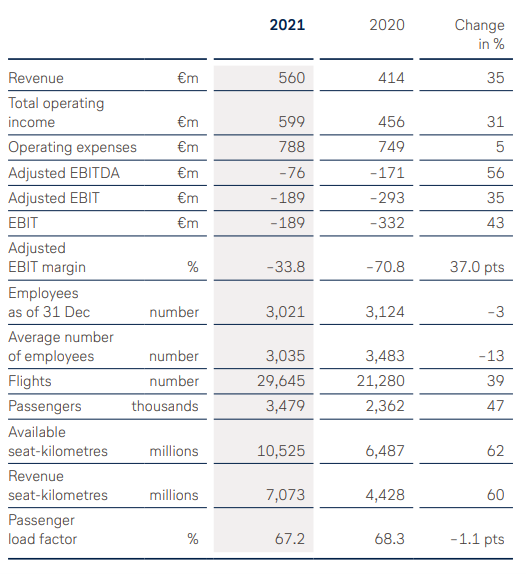
  • In line with expectations due to the Covid-19 crisis, Brussels Airlines booked a loss of EUR 189 million in the financial year 2021, an improvement of 35% versus the previous year.
  • Losses limited thanks to successful Reboot Plus transformation plan and strict cash management.
  • Revenue up by 35% to 560 million, while operating expenses were only up by 5%
  • Passenger numbers rose by 47% to 3.5 million.
  • Growth in 2022 in terms of network, fleet and people

2021 was another year marked by the Covid pandemic and a year that still required a high level of resilience. The year started with a very limited flight schedule, in line with the low market demand due to high infection rates and lockdowns all over Europe, followed by a three-month travel ban issued by the Belgian government. This travel ban heavily impacted Brussels Airlinesโ€™ first quarter.

On 19 April, the travel ban was lifted and demand started to pick up again, while the vaccination campaign was also gaining velocity. What followed was a rapid increase in demand towards the summer. Brussels Airlines restarted full hub operations in June and built up its capacity from 12% to 53% of pre-pandemic levels towards the summer. The summer demand lasted longer than other years due to the effect of postponed travel plans and the desire to travel after the lockdown. This strong and prolonged summer peak led to a positive third quarter and the first profit since the beginning of the pandemic. November came with rising infection numbers and again many restrictions, causing the demand to decrease once more. The end-of-year holiday showed a strong travel peak, before returning to a lower winter demand due to the emergence of the Omicron variant.

After the restructuring phase of the Reboot Plus plan and the numerous changes undertaken, in November 2021 Brussels Airlines presented a new branding to strengthen its Belgian identity and to mark a new start after the coronavirus crisis. The new branding was an important signal towards the market that the airline is here to stay. As additional symbol for its future-readiness the decision was taken in June 2021 to add ย three Airbus A320neos to the Brussels Airlines fleet in summer 2023. With these new state-of-the-art aircraft and by retiring three older A319s, Brussels Airlines takes a significant step to the further modernization of its fleet and reduces carbon and noise emissions in its medium-haul network.

In the whole of 2021, the demand on the African network was again very resilient, mainly thanks to the business and VFR segments (Visiting Friends and Relatives), while the European segment was more volatile. All in all, the full-year capacity (Available seat-kilometres) was 62% higher than in 2020 and Brussels Airlines operated 39% more flights, welcoming 3.5 million passengers (+47%).

The passenger load factor was 1.1 percentage points lower than the previous yearโ€™s level, at 67.2% (previous year: 68.3%). Yields fell by 6.9% after adjusting for exchange rates. Traffic revenue increased with the expansion of traffic by 31% to EUR 503m (previous year: EUR 384m).

Revenue rose by 35% to EUR 560m(previous year: EUR 414m). Operating income rose by 31% to EUR 599m (previous year: EUR 456m). The Reboot Pluscost savings measures and strict cost discipline limited the increase in operating costs. At EUR 788m, they were only up 5% on the previous year. Higher fuel costs (+62%) due to increased prices and volumes as well as higher fees and charges due to volumes (+55%) were partially countered by lower staff costs (โ€“17%).

In the 2021 financial year, Adjusted EBIT at Brussels Airlines was at EUR โ€“189m (previous year: EUR โ€“293m). The Adjusted EBIT margin was โ€“33.8% (previous year: โ€“70.8%). The EBIT was also at EUR โ€“189m (previous year: EUR โ€“332m). The previous yearโ€™s value was adversely affected by write-downs on the fleet totalling EUR 33m.

2021 key figures

Story image

Brussels Airlines successfully completed its Reboot Plus restructuring, creating a competitive cost basis for a profitable future

Brussels Airlines intensified its restructuring programme in response to the pandemic. โ€œReboot Plusโ€ forms the basis for the airlineโ€™s sustainable future. As part of the programme, Brussels Airlines completed the restructuring phase. Two Airbus A330s left the long-haul fleet, and eight A320 family aircraft were removed from the short- and medium-haul fleets. The number of employees was reduced by more than 20% compared to the pre-pandemic level. Since January 2021, new collective labour agreements have been in place with all employee groups at Brussels Airlines to enable competitive staff costs. In 2021, the transformation plan entered a new phase, the phase of improvement and investment into technologies and simplification, to gain efficiency.

“This year we focused on the second phase of Reboot Plus, the improvement phase. We have been building the New Brussels Airlines. Our rebranding was a very visible symbol hereof, while behind the scenes we invested in a new crew scheduling tool, in our renewed office space and in a multitude of projects that either bring efficiency gains or simplification in our processes. I want to thank all Brussels Airlines employees for the achievements last year. Together we are building a bright future for our company.โ€

– Peter Gerber, CEO Brussels Airlines

Outlook 2022

Brussels Airlines will gradually increase its capacity to reach 80% of its 2019 levels by July, reinforcing its position as the home carrier of Belgium with a strong focus on leisure and reinforcing its position in Africa thanks to the 9th aircraft. For the entire year, the airline plans to operate 74% of its 2019 capacity levels.

“We have had some difficult winter months due to the Omicron wave, but we see a promising spring and summer in terms of demand. As travel regulations will dissipate and measures will be eased all around Europe, we foresee a return to 80% capacity of our pre-pandemic levels in the summer holidays. Cost-consciousness remains part of our DNA in order to reach structural profitability. In that respect, our plans remain unchanged: we aim for a black zero in 2022 and we remain committed to reaching 8% EBIT in 2024, under unchanged circumstances. Thanks to the successful implementation of our Reboot Plus plan, we have created the right foundation to grow and to look ahead to a profitable future.โ€

– Nina ร–werdieck, Chief Financial Officer Brussels Airlines


Brussels Airlines strengthens its market position in West Africa

In November 2021, it was decided to expand the long-haul fleet of Brussels Airlines with a ninth A330. With the additional capacity, Brussels Airlines will restart its route to Ouagadougou, Burkina Faso, and Conakry, Guinea, and increase the frequencies of its existing West African routes in 2022.

More growth was announced this week for 2022, as two aircraft will reinforce the summer operations at Brussels Airlines, allowing Brussels Airlines to reinforce its position as Belgiumโ€™s home carrier. To fuel this growth, Brussels Airlines announced earlier that it is hiring 288 people in all departments of the company.

In other news,ย Brussels Airlines has decided to add two aircraft to its medium haul fleet this summer season. This growth comes earlier than foreseen in its transformation plan (and state loan agreement) as it sees an opportunity in the increasing demand for summer. With one extra Airbus 319 and one extra A320, Brussels Airlines wants to cater to the high demand for leisure travel and defend its position in the market as Belgiumโ€™s home carrier.

On the European network, Brussels Airlines noted a significant increase in leisure demand for summer: 75% more requests from tour operators, 140% more requests for charter business compared to 2020, and the expectation that this touristic demand will even further increase leading up to the summer. 

Within the scope of Reboot Plus, Brussels Airlines rightsized its short- and medium haul fleet from 42 aircraft in 2019 to 30 in 2020. With especially touristic markets recovering quicker than initially forecasted, the airline decided to expand its capacity to reap this additional summer demand: The lease of one A319 will therefore be extended to October 2022 and the phase in of one A320 will be advanced to June 2022 in order to offer 80% of the 2019 summer production.

โ€œWe see clear signals that this crisis is slowly but surely coming to an end. The leisure segment in the market recovered more quickly than originally expected and we also see a slow but steady increase in the demand for corporate travel. By 2024 we should again reach the level of 2019 if it comes to the demand in the business travel segment. This is definitely the right time to increase our market share and once again confirm our position as Belgiumโ€™s home carrier.โ€

  • Peter Gerber, CEO Brussels Airlines


This fleet expansion will give the companyโ€™s pilots, who currently have a parttime contract as was foreseen in its transformation plan in 2020 in order to keep all pilots on board, the possibility to return to a full-time working regime two years earlier than foreseen. On the cabin crew side, recruitments are ongoing. As it was promised in 2020, Brussels Airlines first contacted its ex-colleagues who did not see their contract prolonged that year due to the pandemic and the Reboot Plus program. 135 out of the 165 colleagues who were asked to return have accepted to work again for Brussels Airlines.

In December, Brussels Airlines already announced growth on its intercontinental sector, especially in Africa, thanks to a 9th A330ย  aircraft. This additional plane allows Brussels Airlines to increase frequencies to several of its destinations in Sub Sahara Africa and to resume its flights to Ouagadougou (Burkina Faso) and Conakry (Guinรฉe), which were discontinued in 2020.

Brussels Airlines aircraft photo gallery:

BOC Aviation purchases 11 Boeing 737-8 MAX 8 aircraft for leases to Lynx Air

BOC Aviation Limited has announced it has agreed to purchase 11 new Boeing 737-8 MAX 8 aircraft from The Boeing Company.

The aircraft will be leased to Lynx Air on long term leases.

They will be powered by CFM LEAP-1B engines and are scheduled for delivery in 2023 and 2024.

Lufthansa Group expects strong travel season โ€“ Operating loss cut by more than two-thirds in 2021

Carsten Spohr, CEO of Deutsche Lufthansa AG:

“2021, was a challenging year for the Lufthansa Group and its employees. And 2022 also begins with developments that worry us as citizens of this continent. Our Airlines connect people, cultures and economies. We stand for international understanding and peace in Europe and around the world. Our thoughts are with the people of Ukraine and with our colleagues on the ground, to whom we are providing every possible support.

The Lufthansa Group used the past financial year to further renew itself. We have decisively and consistently advanced and implemented the transformation and restructuring of the company. Today, the Lufthansa Group is more efficient and more sustainable than before the pandemic.

Even in the financially most difficult two years in our history, in which painful cuts were unavoidable, we acted in a socially responsible manner and sustainably secured 105,000 jobs in the Lufthansa Group.

We are very certain that air traffic will experience a strong upswing this year. Our strategy of expanding the private travel segment has proved successful and is paying off. People want to travel. They seek and need personal contact – especially after two years of pandemic and the associated social restrictions. The pent up demand for leisure and business travel was already significantly noticeable in 2021 – and this trend is set to intensify in 2022.

The Coronavirus crisis has taken its toll on all of us. The pandemic presented our customers, shareholders and our employees with extreme challenges. We are now leaving the crisis behind us, mentally and – in view of the strong booking figures this year – also commercially and face the next challenge strengthened.โ€

Result 2021

The Lufthansa Group generated revenue of 16.8 billion euros in the fiscal year 2021, around 24 percent more than in the previous year (previous year: 13.6 billion euros).

An increase in passengers, the transformation and restructuring of the company, and the associated cost reductions contributed to a significant improvement in earnings. The company returned to profit in the third quarter due to strong summer travel months. For the full year, the operating loss was significantly reduced, despite the third and fourth pandemic wave and the resulting travel restrictions. Adjusted EBIT in 2021 was -2.3 billion euros (previous year: -5.5 billion euros). Excluding restructuring costs of 581 million euros, Adjusted EBIT was -1.8 billion euros. The Adjusted EBIT margin improved accordingly to -14.0 percent (previous year: ย ย -40.1 percent).

Compared with the pre-crisis level, the structural decrease in personnel expenses, excluding one-off restructuring expenses, effects from short-time working and temporary measures, amounted to 10 percent. With the implementation of additional planned measures, the decrease will be 15 to 20 percent. At the end of last year, the Lufthansa Group employed around 105,000 employees, more than 30,000 fewer than before the start of the Coronavirus pandemic.

The Group net income improved by 67 percent to -2.2 billion euros (previous year: -6.7 billion euros).

Lufthansa Cargo posts record result, Lufthansa Technik and LSG generate profit

The positive earnings trend in the logistics segment continued in the financial year 2021. High demand for freight capacities combined with a limited offer due to a global lack of freight capacity on passenger aircraft and disruptions to supply chains, especially in shipping, ensured that average yields continued to rise. Lufthansa Cargo benefited from this and almost doubled its Adjusted EBIT year-on-year to 1.5 billion euros (previous year: 772 million euros). This is the best result of its history.

By contrast, Network Airlines’ earnings were still heavily impacted by the Corona pandemic in the fiscal year 2021. Adjusted EBIT remained clearly negative at
-3.5 billion euros but improved by 25 percent year-on-year (previous year:
-4.7 billion euros).

Eurowings benefited in particular from the return of demand in the private travel segment, especially last summer. Cost reductions as part of the restructuring program also contributed to the improvement in earnings. Adjusted EBIT increased by 67 percent to -230 million euros (previous year: -703 million euros).

Lufthansa Technik posted a clearly positive result last year. The provider of aircraft maintenance, repair and overhaul services benefited from the recovery in air traffic. Lufthansa Technik achieved an Adjusted EBIT of 210 million euros (previous year: -383 million euros).

The LSG catering division also returned to profitability, posting an Adjusted EBIT of 27 million euros (previous year: -284 million euros), mainly thanks to the recovery of air traffic in North America.

Passenger numbers and traffic development

During the past year, significantly more passengers flew with the Lufthansa Group airlines than in 2020. In total, 47 million passengers were welcomed on board. That was an increase of 29 percent compared to the previous year. The number of flights in 2021 increased by almost 18 percent compared to 2020. As a result of the significant increase in demand, a total of 32 percent more seat kilometers were offered last year than in the previous year.

Alongside the dynamic growth in demand for air travel, the number of offered flights was significantly expanded over the course of the year. While at the beginning of 2021 the offered capacity still only amounted to 21 percent (compared to 2019), by the end of the year the airlines had reached an offered capacity of 60 percent.

In line with expectations, average offered capacity amounted to 40 percent of 2019 capacity for the year.

Free cash flow excluding special effects only slightly negative, liquidity above target value

The Lufthansa Group continued to place a particular focus on consistent cash management in 2021. At 1.3 billion euros, gross capital expenditure remained considerably below pre-pandemic levels. Through strict management of receivables and payables and the significant increase in new bookings, the Group achieved a significant improvement in Adjusted Free Cash Flow to -855 million euros (prior year: -3.7 billion euros). Excluding the payment of taxes amounting to 810 million euros that had been deferred in the previous year, Adjusted Free Cash Flow was close to breakeven at -45 million euros.

In the past year, the Lufthansa Group significantly improved its balance sheet through numerous transactions on the financial market. A successful capital increase, the issue of six bonds and the conclusion of 20 aircraft financings clearly document the confidence of the financial markets in the company. The repayable funds raised as part of the WSF stabilization measures were repaid in full earlier than expected.

As of December 31, 2021, the Lufthansa Group’s available liquidity of 9.4 billion euros was above the long-term target corridor of 6 to 8 billion euros.

Other balance sheet ratios also improved notably in the financial year. Pension liabilities decreased to around 6.7 billion euros, mainly due to an increase in the interest rate used to discount pension obligations (previous year: 9.5 billion euros). As a result of the capital increase, net debt decreased to 9.0 billion euros (previous year: 9.9 billion euros). Equity tripled to 4.5 billion euros (previous year: 1.4 billion euros).

Remco Steenbergen, CFO of Deutsche Lufthansa AG:

“We used the past year to significantly strengthen our balance sheet. Our financing measures on the equity and debt side show that we again have a very good and broad market access. Our liquidity is more than twice as high compared to the pre-crisis level. This, combined with our structural cost savings, gives us a very good financial basis to further expand our strong market position.”

Transformation and restructuring lead to significant cost reductions

The successful continuation of the company’s ambitious transformation and restructuring program led to a further significant reduction in costs in the Group. In the meantime measures have been implemented which will reduce costs by around 2.7 billion euros per year. Thereby more than 75 percent of the annual cost savings of 3.5 billion euros targeted by 2024 have already been secured.ย This has been achieved primarily by reducing personnel costs, increasingย productivity, improving processes at the passenger airlines, Lufthansa Cargo and the Group functions, and the modernization of the fleet.ย The company continues to examine the sale of subsidiaries that are not part of the core business of the Group. AirPlus and the remaining part of LSG’s catering business after the sale of the European part, are to be sold as soon as market conditions permit. A partial sale or a partial IPO are still being pursued for Lufthansa Technik. The closing of the transaction is intended for 2023.

Outlook

The Lufthansa Group expects a significant increase in demand for air travel in the current year. In February, our customers have booked more flight tickets than at any time since the beginning of the pandemic. The number of bookings for the Easter and summer holiday periods has almost reached the level of 2019. To some destinations, the number of bookings has even tripled (compared to 2019). For the Easter vacations, Lufthansa alone will therefore offer more than 50 additional flights to meet all booking requests. Overall, in this year the Lufthansa Group airlines offer a greater variety of tourist destinations than ever before, with more than 120 classic vacation destinations. Demand is particularly strong for destinations in the USA and the Mediterranean.

In line with the growing demand, flight schedules are further expanded. For the summer, the company expects capacity to increase to around 85 percent compared to 2019. On short- and medium-haul routes, the figure is expected to be around 95 percent. Eurowings will even offer more capacity in the summer than in 2019. For the year as a whole, the Lufthansa Group expects an average capacity of more than 70 percent compared to 2019.

The entire airline industry will be confronted with increasing external costs in 2022. Air traffic control and airport charges are significantly increasing. Additional burdens also result from the rising oil price. However, the Group expects to be significantly less affected by this cost inflation than its competitors. It has for example started to hedge at an early stage against rising fuel prices and the increase in the cost of emissions certificates.

Major uncertainties regarding the dramatic developments in Ukraine and the economic and geopolitical consequences of the conflict, as well as remaining uncertainties regarding the course of the pandemic, do not allow to provide a detailed financial outlook at present.

In 2022 however, the company expects further year-on-year improvements in Adjusted EBIT and Adjusted free cash flow. After a challenging first quarter, which is still impacted by the spread of the Omicron variant, the Lufthansa Group expects a significant improvement in operating results in the following quarters.

Building on the progress we forecast for 2022, the Lufthansa Group confirms its communicated targets for 2024 (Adjusted EBIT margin of at least 8% and Adjusted ROCE of at least 10%).

Remco Steenbergen, CFO of Deutsche Lufthansa AG:

“Our ambition is clear – we want to return to positive results as quickly as possible. We have laid the foundations for this, above all by implementing our cost reduction program. The strong recovery in demand in recent weeks also gives us cause for optimism. We cannot yet foresee how the significant increase in geopolitical uncertainties will affect demand and the economic environment. Nevertheless, we will be able to continue and accelerate our economic recovery in 2022.”

Connect the world – protect its future

The Lufthansa Group has set itself ambitious climate protection goals and aims to halve its net COโ‚‚ emissions by 2030 compared to 2019 and to achieve a neutral COโ‚‚ balance by 2050. The company is focusing in particular on accelerated fleet modernization. Last year, the Lufthansa Group took delivery of eleven new aircraft. In 2022, the company expects to take delivery of 29 more fuel-efficient, quiet and efficient aircraft, including four Airbus A350-900s and five Boeing 787-9 long-haul aircraft. The use of sustainable aviation fuels and innovative new offers for customers to make their air travel COโ‚‚-neutral will further reduce COโ‚‚ emissions.

The company’s clear goal is to continue to play a pioneering role in aviation for more and better climate protection in the future. The Lufthansa Group bundles its numerous sustainability initiatives and partnerships in the “CleanTech Hub”, where impulses from science, industry and the global start-up scene are combined with the company’s extensive airline know-how. Experts are currently collaborating on more than 80 projects – which include the production of sustainable aviation fuels using sunlight, the use of artificial intelligence for flight route optimization in real time, the development and the implementation of a fuel-saving surface technology for passenger aircraft that imitates the properties of the particularly streamlined shark skin.

Investments in new premium customer offerings

The clear goal in 2022 is to once again consistently offer the premium service that passengers rightly expect from the Lufthansa Group. Several measures are underway in order to achieve this. For example, the digital offerings and self-service options will be consistently expanded and the processes at the airports optimized for our customers. Onboard service will not only be restored to the usual premium standard as soon as the pandemic-related hygiene protection measures permit but will also be improved further. The company is also investing in renewing and expanding the infrastructure, for example in the lounges.

Further information

Further information on the results of individual business units will be published in the Annual Report. It will be published at the same time as this press release on March 3, 2022, at 7:00 a.m. CET at http://www.lufthansagroup.com/investor-relations.

The annual press conference will be streamed live on http://www.lufthansagroup.com from 10:00 a.m. CET. The analyst call will be streamed live on https://investor-relations.lufthansagroup.com/en/publications/financial-reports.html from 13:00 CET.

Lufthansa Groupย ย    January โ€“ย December October โ€“ December
2021ย  2020ย  ฮ”ย ย  2021 2020ย  ฮ”ย 
Total revenue EUR million 16,811 13,589 +24% 5,833 2,594 +125%
of which traffic revenue EUR million 11,876 9,078 +31% 4,326 1,674 +158%
EBIT EUR million -2,316 -7,353 +69% -193 -1,496 +87%
Adjusted EBIT1ย  EUR million -2,349 -5,451 +57% -271 -1,290 +79%
Network Airlines EUR million -3,486 -4,674 +25% -586 -1,024 +43%
Eurowings EUR million -230 -703 +67% -86 -237 +64%
Logistics EUR million 1,493 772 +93% 552 326 +69%
MRO EUR million 210 -383 nmf. 47 -175 nmf.
Catering EUR million 27 -284 nmf. -25 -15 -67%
Others EUR million -437 -314 -39% -232 -237 +2%
Adjusted EBIT
excl. restructuring cost
EUR million -1,768 -5,218 +66% -145 -1,190 +88%
Net profit/loss EUR million -2,191 -6,725 +67% -314 -1,141 +73%
Earnings per share EUR -2.99 -12.51 +76% -0.45 -2.12 +79%
               
Total Assets EUR million 42,538 39,484 +8%      
Operating cash flow EUR million 618 -2,328   158 -730  
Gross Investments EUR million 1,329 1,273 +4% 362 250 +45%
Adjustedย Freeย  Cashflowย  EUR million -855 -3,669 +77% -261 -1,090 +76%
               
Net Debt EUR million 9,023 9,922 -9%      
 
Adjusted EBIT-Margin in % -14.0 -40.1 +26.1pts. -4.6 -49.7 +45.1pts
               
Employees as of December 31   105,290 110,065 -4%      

1 Adjusted EBIT is not a measure under IFRS. Information on the calculation of the Adjusted EBIT is available in the Annual Report 2020 of Deutsche Lufthansa AG.


Vistara will not like Josh Cahill’s review of the airline