Tag Archives: SYD

QANTAS Link to help open the new Brisbane West Wellcamp Airport

Brisbane West Wellcamp Airport, the countryโ€™s newest airport, and QANTAS Link have announced they have signed a deal to start passenger flights to the airport when it opens later this year.

The landmark deal will secure 11 return flights a week to and from Sydney from November 17 and provide a Toowoomba centric schedule of double daily services Monday to Friday and daily services on the weekend.

BWWA is Australiaโ€™s first privately-funded public airport and the first public airport to be built in 50 years. The 300 ha airport, featuring a 2.87 km runway capable of landing a Boeing 747 aircraft, is the anchor tenant of the 800 ha Wellcamp Business Park.

Copyright Photo: John Adlard/AirlinersGallery.com. Sunstate Airlines Bombardier DHC-8-402 (Q400) VH-QOH (msn 4132) in the special NBCF livery approaches the runway at Sydney.

QANTAS Link-Sunstate Aircraft Slide Show: CLICK HERE


Virgin Australia CEO: โ€œThe 2014 Financial Year has seen one of the most difficult operating environments in the history of Australian aviation”, loses $332.2 million in its fiscal year

Virgin Australia Holdings Limited (Virgin Australia Airlines) (Brisbane) reported a Statutory Loss after Tax of A$355.6 million ($332.2 million) including the impact of equity accounted investments. Financial performance for the 2014 Financial Year was impacted by the confluence of excess market capacity, weak consumer sentiment, continued economic uncertainty and the $51.6 million cost of the carbon tax.

Virgin Australia Chief Executive Officer John Borghetti said: โ€œThe 2014 Financial Year has seen one of the most difficult operating environments in the history of Australian aviation.

โ€œWhile the Virgin Australia Group performed well in attracting high yielding passengers and containing cost growth over the full year, underlying revenue performance was impacted by the challenging operating conditions.

โ€œNotwithstanding these conditions, it was important for the Virgin Australia Group to complete the Game Change Program strategy and strengthen our balance sheet in order to deliver sustainable returns for shareholders over the long-term.

โ€œOver the 2014 Financial Year, the Group further increased revenue from the Corporate and Government market segment, which now represents over 25 per cent of our domestic revenue, far exceeding our original goal of 20 per cent.

โ€œFurthermore, our success in integrating the Skywest8 business has enabled us to significantly grow revenue from the Charter segment, increasing comparative revenue by around 30 per cent on the 2013 Financial Year. We have also positioned our loyalty program Velocity Frequent Flyer as a significant value driver for the Group, with the highest annual membership acquisition in the programโ€™s history and a significant increase in member engagement.

โ€œThe Groupโ€™s cost program delivered a significant reduction in cost growth over the second half of the 2014 Financial Year, with growth in Cost per Available Seat Kilometre (Underlying CASK)9 including fuel and foreign exchange halving to approximately 2 per cent โ€“ a strong performance given we had lower capacity growth and we continue to invest in product and service initiatives for our customers.

โ€œAs a result of several major balance sheet initiatives executed during the year, the Virgin Australia Group finished the year with a total cash position of $783.8 million and an unrestricted cash position of $541.0 million.

โ€œVirgin Australia also re-entered the Australian domestic budget market through the acquisition of a 60 per cent interest in Tigerair Australia at the beginning of the 2014 Financial Year. Over the last 12 months Virgin Australia has worked with Tiger Airways Holdings Limited and Tigerair Australia to overhaul revenue and accounting systems, develop the management team, improve asset utilisation and enhance the operational platform. Tigerair Australiaโ€™s performance needs to be viewed in the context of overall industry performance and weak consumer sentiment, particularly in the last quarter of the year, which has a more pronounced impact on low cost carriers. As a result of progress made during the 2014 Financial Year, and in particular marked increases in customer satisfaction, Tigerair Australia is now well positioned to benefit from a recovery in the domestic market when conditions improve.

โ€œWhile the 2014 Financial Year has been an extremely tough year for the industry, I am confident that the Virgin Australia Group is in a strong strategic position going forward.

โ€œThis next period for us is about maximising the Groupโ€™s potential, by extracting value from the business and generating sustainable profitabilityโ€, Mr Borghetti said.

Financial and Operating Performance

โ€œTotal Group Revenue increased 7.1 per cent to $4,306.6 million on the 2013 Financial Year, including the additional revenue associated with the acquisition of Skywest. While revenue growth in the leisure and regional segments was subdued, this was partially offset by revenue growth in the Corporate and Government, Charter and Interline and Codeshare segments.

โ€œGroup Yield increased by 1.2 per cent, driven by a change in customer mix and improved access to global distribution channels following the introduction of the SabreSonic system in January 2013.

โ€œThe recently acquired Skywest business has now been fully integrated into the Virgin Australia platform and we are seeing positive performance from the Charter business which has increased its comparative revenue contribution by 30 per cent this financial year.

โ€œInternational revenue increased 2.6 per cent compared to the 2013 Financial Year against the backdrop of strong competition and a particular weakness in the South East Asian market.

โ€œAs we outlined in February, Virgin Australia increased its focus on driving down costs during the second half of the 2014 Financial Year. Over the half, we implemented a number of major cost reduction initiatives including programs to reduce overall employment and procurement costs, as well as introducing a new Fuel Management System, targeting 2 per cent fuel efficiency savings by the end of Financial Year 2015.

โ€œWhile there was a material increase in overall costs this year due to the full year impact of the Skywest acquisition in April 2013, Underlying CASK growth was well contained over the year, with a particularly strong performance in the second half.

โ€œVirgin Australia incurred $117.3 million of restructuring costs11 during the 2014 Financial Year as a result of the balance sheet initiatives undertaken, the completion of strategic investments and the optimisation of the business platform. The business has also taken a restructuring provision for the exit of the two original Airbus A330 aircraft, as part of our program to reduce our future cost base through further fleet optimisation, and has booked an asset impairment charge of $56.9 million, driven predominantly by excess capacity and competitive pressure in the South East Asian market.

โ€œWe continued to exceed business efficiency project targets, delivering cumulative efficiency gains of more than $191 million and remain on track to deliver cumulative productivity gains of more than $400 million over the three years to 30 June 2015.

โ€œWith Virgin Australiaโ€™s major shareholders equity accounting their investments in Virgin Australia from 1 July 2014, it was appropriate for Virgin Australia to align its accounting policies with those of its shareholders and other industry participants. Consequently, a revised maintenance policy in relation to leased aircraft has been adopted which required a restatement of prior financial year results in the Appendix 4E. As a result of the adoption of this maintenance policy, there is an increase in the opening retained earnings and the equity of the business of $67.2 million.

โ€œVirgin Australia operates a very successful Australian dollar designated hedging program, providing a large degree of short term certainty and longer term participation and protection. The program achieved effective fuel and foreign exchange rates during the 2014 Financial Year, delivering a result that was significantly favourable compared to spot prices.

โ€œIn order to reduce the volatility of reported financial performance attributed to the hedging program, Virgin Australia will adopt AASB 9 โ€“ Financial Instruments early, from 1 July 2014. As a result of the early adoption of this accounting standard, future statutory financial results going forward are expected to reflect reduced accounting ineffectiveness and deferral of time value of options until maturity for qualifying hedges. In the 2014 Financial Year, time value of options has been separately identified from the underlying results in anticipation of adopting this standard. The 2013 comparatives have been restated in the Financial Year 2014 ASX presentation to reflect this treatment.

โ€œVirgin Australia acquired a 60 per cent interest in Tigerair Australia on July 8, 2013, with our share of equity-accounted losses for the 2014 Financial Year amounting to $46.1 million. Despite the challenging operating conditions, Tigerair Australia carried 500,000 more passengers than the previous year, with passenger numbers increasing to 3.3 million for the 2014 Financial Year.

โ€œIn terms of capacity growth, Virgin Australia recorded normalised growth of 0.112 per cent across the domestic network (excluding Tigerair Australia) for the 2014 Financial Year.

โ€œImportantly, during the 2014 Financial Year, domestic Revenue Load Factors expanded 1.8 percentage points to 76.9 per cent, supported by a record 17.3 million customers choosing to fly with us.

โ€œVirgin Australia is focused on delivering on time services for all of our customers and we have achieved an On Time Performance (OTP) of 84.0 per cent for the 2014 Financial Year, an increase of 2.9 percentage points compared to the prior corresponding periodโ€, Mr Borghetti said.

Cash Position

โ€œVirgin Australia paid down approximately $200 million in Gross Debt during the second half of the 2014 Financial Year and finished the year with a total cash balance of $783.8 million and an unrestricted cash balance of $541.0 million, up $203.3 million and $214.5 million respectively on 30 June 2013.

โ€œWe have significantly enhanced our balance sheet and liquidity through initiatives such as the issue of Enhanced Equipment Notes in October 2013, the Entitlement Offer in November 2013 and the sale and lease back of our Brisbane based office in May 2014. The proposed transaction with Velocity Frequent Flyer announced today will see a further boost to the liquidity position of the Group.

โ€œVirgin Australia remains focused on maintaining a strong unrestricted cash balance and continues to review ways to utilise resources more efficientlyโ€, Mr Borghetti said.

Game Change Program Strategy Update

โ€œWhen we introduced the Game Change Program, it was a long-term strategy to reshape the airline and establish the Virgin Australia Group as a long-term player in all key segments of the Australian aviation market.

โ€œOver the 2014 Financial Year, the Group focused on fast-tracking the completion of the Game Change Program and finished the strategy ahead of schedule.

โ€œI am pleased to report that we have now increased our percentage of domestic revenue from the Corporate and Government market segment to more than 25 per cent, far exceeding our original strategic goal of 20 per cent. This is an enormous credit to all of our team members, who have worked tirelessly to ensure we could attract this important market segment.

โ€œAs a result of the important alliances we have forged and the implementation of SabreSonic, we have developed a comprehensive global virtual network and accessed growth markets around the world. In just a few years, the business has grown from offering around 150 destinations to more than 460 destinations and increased interline and codeshare traffic by more than 300 per cent.

โ€œAt the same time we have completed the important process of integrating and aligning the airline operations and brands, delivering and investing in one strong Virgin Australia brand that is recognised around the world.
โ€œUnder the Game Change Program, Velocity Frequent Flyer has gone from strength to strength, expanding its global network to over 460 destinations and offering competitive earn and redemption rates and unique member rewards. Over the last four years, the program has doubled membership numbers to 4.5 million and has built the widest retail offering of any program in Australia. Velocity has achieved a range of industry accolades, including recognition in five categories at the 2014 Freddie Awards, the highest achievement of any airline program at these global awards.

โ€œCompleting the transformation of the in-flight and on-the-ground experience under the Game Change Program has been a key focus for the business during the 2014 Financial Year, with significant enhancements to our lounge network, in-flight entertainment and cateringโ€, Mr Borghetti said.

โ€œIt is thanks to the tireless efforts of every one of our team members that we have successfully implemented this strategy ahead of schedule in a challenging environment. We have transformed the business and our research indicates that we have now established Virgin Australia as the airline of choice14. Therefore we can confidently say that โ€œThe Gameโ€ has changed.

โ€œI would like to thank all of our team members for their passion and dedication in delivering the strategyโ€, Mr Borghetti said.

Virgin Vision 2017

โ€œNow that we have completed the Game Change Program, this next period for us is about maximising the Groupโ€™s potential, by extracting value from the business and generating sustainable profitability. To do this, we need to increase the growing customer loyalty to the Virgin Australia Group. That is what will assure our business of a stable future revenue stream and enable us to deliver sustainable profitability as the market recovers.

โ€œA few years ago, many travellers were wedded to our competitor because they had no other viable alternative. The Game Change Program essentially created an indifference15 and helped to dislodge those travellers loyal to the incumbent airline group, so that they were happy to travel with either of us, whilst building a Virgin Australia loyalty base.

โ€œGoing forward, we no longer want to create an indifference for this group, we want to convert more of them to our loyalty base. Therefore, our Virgin Vision to 2017 is to become Australiaโ€™s favourite airline group.

โ€œOver the next three years, the Virgin Australia Group will focus on six key areas: capitalising on growth business opportunities, driving yield enhancement, implementing a new cost program, optimising the balance sheet, setting a new standard in customer experience and developing our people to their full potentialโ€, Mr Borghetti said.

Capitalizing on growth business opportunities

Velocity Frequent Flyer

โ€œVelocity Frequent Flyer will be one of our key growth businesses, as we aim to build one of the worldโ€™s leading loyalty programs. Todayโ€™s announcement regarding a strategic transaction for Velocity Frequent Flyer is just the beginning. This transaction represents an opportunity to accelerate growth and value for Velocity and the Virgin Australia Group. Over the next three years we plan to grow membership to more than 7 million, further diversify Velocityโ€™s partner mix, increase partner numbers and strengthen member engagement in both points earned and points redeemed.

Charter

โ€œCharter also represents a significant opportunity for the Group to grow and diversify revenue. Our Charter business has had a very successful first year, delivering comparative revenue growth of around 30 per cent for the 2014 Financial Year, from a combination of new contracts, growth from existing clients and the launch of our first charter operations on the East Coast. This business continues to represent strong growth opportunities for the Group, and we expect it to deliver more than $200 million in revenue by 30 June 2017.

Freight

โ€œIn the 2015 Financial Year, we will launch a Freight division, which will leverage off our current Regular Passenger Transport and Charter capability. We expect the freight business to grow on a similar trajectory to our new charter business with revenue expected to treble to between $150 and $200 million over the next three years to 30 June 2017.

Tigerair Australia

โ€œOur investment in Tigerair Austraia presents an important opportunity for the Group to participate in the growth of the budget market segment.

โ€œThe Tigerair business has undergone the first year of its transformation program, which sets out a clear path to profitability. The focus over the next three years will be on successfully executing this program, to achieve profitability in Financial Year 2017.

โ€œThis includes:

Further improving customer satisfaction โ€“ Customer experience is a major driver of revenue growth and will be a strong focus for Tigerair Australia, with significant progress already made during the 2014 Financial Year.
Driving incremental revenue growth โ€“ Tigerair Australia has implemented a number of revenue enhancing initiatives this year, including a new revenue management system. Further initiatives to help drive incremental revenue growth will be rolled out.

Delivering cost synergies โ€“ Tigerair Australia will implement a range of network, operational and financial synergies, building on the cost savings from synergies already delivered, including the launch of the Brisbane base, coordinated pricing and joint procurement of fuel purchases with Virgin Australia.

Develop an efficient operating platform and network footprint โ€“ Operational efficiency will be a continued focus. Tigerair has made a number of enhancements this year which will drive benefits, including launching a Brisbane base, securing a new more efficient maintenance provider in BAE systems and reaching agreement with Sydney Airport Corporation Limited about infrastructure constraints at Sydney Airport.

โ€œWe are committed to working with Tiger Airways Holdings Limited and Tigerair Australia to ensure the airline has the right network footprint, service standards and cost leadership, to deliver improved financial performance.

Drive yield enhancement

โ€œIn addition to capitalising on growth businesses, we will be focusing on other opportunities to drive yield enhancement. This includes increasing our target of Corporate and Government domestic revenue mix to around 30 per cent by 30 June 2017; increasing interline and codeshare revenue through strengthening and expansion of alliance partnerships and optimising our new PROS revenue management system to drive incremental revenue opportunities.

$1 billion cost program

โ€œImportantly, cost will be a major focus over the next three years, building on the work of the Business Efficiency Project. Over the five years to 30 June 2017, the program will generate $1 billion in cumulative productivity gains and will centre on the following:

Enhancing procurement โ€“ individually and with alliance partners.

Improving productivity โ€“ including increased fuel efficiency, increased utilisation of the Boeing 737 fleet and the retirement of two 12 year old Airbus A330 aircraft; as well as bringing forward our Boeing 737 Max aircraft deliveries from 2019 to 2018.

Streamlining our operations โ€“ including the integration of Virgin Australiaโ€™s New Zealand operations into the rest of our international business and the consolidation of our long-haul international bases from three into two.
Optimise the balance sheet

โ€œGoing forward, optimizing the balance sheet will be central to maintaining a strong platform. The proposed transaction with Affinity Equity Partners and Velocity Frequent Flyer will improve the liquidity and gearing position of the Virgin Australia Group even further, providing additional flexibility and resilience as we execute on โ€œVirgin Vision 2017โ€.

โ€œAs a result of this transaction, lease-adjusted balance sheet gearing will reduce by 8 per cent. The Group profit and loss impact from this transaction is expected to be neutral in the 2015 Financial Year. Over the next three years, we will continue to execute initiatives designed to improve liquidity, reduce debt and maintain a strong cash balance.

Set a new standard in customer experience

โ€œThe Virgin Australia Group will also maintain its strong focus on product and service and over the next three years, we will set a new standard in customer experience.

โ€œWhile we cannot disclose all the initiatives for competitive reasons, they include: the introduction of Business Class on our Trans-Tasman and Fiji services from February 2015; the launch of our first Premium Exit at our Melbourne Airport lounge next month; the unveiling of a new state-of-the-art airport ground experience with the opening of our new terminal and lounge in Perth next year; and the upgrade of our Brisbane terminal and launch of our Darwin lounge in March next year.

โ€œFurthermore, in the next few weeks, we will make a major announcement on our premium product offering.

Develop our people to their full potential

โ€œOur people, and their willingness to go above and beyond for our customers and our shareholders, remains the Virgin Australia Groupโ€™s core differentiator in the market.

โ€œWe are committed to remaining the most attractive employer in the industry and, for that matter, one of the most desirable employers in Australia. It is our ability to attract, develop and retain the best talent, not just in the industry, but across Australia and beyond, that will see us succeed. Over the next three years, we will be rolling out a range of initiatives to continue to develop our people to their full potential.

โ€œI would like to take this opportunity to thank all of our team members for their passion and dedication to delivering the Game Change Program strategy. We are privileged to have such a talented, devoted team and we are committed to supporting their developmentโ€, Mr Borghetti said.

Conclusion and Outlook

โ€œThe 2014 Financial Year was an extremely challenging year for the Virgin Australia Group and the Australian aviation industry as a whole.

โ€œGiven the uncertain economic environment we are unable to provide guidance for the 2015 Financial Year at this time and we will not be providing guidance on capacity growth going forward.

โ€œHowever, the Virgin Vision to 2017 sets out a comprehensive plan of initiatives that will see us deliver a sustainable, profitable business over the long-term.

โ€œWhile the current environment remains challenging, the Virgin Australia Group has significantly enhanced its strategic position over the last four years and is well placed to capitalise on market recoveryโ€, Mr Borghetti said.

Copyright Photo: John Adlard/AirlinersGallery.com. Airbus A330-243 VH-XFE (msn 1319) taxies at Sydney.

Virgin Australia:ย AG Slide Show

QANTAS loses a record $2.6 billion for its fiscal year, outlines its fleet plans

QANTAS Group (Jetstar Airways and QANTAS Airways) (Sydney) is changing its corporate organization in the wake of a large (record) financial loss of A$2.8 billion ($2.6 billion) for its fiscal year. The company hopes to attract new foreign investors with these changes.

The main changes is the creation of a holding company that will manage separate domestic and international divisions.

The company also performed a major write down of the value of its aircraft due to currency fluctuations in the past when the aircraft were purchased.

The company issued this full financial report (all figures are in Australian dollars) and its fleet plans.

QANTAS Group has announced an Underlying Loss Before Tax of $646 million and a Statutory Loss After Tax of $2.8 billion for the 12 months ended 30 June 2014.

The Underlying PBT result was driven by the cumulative impact of two years of industry capacity growth ahead of demand, leading to a $566 million decline in FY14 revenue, and by record Australian dollar fuel costs of $4.5 billion – up $253 million from FY13.

In response, QANTAS is driving an earnings recovery and de-leveraging the Groupโ€™s balance sheet to shape a profitable future and build long-term shareholder value.

The $2 billion accelerated QANTAS Transformation program announced in February is permanently reducing costs and laying the foundations for sustainable growth in earnings.

Transformation benefits totalled $440 million in FY14, including $204 million of second-half benefits from the accelerated QANTAS Transformation program.

A further $900 million of accelerated transformation projects are in the implementation phase, with more than $600 million of benefits from these projects to be realised in FY15.

To date, projects equivalent to more than half the $2 billion target have been delivered or are underway.

Unit costs were reduced by 3 per cent over the year, accelerating from a 2 per cent reduction in the first half to a 4 per cent reduction in the second half.

QANTAS CEO Alan Joyce said the underlying result had been foreshadowed at the Groupโ€™s half-year announcement in February.

โ€œThere is no doubt todayโ€™s numbers are confronting, but they represent the year that is past,โ€ Mr Joyce said.

โ€œWe have now come through the worst. With our accelerated QANTAS Transformation program we are already emerging as a leaner, more focused and more sustainable QANTAS Group.

โ€œThere is a clear and significant easing of both international and domestic capacity growth, which will stabilise the revenue environment.

โ€œWe expect a rapid improvement in the Groupโ€™s financial performance โ€“ and a return to Underlying PBT profit in the first half of FY15, subject to factors outside our control.โ€

Significant one-off costs associated with QANTAS Transformation are recognized in the statutory result, including restructuring and redundancies ($428 million) and primarily non-cash costs relating to early aircraft retirements ($394 million). Of the 5,000 redundancies announced in February, 2,500 have been implemented as at August 28.

At the same time as delivering cost reduction, the Group has taken action to adjust its capacity and network in response to shifts in demand and the competitive environment โ€“ while retaining flexibility to make further adjustments if required.

International competitor capacity growth is expected to be 2.4 per cent in the first half of FY15 and domestic market capacity growth is expected to be around 1 per cent, significantly below recent trends for both markets.

Financial Position

Group liquidity at June 30 was $3.6 billion, comprising $3 billion in cash โ€“ up around $600 million from the half-year โ€“ and $630 million in undrawn committed facilities. With operating cash flow of $1.1 billion, the Group was net free cash flow neutral in FY14.

The Group significantly extended its debt maturity profile through two landmark bond issuances totalling $700 million, with no major unsecured refinancing required before April 2016. Net debt including operating lease liability was reduced by $96 million.

Overall capital investment has been reduced to maximise net free cash flow for debt reduction, while the Group has maintained targeted investment in fleet, product and service to sustain brand and yield premiums for Qantas and Jetstar.

Capital investment was $874 million in FY14. Planned capital investment in FY15 has been reduced from $800 million to $700 million, with a forecast of $800m in FY16.

The Groupโ€™s average fleet age remains at a 20-year low of 7.7 years, with 35 per cent of the fleet debt-free. Thirty-one new debt-free aircraft have been added since FY10, including seven in FY14.

Outcome of Structural Review

QANTAS today also announced the outcomes of the structural review that commenced in December 2013.

The Group has identified, valued and will continue to assess opportunities to sell non-core assets such as airport terminals, property and land holdings. Any proceeds from such sales will be used to repay debt.

After detailed strategic and structural assessment of QANTAS Loyalty, the decision has been made to retain this highly valuable business within the existing Group structure. It was determined that there was insufficient justification for a partial sale. QANTAS Loyalty continues to offer major profitable growth opportunities.

No new Jetstar ventures will be established while the Group is focused on transformation. Substantial value exists across the Jetstar Group airlines, to be realised over time.

Since 2012, QANTASโ€™ international and domestic airlines have reported their financial performance as separate segments, to strengthen accountability and performance. Following the partial repeal of the QANTAS Sale Act, the Group will establish a new holding structure and corporate entity for QANTAS International. This decision will create the long term option for QANTAS International to attract external investment and participate in partnership opportunities in the international aviation market, with a view to achieving efficiencies and improved returns to shareholders.

Fleet write down

Under accounting standards, the decision to establish a new holding structure and corporate entity for QANTAS International requires a change to QANTASโ€™ Cash Generating Units (CGUs) for impairment testing. The previous โ€˜QANTAS Brandsโ€™ CGU has been split into four separate CGUs: QANTAS International, QANTAS Domestic, QANTAS Loyalty and QANTAS Freight.

After being tested on a standalone basis for the first time, the QANTAS International CGU requires a write down of $2.6 billion. The size of the write down is largely due to the historic cost of aircraft purchased with an average exchange rate from Australian dollars to U.S. dollars of $0.68.

This writedown is a non-cash charge, recognised in the statutory result, with no cash impact on the Groupโ€™s or QANTAS Internationalโ€™s operations. It is a writedown to the carrying value of aircraft that QANTAS has no intention to sell and intends to retain in its fleet.

Following the write down, the carrying value of QANTAS International aircraft will be more reflective of the current market value of the fleet, and future depreciation expense will be approximately $200 million per year lower as a result of this change.

CEO Comment

Mr Joyce said the Groupโ€™s priority now was to push forward with the accelerated QANTAS Transformation program after a positive start.

โ€œAfter an extremely difficult period, we are focused on building momentum with our turnaround in FY15,โ€ Mr Joyce said.

โ€œOur cash balance and liquidity position is strong, and the Groupโ€™s overall financial performance is rapidly improving. We are removing costs to drive earnings growth. And the work weโ€™ve done over recent years to renew our fleet and improve service has been recognised with a string of awards and record customer satisfaction.

โ€œIn February we made a deliberate choice to continue investing in core initiatives for customers in order to hold our competitive position, keep our brands strong and maintain a yield premium in a challenging market. As we transform our business at pace, our airlines are providing better service than ever.

โ€œThe structural decisions we announce today give the Group maximum scope to attract capital in a fiercely competitive international aviation market. Standing still while the world changes around us is not an option.

โ€œWith our structural review complete, we can move forward with certainty.โ€

Breakdown of Results

QANTAS Domestic

QANTAS Domestic reported Underlying EBIT of $30 million, down from $365 million in FY13.

Group Underlying EBIT, including QANTAS Domestic and Jetstarโ€™s domestic operations, was just below $50 million.

The earnings deterioration in FY14 was a result of market capacity increases ahead of demand, weaker demand in the resources and government sectors, price pressure in all industries, unrecovered carbon tax costs and an unfavourable fuel cost of $68 million.

In this volatile market, QANTAS Domesticโ€™s strategy of maintaining a capacity, frequency and product advantage over the competition saw it remain Australiaโ€™s premium carrier of choice.

The airline held an 80 per cent share of the domestic corporate travel market by revenue, including 48 new accounts, eight accounts won back from the competition, 10 accounts lost and 182 accounts renewed.

Comparable unit costs were reduced by 3 per cent as QANTAS Transformation benefits began to flow, helping close the cost gap with the competition.

Both customer satisfaction and customer advocacy were at record levels in FY14, helped by QANTAS Domesticโ€™s consistently superior on-time performance.

QANTAS Domestic was Australiaโ€™s most punctual major domestic airline every month in FY14 and, as at June 2014, had led the competition for 18 straight months โ€“ a key factor in winning and retaining corporate accounts.

QANTAS International

QANTAS International reported an Underlying EBIT loss of $497 million, compared with a loss of $246 million in FY13.

The business delivered another strong year of cost reduction, cutting comparable unit costs by 4 per cent, and has now realised more than $400 million of transformation benefits over the past two financial years. However, these benefits were offset in FY14 by competitor capacity growth of 9.5 per cent โ€“ well above demand โ€“ and record fuel costs.

Fuel price and foreign exchange movements hit Qantas International hardest of any of the Groupโ€™s businesses, with an impact of $142 million.

Between FY09 and FY14, competitor capacity growth in the Australian international market was 44 per cent, compared with global growth of 29 per cent. Importantly for the Groupโ€™s outlook, capacity expansion is now slowing, with expectations for competitor growth of 2.4 per cent in the first half of FY15.

By optimizing its network and fleet, including the retirement of older Boeing 747s, QANTAS International is cutting unit costs while improving the travel experience for customers. Retiming the QF9/10 services to Dubai and London, for example, has freed up an A380 to operate on the popular Dallas/Fort Worth route and will lead to a significant increase in asset utilization.

Customer satisfaction reached record levels in FY14 and customer advocacy was a record for the year. New lounges were opened in Singapore, Hong Kong and Los Angeles, while new and expanded codeshare agreements were struck with China Southern, LAN Airlines and Bangkok Airways.

These agreements complement the ground-breaking QANTAS-Emirates partnership launched in FY13. The Dubai route continues to receive the highest customer satisfaction anywhere on the QANTAS International network, with more than 2 million QANTAS customers having already travelled through the hub since the partnership was launched.

QANTAS International now offers its biggest ever global network, with 1,200 destinations available with Qantas and its partner airlines.

Jetstar Group

The Jetstar Group reported an Underlying EBIT loss of $116 million, down from Underlying EBIT of $138 million in FY13.

Controllable unit costs were reduced by 2 per cent. However, these gains were offset by an unfavourable fuel cost of $86 million, a yield decline of $113 million across the highly competitive South East Asian and Australian markets and an increase in associate start-up losses of $20 million. Total associate start-up losses in Asia were $70 million due primarily to the rapid expansion of Jetstar Japan as it consolidates its leading LCC position in the Japanese domestic market.

Jetstarโ€™s domestic business in Australia remained profitable โ€“ as it has been every year since launch in 2004 โ€“ and continued to play its part in the Groupโ€™s successful two-brand strategy.

Customer satisfaction remains at record levels in Jetstar Airwaysโ€™ domestic and international operations, helped by continued improvement in on-time-performance and the introduction of the Dreamliner on key international routes, including Bali, Phuket and Bangkok.

The Jetstar Group airlines in Asia, in which QANTAS is a minority investor, remain focused on distinct market priorities:

Growth at Jetstar Asia has been suspended in a very challenging Singapore market that saw capacity expand by 23 per cent in FY14, but the business made productivity gains, holds a substantial yield premium to its LCC competitors, and is ranked the nationโ€™s leading LCC. Its performance is expected to improve as capacity growth moderates, with market correction already underway.

Jetstar Japan is Japanโ€™s largest and fastest growing LCC, having carried over 5 million passengers since launch and opened a second domestic base in Osaka. The launch of operations from the second base is improving unit cost performance, as a result of increased asset utilisation from the 24-hour airport in Osaka. With LCCs still holding just 6 per cent of the Japanese domestic market, the business has significant growth potential.

Vietnamโ€™s Jetstar Pacific cut unit costs and increased customer advocacy in a high-growth market. The business has completed its recapitalisation, has begun international services and will expand its fleet from 7 to 10 aircraft by December 2014.

The Board and management of Jetstar Hong Kong continue to work with local regulators towards gaining approval to begin operations.

QANTAS Freight

QANTAS Freight reported Underlying EBIT of $24 million, compared with $36 million in FY13.

Earnings were lower as a result of the sale of Star Track Express in FY13, while global air cargo markets remained challenging. However, the integration of Australian air Express with Qantas Freight is now complete and full run-rate benefits began to flow in the second half of FY14.

Outlook

The Group expects a return to an Underlying Profit Before Tax in the first half of FY15, subject to factors outside its control.

This is based on the following expectations:

A target of $300 million of Qantas Transformation benefits to be realised in the first half.

A stabilising operating environment, as market capacity growth subsides.

First half fuel costs in line with the first half of FY14.

The repeal of the carbon tax.

Reduced depreciation costs compared with the first half of FY14.

Fleet Update:

The QANTAS Group provided an update on its fleet and network strategy for FY15 and beyond.

Since FY09, the Group has taken delivery of more than 140 aircraft and retired or returned leases for 80 aircraft, resulting in an average fleet age of 7.7 years โ€“ the youngest for two decades and significantly below the average in North America, Europe and the Asia Pacific.

The Groupโ€™s focus now is on maximizing the advantages of this young, competitive fleet, and completing the retirement of older aircraft types.

QANTAS CEO Alan Joyce said the Groupโ€™s fleet strategy was based on clear, consistent principles:

Increasing fleet utilization in the international and domestic markets.

Putting the right aircraft on the right route.

Offering the best experience in every market for customers.

Realising the cost benefits of new-generation aircraft.

Fleet and Network Changes

Key fleet and network changes completed or announced during FY14 are as follows:

QANTAS International

A more than 5 per cent increase in asset utilization by QANTAS International, including the retime of Melbourne-Dubai-London services and allocation of an Airbus A380 to the Dallas/Fort Worth route from September 2014.

Gradual replacement of Boeing 747s with A330s on routes to Asia, with all Sydney-Singapore and Brisbane-Singapore services to be operated by A330s by the end of September 2014.

Early retirement of four Boeing 747-400s, as the Group works towards the retirement of all non-reconfigured Boeing 747-400s by early 2016. This will leave nine, newer Boeing 747-400s fitted with A380-standard interiors.

Four Boeing 787-8s delivered to Jetstar, allowing the transfer of three A330-200s from Jetstar to QANTAS Domestic.

QANTAS Domestic

Planning for a reduction in average โ€˜turn timeโ€™ for QANTAS Domestic aircraft to increase utilization, to be implemented during FY15.

The announcement that all the Groupโ€™s Boeing 737-800s will be refurbished from mid-2015, expanding total Boeing 737-800 capacity by 3 per cent, along with improvements to inflight entertainment systems.

Retirement of all older Boeing 737-400s (completed in February 2014).

Early retirement of seven Boeing 767-300s, with all aircraft of this type to go by the end of 2014. Current fleet size is 10 aircraft.

More targeted use of QANTAS Domesticโ€™s bigger A330-200s to reflect demand, with a focus on East-West routes to Perth and peak East Coast services.

All of Network Aviationโ€™s seven Brasilia turboprop aircraft have been retired (effective August 2014).

Network aviation now has a single fleet of 12 Fokker F100 jets.

Fleet Renewal and Simplification

In FY14 the Group took delivery of 23 new aircraft, retired 19 older aircraft and returned eight leases.

Under current plans for FY15 the Group will receive 10 new aircraft, retire 18 aircraft and return two leases.

As a result of ongoing fleet retirements and simplification, the Groupโ€™s mainline fleet will be reduced from 11 different types in FY13 to seven different types in FY16.

Restructured Order Book

The Group announced in February that more than 50 aircraft on order would be deferred or sold to reflect more efficient fleet utilization and slower capacity growth.

In light of the more subdued domestic capacity outlook and shift to more efficient utilization of narrow-body aircraft:

Two QANTAS Boeing 737-800s, including one sourced from the domestic fleet and one from the trans-Tasman fleet, will be sold during FY15.

A decision has been taken not to renew the leases on two QANTAS Domestic A330-200s, meaning these aircraft will leave the fleet in the first half of FY16.

Five Airbus A320ceos on order for Jetstar Airways have been sold, reflecting the more subdued outlook for domestic capacity in FY15.

Two QANTAS Link Bombardier Q300s will be sold during FY15.

In addition:

Orders for 21 Airbus A320ceos have been deferred by four years and converted to orders for 21 of the more-fuel-efficient A320neos, meaning that the Group has orders for a total of 99 A320neos.

The Group has pushed back the first of its 50 Boeing 787 options and purchase rights from 2016 to 2017, in line with the completion of the accelerated QANTAS Transformation plan.

As previously announced, the Group has deferred the final eight Airbus A380s on order for QANTAS International, with an ongoing review of delivery dates to meet potential future requirements.

As previously announced, the Group has deferred the final three of 14 Boeing 787-8s on order for Jetstar.
The Group retains significant flexibility in arrangements with manufacturers and lessors should the competitive environment or capacity forecasts change substantially.

Copyright Photo: John Adlard/AirlinersGallery.com. QANTAS is now planning for an early retirement of seven Boeing 767-300s. All 767s will be gone by the end of 2014. The current 767-300 fleet size is 10 aircraft. Boeing 767-338 ER VH-OGD (msn 24407) arrives at the Sydney hub.

QANTAS Airways:ย AG Slide Show

Jetstar Airways (Australia):ย AG Slide Show

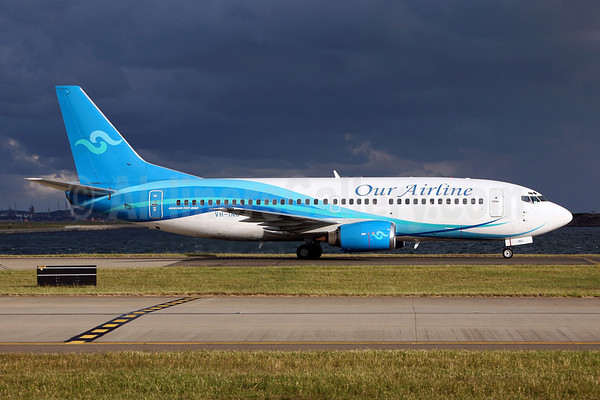
Our Airline to become Nauru Airlines on August 1

Our Airline (Nauru Air Corporation) (formerly Air Nauru) (Nauru and Brisbane) has decided to rebrand again. The flag carrier of the Republic of Nauru has decided to rename itself as Nauru Airlines effective August 1, 2014.

Read the full story from the Solomon Star: CLICK HERE

The airline is also adding a Boeing 737-300 freighter (VH-VLI, msn 27125) per ch-aviation.

Copyright Photo: John Adlard/AirlinersGallery.com. Boeing 737-3Y0 VH-INU (msn 23684) taxies at Sydney.

Our Airline:ย AG Slide Show

Our Airline logo

Route Map:

Our Airline 7.2014 Route Map

Air Mauritius has a profitable year, reversing two years of losses

Air Mauritius (Port Louis, Mauritius) posted a net profit of โ‚ฌ7.3 million ($9.9 million) for its fiscal financial year ending on March 31, 2014.

These positive results marked the return to profit of the national airline over a full financial year after two consecutive loss making years.

Air Mauritius has benefitted from its transformation program named “7 Step Plan” which was launched in February 2012. This program, which is on-going, encompasses four “Recovery Steps” and three “Game Changers”. The former relate to our network and fleet, commercial and revenue management, cash improvement and asset rationalization. According to the carrier, “The Game Changers aim at ensuring long term sustainability and involve re-fleeting, improving quality of service and harnessing our human capital.”

“Re-balancing growth to emerging markets was further strengthened during financial year 2012-13. Air Mauritius has rationalized its network and now offers more choice and flexibility to its passengers by serving hubs while flying directly to 20 destinations in Europe, Asia, Africa, Australia and the South West Indian Ocean region. We have also reinforced our gateways to Africa, Asia and Australia while concentrating our network around hubs in Paris, Kuala Lumpur, Johannesburg, Nairobi and Perth with enhanced agreements with airline partners.”

Copyright Photo: John Adlard/AirlinersGallery.com. The Airbus A340s are being phase out. A340-312 3B-NAU (msn 076) lands in Sydney.

Air Mauritius:ย AG Slide Show


QANTAS Airways to bring the Airbus A380 to Dallas/Fort Worth

QANTAS Airways (Sydney) has announced that its Dallas/Fort Worth (DFW) to Sydney service will be served with the Airbus A380 superjumbo aircraft starting on September 29. The upgrade to the Airbus A380 will mean that the longest scheduled commercial flight in the world will now be served by the largest passenger jet in the world.

Given the additional range of the A380, the QANTAS DFW to Australia service will now operate nonstop to Sydney rather than via Brisbane. The new A380 service will operate six flights per week between Dallas/Fort Worth and Sydney (every day except Tuesdays), representing a net increase of seats on the route by 10 percent per week.

The announcement means DFW will host Airbus A380 flights from two carriers, the other being Emirates Airline, starting in the fall. Those aircraft will utilize two gates, D15 and D16, and will be served utilizing three passenger jet bridges.

DFW Airport is currently finalizing preparations for the arrival of the A380 with the construction of a second level jet bridge in Terminal D and modifications to the airfield, ramps and taxiways. Terminal D opened in 2005 with A380 capabilities already built into its design, so the final additions to make DFW ready for the A380 are relatively minor.

DFW offers nonstop service to 56 international destinations and 147 cities in the U.S. with every major city in the U.S., Canada and Mexico within a four-hour flight. For Qantas customers, DFW provides the best routing to more than 100 destinations in the United States, Canada and Mexico.

Copyright Photo: John Adlard/AirlinersGallery.com. Airbus A380-842 VH-OQA (msn 014) taxies at Sydney.

QANTAS Airways:ย AG Slide Show

Philippines introduces the Boeing 777-300 ER to the Manila-Los Angeles route

Philippines (Philippine Airlines) (Manila) today (May 3) introduces the Boeing 777-300 ER on the Manila-Los Angeles route.

Copyright Photo: John Adlard/AirlinersGallery.com. Boeing 777-36N ER RP-C7777 (msn 37709) arrives down under in Sydney, Australia.

Philippines:ย AG Slide Show

Jetstar Airways announces new Brisbane-Honolulu flights starting on December 15

Jetstar Airways (Australia) (Melbourne) has announced new nonstop service between Brisbane and Honolulu starting on December 15, 2014.

The route will be operated by Airbus A330 aircraft up to three times a week during the peak season with two weekly services in the off peak.

The new Honolulu route will be the second wide body service from Brisbane following the start of nonstop services to Bali later this month to be operated by the Boeing 787 Dreamliner.

Flights will depart from Brisbane on Tuesdays and Fridays with services operating from Honolulu on Mondays and Thursdays.

The third service for peak season will operate on a Sunday. The route will eventually be operated by the Boeing 787 Dreamliner as Jetstar continues to take delivery of more aircraft.

Copyright Photo: John Adlard/AirlinersGallery.com. Airbus A330-202 VH-EBA (msn 508) taxies at Sydney.

Jetstar Airways:ย AG Slide Show


QANTAS Airways responds to untrue claims against the carrier

QANTAS Airways (Sydney) has issued this “Questions and Answers” statement concerning industry rumors about the carrier:

CLAIM: Qantas aircraft are less safe when serviced at overseas heavy maintenance facilities.

FACT:ย This is not true. The aviation industry is one of the most highly regulated industries in the world. All maintenance on Australian aircraft needs to be conducted at facilities approved by Australiaโ€™s aviation safety regulator, CASA.

The unionโ€™s claims are actually more than 10 years old. They have already been investigated by Qantas and CASA, and the facilities continue to be approved by CASA and used by the world’s leading airlines.

This particular union has repeatedly played the safety card against Qantas and was found in the Federal Court to be using safety claims to pursue industrial issues.

The majority of Qantasโ€™ maintenance is done in Australia. Our A380s and B747s have their heavy maintenance conducted overseas at world-class heavy maintenance facilities. Regardless of geography, all our maintenance is done at facilities approved by CASA and to Qantasโ€™ high standards.

As with all elements of aviation, there are multiple fail-safes to account for the very small amount of human error that may occur โ€“ so suggesting any mistake is a potential catastrophe is alarmist and disingenuous.

CLAIM: Qantas does not have oversight of the maintenance conducted at overseas facilities.

FACT:ย Qantas sends teams of employees from our Engineering division to oversee heavy maintenance conducted outside of Australia, including senior managers and support staff. The senior manager is often an experienced Licenced Aircraft Maintenance Engineer.

All maintenance on Qantas aircraft that is conducted at overseas facilities is done to Qantasโ€™ high standards and at facilities approved by CASA.

CLAIM: The safety of a Qantas Aircraft was jeopardised by maintenance conducted in Hong Kong in 2008 with engine the engine not bolted on correctly.

FACT:ย Qantas disputes the unionโ€™s interpretation of this incident and categorically rejects suggestions that the safety of the aircraft was at risk as a result of what was a minor maintenance issue.

Firstly the issues relate to washers โ€“ not bolts. One engine had three of the eight washers installed upside down. Two engines had one washer installed instead of two on the bolts. (Note โ€“ Boeing recommends only one washer to be used.)

While this was not in strictly keeping with Qantas maintenance manual, it had no bearing on the safety of the aircraft at all. This was looked at by CASA at the time and found no need to investigate further.

The claim that the engines could have fallen off the aircraft during the flight as a consequence is false and alarmist.

CLAIM: Qantas executives have enjoyed massive pay increases, taking executive packages to a ratio of 140:1 to Qantas workerโ€™s wages.

FACT:ย Qantas executives have not had โ€˜massive pay increasesโ€™. In fact, executive pay has decreased since 2010. Alan Joyce will take home 36 per cent less this year compared to last year and there is currently a bonus and pay freeze in place for executives and all employees. The Qantas Board has also taken a reduction in fees.

Qantas is not aware how the union came up with the 140:1 ratio, however it is incorrect.

CLAIM: Half of Qantas workers earn less than $50,000 a year.

FACT:ย The claim that half of Qantas employees earn less than $50,000 a year is completely false. Less than 10 per cent of Qantas employees earn less than $50,000 and this includes both full time and part time employees. The majority of part time workers also earn more than $50,000 a year.

CLAIM: Hangar 245 in Sydney was vacated in 2006 and has been empty ever since.

FACT:ย This is not true. We have invested millions of dollars upgrading the hangar and it is currently being used by our line maintenance engineers.

Copyright Photo: John Adlard/AirlinersGallery.com. Boeing 737-838 VH-XZJ (msn 39365) in the Mendoowoorrji special livery taxies at the Sydney hub.

QANTAS Airways:ย AG Slide Show

Jetstar Airways to launch Melbourne-Ayers Rock flights on June 29

Jetstar Airways (Melbourne) has announced it will commence a four times weekly return service between Melbourne and Ayers Rock Airport (Uluru) from June 29, 2014.ย Jetstarโ€™s existingย Sydney-Uluru route will increase to daily service from June 28, 2014.

Copyright Photo: John Adlard/AirlinersGallery.com. Airbus A320-232 VH-VQP (msn 2573) arrives in Sydney.

Jetstar Airways:ย AG Slide Show