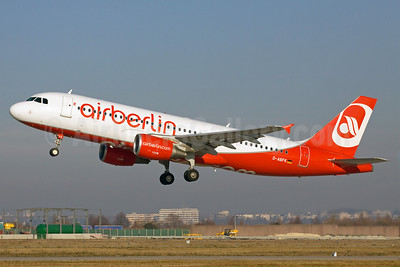
Tag Archives: Airberlin

Germania to end its Boeing 737-700 wet lease agreement with Airberlin

Germania Fluggesellschaft (Berlin-Tegel) will end its wet-lease agreement with Airberlin (airberlin.com) (Berlin-Tegel) for two Boeing 737-700s (D-ABLB and D-AGEN) on October 31 per ch-aviation.

Copyright Photo: Paul Bannwarth/AirlinersGallery.com. Operated by Germania for Airberlin, Boeing 737-75B D-AGEN (msn 28100) approaches Zurich for landing.

Airberlin:ย AG Slide Show

Germania:ย AG Slide Show

Airberlin narrows its second quarter loss

Airberlin (airberlin.com) (Berlin) narrowed its second quarter loss to 8.1 million euros ($10.8 million), down from a loss of 29.4 million euros for the same quarter a year ago. The airline has been downsizing, eliminating 300 positions.

The company issued this statement:

In the second quarter of 2013, Airberlin improved its operating result (EBIT) despite a difficult market environment. Airberlin was able to increase EBIT (earnings before interest and taxes) to EUR -8.1 million, an improvement of two-thirds over the corresponding quarter of 2012 (EUR -29.4 million). EBITDAR (earnings before interest, taxes, depreciation, amortization, and leasing expenses and rentals) increased by 12 percent to EUR 166.4 million (2012: EUR 148.0 million). Despite a noticeable eight percent capacity reduction, Airberlin’s total revenue at EUR 1.11 billion remained at the level of the previous year (EUR 1.13 billion). Airberlin reduced its net loss for the second quarter to EUR -38.0 million, an improvement of almost two-thirds over the previous yearโ€™s corresponding quarter (EUR -99.8 million).

Increased capacity utilization, RASK and Yield

In the second quarter, Airberlin further increased its capacity utilization, revenue per available seat kilometer (RASK) and revenue per passenger. The number of routes flown in the second quarter decreased from 520 in 2012 to 440 in the current year, while the number of route frequencies increased by 14 percent. Capacity utilization increased by four percentage points, to 83.7 percent (previous year: 79.7 percent). Revenue per available seat kilometer (RASK) increased by 4.8 percent to 7.20 Eurocents (previous year: 6.87 Eurocents). Average yield (revenue per passenger) increased to EUR 113.74 (previous year: EUR 112.85).

Presenting the second quarter results for 2013, Airberlin’s CEO Wolfgang Prock-Schauer comments: “An improved operating income, increased capacity utilization, increasing revenue per seat kilometer and stable revenue despite capacity reduction, demonstrate that important key numbers are moving in the right direction. The positive effects of our Turbine program will bear fruit later in the year. As a result of the generally muted economic conditions and the market environment, the ability to reach our targets is becoming increasingly challenging.”

Turbine implementation according to plan

The implementation of Turbine is continuously progressing according to plan, and will due to increasing challenges continue to be advanced as a matter of priority over the course of the year. The focus remains on increasing efficiency, expanding services, and negotiating with relevant stakeholders.

Airberlin has concluded new collective labor agreements with all relevant employees. This is the first time that uniform collective labor agreements have been concluded for all pilots and respectively for all cabin crew. These long-term collective agreements enable planning reliability and give Airberlin the required flexibility for further restructuring and increasing productivity. Personnel cutbacks are proceeding as planned, and by the end of July, Airberlin had eliminated 300 full-time positions.

Wolfgang Prock-Schauer comments: “The Turbine program is progressing as planned. The negotiations with our contracting partners have yielded productive results, and we are continuously optimizing our structure and our operating performance. More than 80 percent of the Turbine program’s planned contribution for 2013 has already been attained, with respect to both earnings and costs. Despite the challenging environment, we continue to strive to reach the target figure of EUR 200 million for 2013. For the coming winter flight plan, we will implement a streamlined concept of aircraft-positioning, in order to use our fleet even more efficiently.โ€

Improved liquidity

At the end of the first half-year, Airberlin had liquid assets amounting to EUR 436.8 million at its disposal, those assets having grown by more than one-third from EUR 315 million in the first half-year of 2012. Equity capital at the end of the traditionally weak first half-year amounted to EUR -116.3 million as at the reporting date of 30 June. As a valuation at the reporting date according to IFRS, equity capital has no impact on the economic operation of the company.

Airberlin’s Chief Financial Officer Ulf Hรผttmeyer explains: “The traditionally weak earnings position in the first six months together with the non-recurring charges stemming from our turnaround program lead to negative equity capital. We expect the equity capital to increase over the following quarters. The target of reaching an equity capital ratio of 15 to 20 percent in the medium-term remains unchanged.”

Partnerships exceed expectations

In the second quarter, the strategic partnership with Etihad Airways (Abu Dhabi) again delivered strong growth in the number of Airberlin passengers stemming from the code-share flights. The number of passengers more than tripled from 75,000 in 2012 to 267,000, based on a half-year comparison. With 449,000 passengers – this includes bookings made through July – the expectations for the entire year for the common code-share routes of Etihad Airways and Airberlin have already been exceeded. Furthermore, Airberlin is benefitting from code-share agreements with partners of Etihad Airways’ “Equity Alliance”, including Virgin Australia, Air Seychelles and Air Serbia. Airberlin and Etihad Airways are also expanding their cooperation in other fields such as maintenance and procurement.

The number of passengers traveling onย oneworldยฎย alliance flights likewise exceeded expectations. In the first half of the year, 267,000 passengers had already traveled on code-share flights operated by Airberlin and itsย oneworld partners.

Read the analysis by Reuters: CLICK HERE

Copyright Photo: Pedro Pics/AirlinersGallery.com. Boeingย 737-7Q8 D-ABBW (msn 30642) taxies at London (Stansted).

Airberlin:ย AG Slide Show

Airberlin and Jat Airways begin code sharing on August 1

Airberlin (airberlin.com) (Berlin) and Jat Airways (Belgrade), the national airline of the Republic of Serbia, will offer their passengers selected flights under shared flight numbers, subject to government approvals. The codeshare agreement is valid for flights from August 1, 2013.

Under the agreement, Airberlin will offer the nonstop Jat Airways flights between Belgrade and Berlin, Dusseldorf, Frankfurt and Stuttgart under an AB flight number, thereby expanding their route range in South East Europe.

In return, Jat Airways passengers will be able to connect from Berlin, Dusseldorf, Frankfurt and Stuttgart to numerous Airberlin German domestic flights. From Airberlinโ€™s hub in Berlin there will be further codeshare flights to prime destinations in Northern Europe to cities such as Copenhagen, Oslo and Stockholm.

Top Copyright Photo: Ton Jochems/AirlinersGallery.com. Airberlin’s Boeing 737-86J D-ABMC (msn 37752) in the Oneworld color scheme taxies to the gate at Palma de Mallorca.

Airberlin:ย AG Slide Show

Jat Airways:ย AG Slide Show

Bottom Copyright Photo: Keith Burton/AirlinersGallery.com. Jat Airways’ Boeing 737-3H9 YU-AND (msn 23329) prepares to land at London (Heathrow).

Virgin Australia starts its new code share agreement with Airberlin

Virgin Australia Airlines (Brisbane) has announced a reciprocal code share and frequent flyer agreement with Airberlin (Berlin), Germanyโ€™s second largest airline.

The code share flights commence on August 1, 2013, subject to government approval, Virgin Australia will code share on Airberlinโ€™s daily direct services from Abu Dhabi to Dusseldorf and Berlin. Airberlin will also code share on Virgin Australiaโ€™s Abu Dhabi to Sydney service, its Phuket to Perth service and on nine of its domestic services within Australia.

As part of the new agreement, members of Virgin Australiaโ€™s loyalty program Velocity Frequent Flyer and Airberlinโ€™s top bonus program will receive reciprocal benefits, with the ability to earn and redeem Points or miles, regardless of which airline is operating the flight.

Airberlin operates daily direct services between Abu Dhabi and Berlin and between Abu Dhabi and Dusseldorf. The Airbus A330-200 operated services offer Full Flat seats with a massage function and 15 inch LED monitors in Business Class ensuring a superior level of comfort. In Economy Class, Airberlin offer new seats with anti-thrombosis cushions, a complimentary drinks service and a new in-seat entertainment system.

Top Copyright Photo: John Adlard/AirlinersGallery.com. Airbus A330-243 VH-XFC (msn 1293) arrives at the Sydney hub.

Virgin Australia:ย AG Slide Show

Airberlin:ย AG Slide Show

Bottom Copyright Photo: Ton Jochems/AirlinersGallery.com. Airbus A330-223 D-ABXA (msn 288) in the Oneworld scheme taxies to the runway at Palma de Mallorca.

Etihad Airways to recruit 50 pilots from Airberlin, enters a new relationship with KLM

Etihad Airways (Abu Dhabi) has announced it will recruit around 50 pilots from partner Airberlin (Berlin) which has been downsizing. The carrier issued this statement:

The move comes as Airberlin, Germanyโ€™s second largest carrier, continues to work through its Turbine business turnaround program, and as Etihad Airways prepares for significant international expansion.

The recruitment transfers began in April when the first batch of six Boeing 737-rated First Officers arrived inย Abu Dhabiย to start type conversion training on to the Boeing 777 at Etihad Airwaysโ€™ Flight Training Centre.

Upon successful completion, the six pilots will undertake line training on the airlineโ€™s global network, before being fully licensed as type-rated Boeing 777 First Officers.

Further pilot transfers will take place in the coming months, comprising Airbus A320 Captains, Airbus A320 First Officers, Airbus A330 First Officers and Boeing 777 non-rated First Officers.

Etihad Airwaysโ€™ current fleet of 77 Boeing and Airbus aircraft will grow significantly this decade with more than 90 firm order aircraft scheduled for delivery.

Over the next 12 months the carrier will take delivery of four Boeing 777-300 ERs, five Airbus A320s, one Airbus A321, one Airbus A330-200 and one Airbus A330-200 freighter aircraft.ย  Late next year, Etihad Airways will also introduce its first Airbus A380 and Boeing 787 Dreamliner aircraft.

Etihad Airways currently employs over 1,400 pilots, and plans to recruit 1,000 more by 2020.

In other news, Etihad has announced it has entered the second phase of its strategic partnership with KLM Royal Dutch Airlines (Amsterdam) following the launch of new Amsterdam service. The airline issued this statement:

The daily service, operated by a two cabin Airbus A330-200 and configured to carry 262 passengers with 22 in Pearl Business Class and 240 in Coral Economy Class, was launched on May 15 and carries KLMโ€™s KL code.

The launch of the new flights coincides with the addition of 12 new KLM destinations out of Schiphol Airport which now carry Etihad Airways EY code. KLM has also added its KL code to a further six Etihad Airways destinations from its Abu Dhabi hub.

The 12 additional destinations that Etihad Airways customers can now access through codeshare operations with KLM are Stockholm, Aberdeen, Barcelona, Bergen, Birmingham, Copenhagen, Edinburgh, Glasgow, Gothenburg, Helsinki, Leeds/Bradford and Madrid.

These cities join the first phase of cities served by KLM, which carry the EY code, Billund, Cardiff, Newcastle, Oslo, and Stavanger.

KLM now has its KL code on six Etihad Airwaysโ€™ flights to Abu Dhabi, Brisbane, Khartoum, Male, Muscat and Seychelles.

These join the initial group of cities served by Etihad Airways โ€“ Colombo, Islamabad, Lahore, Melbourne, and Sydney โ€“ which also carry the KL code.

In addition to flight operations Etihad Airways has this year wet-leased a Boeing 747-400 freighter from KLM. This aircraft, with a payload capacity of 124 tons, links the two cargo hubs of Abu Dhabi and Amsterdam, and increases our capacity to Frankfurt, Hong Kong and Dhaka.

From KLMโ€™s partner, Air France, Etihad Airways has also wet-leased an Airbus A340-300 for use on the Paris-Abu Dhabi route from now until the end of the year.

Amsterdam joins a group of 17 leading European cities that Etihad Airways flies to including Brussels, Dublin, Frankfurt, Geneva, London and Paris.

Copyright Photo: Arnd Wolf. Etihad Airways’ย Airbus A330-243 A6-EYE (msn 688) (Manchester City Football Club) arrives at Munich.

Video: Etihad Airways.

Etihad Airways:ย AG Slide Show

Frameable Color Prints and Posters:ย AG All Photos Available

Airberlin:ย AG Slide Show

KLM Royal Dutch Airlines:ย AG Slide Show

Airberlin returns to profitability, produces a $8.7 million net profit for 2012

Airberlin (airberlin.com) (Berlin) has announced its financial results for 2012. The company has returned to profitability and issued this statement:

  • Net result of EUR 6.8 million ($8.7 million), 33.3 million guests
  • Group revenue of EUR 4.31 billion, capacity utilization and yield increased
  • Strategic partnership with Etihad Airways provides joint revenue of EUR 100 million, new code share routes expected to provide further growth
  • First โ€œTurbineโ€ measures started – EUR 400 million until the end of 2014
  • 180 positions already cut between January and the end of March 2013
  • As of summer 2013, the Berlin and Dusseldorf hubs will be strengthened with increased flight frequencies and new destinations
  • Revenue growth with fewer routes and increased frequencies: routes will be reduced from 523 in summer 2012 to 438 in summer 2013.
  • Fleet reduction by twelve aircraft to 143 aircraft by the end of 2013
  • The goal for 2013 is operational profitability, break-even at the EBIT level

Over the first months of the year, Airberlin, Germanyโ€™s second-largest airline, implemented numerous measures of the โ€œTurbineโ€ turnaround program. At the press conference on the 2012 results, airberlinโ€™s CEO Wolfgang Prock-Schauer stated: โ€œWith Turbine, we are setting up airberlin in line with the market. We are becoming leaner, faster and are, at the same time, continuously improving our service and flight offers. In the first months of 2013, we have initiated a number of measures. It goes without saying that such programs have a start-up phase and start-up costs. We will reach โ€˜cruising altitudeโ€™ by the end of 2014.โ€

This two-year program will enable Germanyโ€™s second-largest airline to further expand its presence in core markets and to make structural changes aimed at making the company sustainably fit for the future. For that purpose, airberlin will further promote its integrated business model through which the company caters to tourist travelers and business clients. Up to the end of 2014, the Turbine program includes initiatives of approximately EUR 400 million, so as to achieve a sustainably competitive profit situation.

Turbine program with multiple measures started

The turnaround program comprises in particular the areas network and fleet, sales & distribution, products and services as well as operations. The first Turbine measures have already been implemented in this yearโ€™s summer flight schedule. The optimized offer strengthens airberlinโ€™s presence in Europe and further expands the long-haul connections to North America. Airberlin is carrying out the network optimization by using the principle of increasing frequencies on economically profitable routes. The target is a robust network that is less susceptible to seasonal fluctuations and provides for more productive aircraft and personnel. As a result the airline is strengthening its long-haul hubs Berlin and Dusseldorf with additional long-haul frequencies and improved flight connections. These will increase in Berlin from ca. 7,600 to ca. 11,000, and in Dusseldorf from ca. 3,000 to ca. 4,050. At both airports, the number of weekly flight frequencies will grow by a total of 61 additional connections as compared to the previous year. At the same time airberlin has reduced economically unprofitable routes, with the number of routes decreasing from 523 to 438 on an annual comparison. With the optimized flight schedule, the fleet will be reduced from 155 aircraft at the end of 2012, to 143 aircraft at the end of 2013.

Network and station optimization will result in increased crew productivity. In the future, comprehensive aircraft maintenance (Base Maintenance) will only be carried out in Munich.

In connection with the restructuring cost reductions in personnel are necessary. Between January and the end of March 2013, 180 jobs will have been eliminated.

Airberlin is expanding its service in line with passenger requirements. From mid-year onwards, a modular catering concept will be introduced on the short and medium-haul flights. This will provide passengers with services commensurate with the duration of the flight. An example is the new Business Class seats introduced on long-haul flights.

Net profit for 2012

Airberlin concluded the 2012 business year with a return to profitability. The operating profit before interest and taxes (EBIT) of EUR 70.2 million was a significant improvement over the previous year results. The companyโ€™s net income of EUR 6.8 million marks a return to profitability and follows a loss of reported EUR 271.8 (restated: -420.4 million) in the 2011 business year.

In the past year, airberlin increased its group revenue to EUR 4.31 billion (2011: EUR 4.23 billion). While the number of passengers decreased by 5.5 per cent to 33.3 million (previous year: 35.3 million), capacity utilisation increased by 1.6 percentage points to 79.80 per cent (previous year: 78.21 per cent). This was achieved by a further fleet reduction of 15 aircraft to 155 aircraft and improvements of the flight schedule. Yield (revenue per passenger) improved by 7.7 percent to EUR 120.05 (previous year: EUR 111.43).

The spin-off of the frequent-flyer program โ€œtopbonusโ€, the implementation of the efficiency program โ€œShape & Sizeโ€ and the increasing synergy effects resulting from the strategic partnership with Etihad Airways have contributed to the positive development of the operating result. In this context, Shape & Size has contributed EUR 250 million.

โ€œThe profit of the past financial year and the successful placement of the convertible bond enabled us to further stabilize the financial basis of the company. The favorable conditions, the swift placement and over-subscription of the bond demonstrate the marketโ€™s confidence in our company,โ€ stated Airberlinโ€™s Chief Financial Officer, Ulf Hรผttmeyer. The goal for 2013 is a break-even at the EBIT level and therefore operational profitability.

The strategic partnership with Etihad Airways, which started at the beginning of 2012, has already shown positive effects within less than 12 months. By the end of 2012, codeshare routes enabled the two airlines to generate together a revenue increase of EUR 100 million. airberlin and Etihad Airways have already concluded almost 100 agreements with companies and sales partners and through synergies have further increased revenue and reduced operating costs. By further expanding codeshare routes with other Etihad Airways partners, airberlin will be able in the future to offer more destinations and increase revenue generated by codesharing. Furthermore, the strategic partnership is increasingly reducing costs for both airlines. For example, in the areas of procurement, maintenance, training and product harmonization, the two airlines are increasingly making use of their synergy potentials and expect these to reach their full potential in the coming years.

Global network established

Wolfgang Prock-Schauer assesses the advantages of the strategic partnership with Etihad Airways: โ€œOur cooperation with Etihad Airways exceeds all our expectations.โ€ This cooperation enabled airberlin to set up a global route network in the course of the past year. Within one year, Etihad Airways and airberlin have increased the number of codeshare routes to 90 connections and are flying to a combined 239 destinations in 77 countries. In 2012 alone, more than 320,000 passengers used the common flight network.

Airberlinโ€™s membership in the global airline alliance,ย oneworldยฎ, which started in March 2012, is also positive. The number of passengers traveling on these codeshare routes increased to 310,000 passengers.

Airberlin CEO Wolfgang Prock-Schauer added: โ€œOur optimized route network together with the global network of our partners will enable us to be sustainably successful in the future. For that purpose, we need a functional hub in Berlin and the new airport BER that adheres to the operating times as foreseen in the official planning.โ€

Copyright Photo: Ole Simon.ย Airbus A320-214 D-ABFK (msn 4433) climbs away from Stuttgart.

Airberlin:ย AG Slide Show

Airberlin downsizes its tourist hub at Nuremberg

Airberlin 737-800 WL D-ABBF (08)(Grd) NUE (GM)(LRW)

Airberlin (airberlin.com) (Berlin) is working to trim its unprofitable routes. The carrier has announced it is downsizing ย its mainly tourist hub at Nuremberg for the coming winter schedule. The carrier will retain some holiday routes to southern destinations.

Read the full report (in German) byย Bayerischer Rundfunk: CLICK HERE

Copyright Photo: Gunter Mayer. Boeing 737-86J D-ABBF (msn 32917) taxies to the gate at NUE.

Airberlin:ย AG Slide Show

Airberlin returns to profitability with a net profit of $8.8 million in 2012

ย 

Airberlin (airberlin.com) (Berlin) is enjoying a financial turnaround. The company recorded a record net profit of $8.8 million in 2012. The company issued this statement:
  • Net result of EUR 6.8 million, 33.3 million guests
  • Group revenue of EUR 4.31 billion, capacity utilization and yield increased
  • Strategic partnership with Etihad Airways provides joint revenue of EUR 100 million, new code share routes expected to provide further growth
  • First โ€œTurbineโ€ measures started – EUR 400 million until the end of 2014
  • 180 positions already cut between January and the end of March 2013
  • As of summer 2013, the Berlin and Dusseldorf hubs will be strengthened with increased flight frequencies and new destinations
  • Revenue growth with fewer routes and increased frequencies: routes will be reduced from 523 in summer 2012 to 438 in summer 2013.
  • Fleet reduction by twelve aircraft to 143 aircraft by the end of 2013
  • The goal for 2013 is operational profitability, break-even at the EBIT level

Over the first months of the year, airberlin, Germanyโ€™s second-largest airline, implemented numerous measures of the โ€œTurbineโ€ turnaround program. At todayโ€™s press conference on the 2012 results, airberlinโ€™s CEO Wolfgang Prock-Schauer stated: โ€œWith Turbine, we are setting up airberlin in line with the market. We are becoming leaner, faster and are, at the same time, continuously improving our service and flight offers. In the first months of 2013, we have initiated a number of measures. It goes without saying that such programs have a start-up phase and start-up costs. We will reach โ€˜cruising altitudeโ€™ by the end of 2014.โ€

This two-year program will enable Germanyโ€™s second-largest airline to further expand its presence in core markets and to make structural changes aimed at making the company sustainably fit for the future. For that purpose, airberlin will further promote its integrated business model through which the company caters to tourist travelers and business clients. Up to the end of 2014, the Turbine program includes initiatives of approximately EUR 400 million, so as to achieve a sustainably competitive profit situation.

Turbine program with multiple measures started

The turnaround program comprises in particular the areas network and fleet, sales & distribution, products and services as well as operations. The first Turbine measures have already been implemented in this yearโ€™s summer flight schedule. The optimized offer strengthens airberlinโ€™s presence in Europe and further expands the long-haul connections to North America. airberlin is carrying out the network optimization by using the principle of increasing frequencies on economically profitable routes. The target is a robust network that is less susceptible to seasonal fluctuations and provides for more productive aircraft and personnel. As a result the airline is strengthening its long-haul hubs Berlin and Dusseldorf with additional long-haul frequencies and improved flight connections. These will increase in Berlin from ca. 7,600 to ca. 11,000, and in Dusseldorf from ca. 3,000 to ca. 4,050. At both airports, the number of weekly flight frequencies will grow by a total of 61 additional connections as compared to the previous year. At the same time airberlin has reduced economically unprofitable routes, with the number of routes decreasing from 523 to 438 on an annual comparison. With the optimized flight schedule, the fleet will be reduced from 155 aircraft at the end of 2012, to 143 aircraft at the end of 2013.

Network and station optimization will result in increased crew productivity. In the future, comprehensive aircraft maintenance (Base Maintenance) will only be carried out in Munich.

In connection with the restructuring cost reductions in personnel are necessary. Between January and the end of March 2013, 180 jobs will have been eliminated.

Airberlin is expanding its service in line with passenger requirements. From mid-year onwards, a modular catering concept will be introduced on the short and medium-haul flights. This will provide passengers with services commensurate with the duration of the flight. An example is the new Business Class seats introduced on long-haul flights.

Net profit for 2012

Airberlin concluded the 2012 business year with a return to profitability. The operating profit before interest and taxes (EBIT) of EUR 70.2 million was a significant improvement over the previous year results. The companyโ€™s net income of EUR 6.8 million marks a return to profitability and follows a loss of reported EUR 271.8 (restated: -420.4 million) in the 2011 business year.

In the past year, Airberlin increased its group revenue to EUR 4.31 billion (2011: EUR 4.23 billion). While the number of passengers decreased by 5.5 per cent to 33.3 million (previous year: 35.3 million), capacity utilisation increased by 1.6 percentage points to 79.80 per cent (previous year: 78.21 per cent). This was achieved by a further fleet reduction of 15 aircraft to 155 aircraft and improvements of the flight schedule. Yield (revenue per passenger) improved by 7.7 percent to EUR 120.05 (previous year: EUR 111.43).

The spin-off of the frequent-flyer program โ€œtopbonusโ€, the implementation of the efficiency program โ€œShape & Sizeโ€ and the increasing synergy effects resulting from the strategic partnership with Etihad Airways have contributed to the positive development of the operating result. In this context, Shape & Size has contributed EUR 250 million.

โ€œThe profit of the past financial year and the successful placement of the convertible bond enabled us to further stabilize the financial basis of the company. The favorable conditions, the swift placement and over-subscription of the bond demonstrate the marketโ€™s confidence in our company,โ€ stated airberlinโ€™s Chief Financial Officer, Ulf Hรผttmeyer. The goal for 2013 is a break-even at the EBIT level and therefore operational profitability.

The strategic partnership with Etihad Airways, which started at the beginning of 2012, has already shown positive effects within less than 12 months. By the end of 2012, codeshare routes enabled the two airlines to generate together a revenue increase of EUR 100 million. airberlin and Etihad Airways have already concluded almost 100 agreements with companies and sales partners and through synergies have further increased revenue and reduced operating costs. By further expanding codeshare routes with other Etihad Airways partners, airberlin will be able in the future to offer more destinations and increase revenue generated by codesharing. Furthermore, the strategic partnership is increasingly reducing costs for both airlines. For example, in the areas of procurement, maintenance, training and product harmonization, the two airlines are increasingly making use of their synergy potentials and expect these to reach their full potential in the coming years.

Global network established

Wolfgang Prock-Schauer assesses the advantages of the strategic partnership with Etihad Airways: โ€œOur cooperation with Etihad Airways exceeds all our expectations.โ€ This cooperation enabled Airberlin to set up a global route network in the course of the past year. Within one year, Etihad Airways and Airberlin have increased the number of codeshare routes to 90 connections and are flying to a combined 239 destinations in 77 countries. In 2012 alone, more than 320,000 passengers used the common flight network.

Airberlinโ€™s membership in the global airline alliance,ย oneworldยฎ, which started in March 2012, is also positive. The number of passengers traveling on these codeshare routes increased to 310,000 passengers.

Airberlin CEO Wolfgang Prock-Schauer added: โ€œOur optimized route network together with the global network of our partners will enable us to be sustainably successful in the future. For that purpose, we need a functional hub in Berlin and the new airport BER that adheres to the operating times as foreseen in the official planning.โ€

Copyright Photo: Andi Hiltl. The Niki name is being kept alive at the Austrian subsidiary of Airberlin while assuming the brand colors of the parent.ย Niki-The Spirit of Niki (flyniki.com) Airbus A320-214 OE-LEX (msn 2867) arrives at Zurich.


Airberlin:ย AG Slide Show

Niki:ย AG Slide Show

Airberlin returns to profitability with a net profit of $8.97 million in 2012

Airberlin (Berlin) has returned to the black with a reported $8.97 million net profit in 2012.

Read the full report from the airline: CLICK HERE

Copyright Photo: Mark Durbin. Airbus A330-223 D-ALPI (msn 828) in the delayed Berlin Brandenburg Airport scheme taxies at San Francisco.

Airberlin:ย AG Slide Show

Airberlin to cut 900 positions in order to become profitable again

Airberlin (airberlin.com) (Berlin)ย plans to eliminate almost 10 percent of its workforce of 9,300 (900 jobs) as part of a cost-cutting campaign designed to eliminate is continuing yearly losses.

Airberlin hopes to achieve $535 million in annual savings by the end of 2014. The airline has not posted an annual profit since 2007.

The company issued the following statement today about its “Lean and Smart” “Turbine” turnaround program:

Today Airberlin began to implement its “Turbine” turnaround program. This is a comprehensive scheme to ensure that Germany’s second largest airline focuses on its key markets on the basis of a stringent business model. The two-year program extends across all divisions. The airline will be expediting the optimization of its network, fleet and timetables already under way, improve its offering, sales and customer orientation and slim down its administration and working processes as well. “Turbine” has defined initiatives of around 400 million euros by the end of 2014 to achieve a lastingly competitive result.

Efficient operations, greater cost-efficiency and an attractive, intelligent offering are designed to make airberlin profitable and achieve a sustainable future. That is why the company will continually improve its integrated business model for serving leisure and business customers. The entire change process instituted by “Turbine” will develop the company on the basis of “Lean & Smart” criteria. In this context “Lean” signifies the simplest and most cost-efficient organization possible in conjunction with streamlined processes. “Smart” shifts the focus onto core markets and partnerships as well as towards integrated, intelligent and innovative customer orientation offering “that little bit extra”.

Meetings with staff representatives to discuss the turnaround programme and the planned personnel measures have already begun. airberlin’s management will be implementing “Turbine” in conjunction with employees and on the basis of a constructive dialogue with the employee representatives and will be giving these discussions top priority over the next few months.

The program covers all areas of operation and relationships with business partners as well. It also involves cutting about 900 jobs in which the possibility of redundancies cannot be excluded.

The elements that make up “Turbine” include network and fleet optimisations that have already been initiated, concentrating on profitable routes and increasing flight frequencies in key markets. These measures are specifically designed to strengthen Airberlin’s position in its core market, for example, the D/A/CH region (Germany, Austria and Switzerland). There will be even more flights to Palma de Mallorca. The hubs in Berlin and Dusseldorf with their long-haul services are to be expanded. The airports in Vienna, Hamburg, Munich, Zurich and Stuttgart will retain their function as principal stations within the Airberlin route network. Reducing the fleet to 142 aircraft in the current year, with six earmarked as operational reserves, and optimising the network go hand in hand with further fleet harmonization, stationing concentration and simpler rotation.

Airberlin already has a product with high customer acceptance and will be further enhancing this strong position with intelligent and customised services along its entire travel chain to delight its guests. The offering will continue to feature an excellent price-performance ratio, the “Airline with heart” brand image and trend-setting innovations. Airberlin is planning to concentrate its customer contacts in a single Customer Care section, to offer more technical opportunities for self service and to provide much-enhanced business class facilities on long-haul flights.

Copyright Photo: Javier Rodriguez. The diverse fleet will be reduced to 142 aircraft from 158. Airbus A321-211 D-ABCH (msn 4728) arrives at Palma de Mallorca which will seek further expansion in the AB system.

Airberlin:ย AG Slide Show