Cathay Pacific to relaunch Hong Kong-Zurich flights

Cathay Pacific Airways (Hong Kong) has announced that it will resume nonstop daily service from Hong Kong to Zurich on March 29, 2015.

The Zurich service will be operated by a Boeing 777-300 ER aircraft.

Copyright Photo: Ken Petersen/AirlinersGallery.com. This dramatic “in your face” runway action photo shows Boeing 777-367 ER B-KPF (msn 36832) in the special “Hong Kong – Asia’s world city” livery at New York (JFK).

Cathay Pacific:ย AG Slide Show

American Airlines and PSA Airlines show off the first American Eagle Bombardier CRJ900 at DFW

American Eagle-PSA (2nd) CRJ900 (13)(Flt)(PSA)(LRW)

American Airlines (Dallas/Fort Worth) and PSA Airlines (2nd) (US Airways Express and American Eagle) (Dayton) yesterday (May 20) showed off the first Bombardier CRJ900 (CL-600-2D24) to the media at Dallas-Fort Worth International Airport (DFW). The aircraft was flown by Bombardier.

The aircraft is not officially handed over to American and PSA and currently carries the temporary registration of C-GWGQ (msn 15317). This aircraft is the first of 30 CRJ900s that will be operated for American Eagle. The first delivery will be in June. The routes have not yet been specified.

The aircraft will be on display at the Dayton base today.

Bombardier issued this statement:

Bombardier Aerospace unveiled the first of 30 enhanced CRJ900 NextGen aircraft ordered by American Airlines Group Inc. in December 2013. The purchase agreement also included options on an additional 40 CRJ900 NextGen aircraft. The aircraft was unveiled to American Airlines employees and the media during a celebratory event on May 20 at Dallas/Fort Worth International Airport, and will be showcased ย in Dayton, Ohio the following day, to team members at American Airlines Groupโ€™s โ€™ wholly owned subsidiary, PSA Airlines, Inc. PSA Airlines will operate the 30 CRJ900 NextGen aircraft under the American Eagle brand.

American Airlines is the first customer to benefit from the latest enhancements to the CRJ900 NextGen regional jet, which provides up to 5.5 per cent fuel burn reduction over earlier-generation CRJ900 aircraft.

โ€œThe new Bombardier CRJ900 NextGen airliner will optimize our fleet to fly the right size aircraft to the appropriate markets and lower operating costs by replacing older aircraft,โ€ said Kenji Hashimoto, Senior Vice President โ€“ Regional Carriers, American Airlines. โ€œWith an impressive interior that allows us the flexibility to offer First Class, Main Cabin, as well as additional Main Cabin Extra seats, we are delighted to showcase our first CRJ900 NextGen aircraft in Dallas/Fort Worth and Dayton and look forward to introducing it to our customers later this year.โ€

โ€œIn addition to offering American Airlines significant fuel cost savings per aircraft, as well as outstanding operational flexibility, the CRJ900 NextGen aircraft will provide customers with an improved experience that includes bright cabins resulting from large windows and LED lighting as well as large overhead bins,โ€ said Ray Jones, Senior Vice President, Sales, Marketing and Asset Management, Bombardier Commercial Aircraft. โ€œTogether with the fuel burn enhancements and upgraded cabin amenities, we are firmly cementing the CRJ NextGen family of aircraft as the benchmark in regional aviation.โ€

The CRJ900 NextGen aircraftโ€™s advanced technologies include a conic-shaped exhaust nozzle that improves exhaust flow and reduces fuel consumption; various weight-saving initiatives; and a modern six-screen glass cockpit featuring the Rockwell Collins Pro Line IV integrated avionics suite, whose robust open architecture delivers reliable performance with growth capability to meet future communication, navigation, surveillance and air traffic management requirements.

As of March 31, 2014, Bombardier had recorded firm orders for 1,817 CRJ Series aircraft, including 343 CRJ900 and CRJ900 NextGen aircraft. Worldwide, CRJ Series aircraft are in service with more than 60 airlines and more than 30 customers operate corporate variants of the aircraft. The aircraft are operating in over 50 countries on six continents, and on average, a CRJ aircraft takes off every 10 seconds somewhere in the world. CRJ Series aircraft have transported more than 1.4 billion passengers and have logged more than 39 million flight hours and over 32 million takeoffs and landings.

Read the full story from the Dallas News: CLICK HERE

American Airlines (current):ย AG Slide Show

US Airways Express-PSA Airlines (2nd):ย AG Slide Show

PSA (2nd) 2014 logo

JetBlue announces two more routes from Fort Lauderdale/Hollywood

JetBlue Airways (New York) has announced two new nonstop routes from Fort Lauderdale-Hollywood International Airport to Cartagena, Colombia (CTG) and Las Vegas, Nevada (LAS). Both flights will begin on October 29, 2014, the same day the airline will also launch its new nonstop service to Pittsburgh.

These three upcoming routes are in addition to the six international routes already launched within the last year from JetBlue’s South Florida focus city. New international destinations include San Jose, Costa Rica; Lima, Peru; Port-au-Prince, Haiti; Port of Spain, Trinidad and Tobago; Montego Bay, Jamaica; and Punta Cana, Dominican Republic.

Copyright Photo: Bruce Drum/AirlinersGallery.com. Airbus A320-232 N510JB (msn 1280) approaches the runway at Fort Lauderdale-Hollywood International Airport (FLL) in the old Dots tail design and smaller aircraft titles.

JetBlue Airways:ย AG Slide Show

Boeing and Nok Air finalize the order for new Boeing 737s

Boeing (Chicago and Seattle) and Nok Airlines Public Company Limited (Nok Air) (Bangkok) have finalized an order for eight Next-Generation 737-800s (above) and seven 737 MAX 8s. Nok Air also announced that it intends to convert one of the 737-800s into a 737 MAX at a later date.

The order, first announced as a commitment at the Singapore Air Show in February, is valued at $1.45 billion at list prices and will establish Nok Air as the first airline in Thailand to operate the 737 MAX. While Nok Air currently operates a fleet of 15 Next-Generation 737s, this marks the airline’s first direct order with Boeing.

The 737 MAX now has 2,017 orders from 40 customers. The 737 MAX brings the most advanced engine technologies to the world’s best-selling airplane, building on the strengths of today’s Next-Generation 737. The 737 MAX incorporates the latest-technology CFM International LEAP-1B engines to deliver the highest efficiency, reliability and passenger comfort in the single-aisle market. Airlines operating the 737 MAX will see an 8 percent operating cost per seat advantage over tomorrow’s competition.

Copyright Photo: Richard Vandervord/AirlinersGallery.com. A beautiful takeoff photo of Nok Air’s (Bird Air in Thai) Boeing 737-86J HS-DBK (msn 37774) departing from Phuket in southern Thailand.

Nok Air:ย AG Slide Show

Air Canada today unveils its new Boeing 787 cabins

Air Canada 787 International Business Cabin 1 (Air Canada)(LRW)

Air Canada (Montreal) today (May 20) unveiled its brand new international interior product following the arrival in Toronto on Sunday of its first Boeing 787 Dreamliner.

“The new interiors and seating on the 787 Dreamliner will become Air Canada’s new international standard. As recently announced, we also plan to begin conversion in late 2015 of 12 Boeing 777-300 ER and six Boeing 777-200 LR aircraft to provide our customers a consistent product with the Boeing 787 Dreamliner. With the conversion of these 777 aircraft, we will introduce a much desired premium economy cabin and refurbish the International Business Class cabin to the new Boeing 787 state-of-the-art standards. The reconfiguration project is planned be completed in the second half of 2016,” continued Mr. Smith.

Air Canada will provide three cabins of service on board its Boeing 787 Dreamliners and converted 777 aircraft, highlighted by comfortable ergonomic seating that features 180-degree lie-flat seats in its International Business Class cabin (top photo). An extensive choice of in-flight entertainment on enhanced definition seat back touch screens will be available for all customers along with power outlets and USB ports.

“The introduction of 787 Dreamliner aircraft featuring our new standard of onboard product is a key component of Air Canada’s international expansion plans that include the development of Toronto Pearson into a preferred North American gateway and true airline hub,” said Mr. Smith. “The fuel efficient Boeing 787 aircraft will open up opportunities for Air Canada to serve new international destinations and convert existing routes to Dreamliner service as we replace existing Boeing 767 aircraft with the new 787 Dreamliners.”

Contemporary New Cabin Design

With the introduction of the 787 Dreamliner into its widebody fleet, Air Canada is unveiling a contemporary, sophisticated cabin design in a palette of slate grey and neutral tones with accents of Canadian red and celeste blue.

The interior decor, cabin architecture and seating in all three cabins – International Business Class, Premium Economy and Economy – have been designed to provide customers with an exceptional travel experience.

Highlights of Air Canada’s new International Business Class cabin on the 787 Dreamliner include 20 lie-flat Executive Pods with an adjustable pneumatic cushion system that can be extended into a fully flat sleeping position 80 inches in length. New features that enhance the airline’s award-winning International Business cabin include:

An adjustable pneumatic cushion headrest offers a massage feature, unique for an airline in business class.

The personal entertainment screen with touch handset, at 18 inches, is the largest offered by a North American airline in business class. Universal power and USB outlets are available at each seat.

Air Canada will also introduce later in 2014 a new espresso and cappuccino service for International Business Class customers.

A 1-2-1 configuration guarantees direct aisle access with window views featuring the largest windows of any aircraft flying today.

Air Canada 787 Premium Economy cabin (Air Canada)(LRW)

Air Canada’s Premium Economy cabin (above) on the 787 Dreamliner has 21 seats in a 2-3-2 configuration providing 38-inch legroom and generous 19.5-inch seat width and 7-inch recline. Each seat is equipped with a 9- or 11-inch enhanced definition intuitive touch personal entertainment screen, as well as universal power and USB outlets. Air Canada’s Premium Economy cabin service, unique in North America, offers premium meals, complimentary bar service and priority check-in and baggage delivery at the airport.

Air Canada 787 Economy cabin (Air Canada)(LRW)

Air Canada’s Economy cabin (above) has 210 slimline seats in a 3-3-3 configuration providing personal space consistent with the comfort of Air Canada’s current Economy cabin. Each seat is equipped with a 9-inch enhanced definition intuitive touch personal entertainment screen with USB outlet and a universal power outlet available at arm’s reach.

Boeing 787 Dreamliner: A New Generation in Comfort and Fuel Efficiency

Boeing is the world’s first major airliner to use composite materials in the construction of its airframe, allowing for significant fuel efficiencies, a more economical long flying range and an enhanced passenger experience with less impact on the environment. Air Canada is the only Canadian carrier to order this new generation aircraft.

The Boeing 787 Dreamliner is 20 per cent more fuel efficient than the Boeing 767 aircraft it will replace.

The Boeing 787 Dreamliner provides passengers with an unparalleled passenger experience:

A quieter, smoother flight, lower cabin pressure, higher humidity levels and ambient mood lighting contribute to a more rested feeling upon arrival;

Windows are 30 per cent larger than those on most similarly sized airplanes and feature an electrochromatic electronic dimming system;

A more spacious interior cabin design featuring larger overhead bins;

Cleaner air continuously circulating through an advanced filtration system.

Air Canada’s Dreamliner fleet will consist of a total of 15 787-8 aircraft and 22 of the larger capacity 787-9 aircraft. All 37 Boeing 787 aircraft are scheduled to be delivered by the end of 2019. As Air Canada takes delivery of new widebody aircraft for its mainline fleet, current Boeing 767 and Airbus A319 aircraft will be transferred to its leisure carrier subsidiary, Air Canada rouge.

Copyright Photos: Air Canada.

Air Canada:

Video:ย Air Canada’s first 787 Dreamliner operating as flight AC7008 lands and receives a water cannon salute at Toronto’s Pearson Airport, Sunday May 18, 2014.

Video: A time-lapse of the construction of the first Air Canada 787:

Boeing today surpasses 2,000 orders for the new 737 MAX

B

Boeing (Chicago and Seattle) celebrated a milestone achievement today (May 20) on the 737 MAX program, surpassing the 2000th order for the super-efficient single-aisle airplane. With the addition of 30 orders from unidentified customers this week, the 737 MAX now has a total of 2,010 orders from 39 customers worldwide, valued at $209 billion at list prices. The 737 MAX also has commitments for more than 250 additional airplanes.

The 737 MAX has reached 2,000 orders faster than any other Boeing airplane in history. This unprecedented demand is fueled by air traffic growth and the need for more fuel-efficient airplanes.

According to Boeing, “the 737 MAX will be 14 percent more fuel-efficient than today’s most efficient Next-Generation 737s โ€“ and 20 percent better than the original Next-Generation 737s when they first entered service. The 737 is more fuel efficient than the A320 today and will be more fuel efficient than the A320neo tomorrow. Airlines operating the 737 MAX will see an 8 percent operating cost per seat advantage over the A320neo”.

On track to begin final assembly in mid-2015, the 737 MAX will fly in 2016 and will be delivered to launch customer Southwest Airlines in the third quarter of 2017.

Image: Boeing.

Tailwind Air Service plans to launch Cessna Caravan seaplane flights from Manhattan this summer to Boston and Washington

Tailwind Air Service Logo

Tailwind Air Service (New York) has announced is launching passenger flights this summer, offering weekday seaplane service between Manhattan’s East River at 23rd Street, Boston Logan and Washington Dulles. Flights will depart Manhattan in the mornings, offering same-day returns from Boston and DC in the evenings.

Tailwinds’ seaplanes will ultimately land in the downtown waterfronts in both Boston and Washington, D.C., but in early stages the flights will land at private terminals in Boston (Logan) and Washington (Dulles).

Tailwind, a new venture, has aligned with Fly The Whale, an established seaplane and private charter operator most popular for its weekend shuttles to the Hamptons and Nantucket. The two companies will utilize each other’s aircraft for increased and efficient service.

Flight times between 23rd Street and Boston Logan or Washington Dulles is approximately 1 hour and 15 minutes. Passengers only need to arrive at 23rd Street and the private terminals at Logan and Dulles 20 minutes prior to take-off, shaving hours off the normal air commute. Single tickets will range from $450-$650 each way.

The carrier defines its operations as:

“Tailwind is a FAA Certified Air Carrier operating amphibious Cessna Caravans in the Northeast United States. We operate shared charter flights between major cities and are also available for charter to countless destinations. All Tailwind flights are operated by Lima NY Corp., FAA Certificate No. L87A495L.”

Bloomberg Businessweek takes a look at this new airline: CLICK HERE

Images: Tailwind Air Service.

Tailwind 5.2014 Route Map

Norwegian pleads to allow its Norwegian Air International subsidiary to operate to the USA

Norwegian Air Shuttle (Norwegian Long Haul) (Norwegian.com) (Oslo) is arguing before the DOT and public opinion, citing an editorial by USA Today, to allow its Irish subsidiary Norwegian Air International (NAI) (Dublin) to operate its Boeing 787 Dreamliners on low-fare flights to the United States. Several unions of other airlines are arguing against this approval process. Norwegian issued this statement:

Citing the airline’s “discount ticket prices” that give “passengers a reason to celebrate,” the USA Today has endorsed Norwegian Air International (NAI)’s application to begin flying from the United States. The USA Today argued that U.S. Department of Transportation โ€“ which has delayed approval of NAI’s application for months โ€“ could provide a major boon to consumers by approving NAI’s application and introducing competition into the transatlantic flight market. The full editorial is available here:

Read the editorial from USA Today: CLICK HERE

The editorial noted that NAI is able to offer fares far below those of U.S. legacy carriers because NAI is more efficient than its competitors. The airline is using 787 Dreamliners, which “provide big savings on fuel costs.” Further, NAI “steers clear of high-cost, congested airports.”

The editorial further criticized opposition to NAI for running ads that “try to cast NAI as a lawbreaker while implying that safety is being compromised.” The editorial clearly states, however, that NAI’s opposition “lacks any proof” that NAI will not follow the highest safety standards and all U.S. laws.

The USA Today made clear that it believes that “unless the critics can prove that [NAI] is doing something unsafe or illegal, the U.S. government should let NAI fly.”

Meanwhile, the Association of Flight Attendants-CWA continues to oppose NAI and issued this statement:

Association of Flight Attendants-CWA (AFA), was joined by the European Transport Workers’ Federation (ETF) as well as the International Transport Workers’ Federation (ITF) in calling on the United States Department of Transportation (DOT) to deny an application for a foreign air carrier permit submitted by Norwegian Air International (NAI).

AFA, ETF and ITF once again spotlight the unfair labor practices established by NAI in their mission to enter the U.S. aviation market. NAI’s business plan is crafted to circumvent worker protections by evading international labor laws, creating unfair competition with EU and U.S. carriers and threatening to degrade labor standards both in the U.S. and in Europe.

Veda Shook, AFA International President stated: “AFA remains committed to a healthy and robust global aviation marketplace that provides career opportunities and good jobs for workers across the world. Competition and growth are essential to our industry but we must remain dedicated to promoting strong labor standards. Skirting international laws in order to gain unfair advantage cannot be tolerated. We call on Secretary Foxx to deny NAI’s current application before such labor practices become the norm in international aviation, triggering a race to the bottom.”

Franรงois Ballestero, the ETF Civil Aviation Political Secretary commented: “The attempt of Norwegian Air to import cheap labor from Asia by employing non-European cabin crew on its long-haul routes are an attack on working conditions of the existing workers. The ETF is committed to fight against social dumping and we urge the DOT to put an end to these unfair practices. And we are not alone in our concerns: the Norwegian Minister of Transport and Communications recently raised his concern to the European Commission about the challenges facing European aviation that are created by fragmented operations between multiple countries.”

Gabriel Mocho Rodriguez, ITF Civil Aviation Secretary added: “The practice of establishing subsidiaries and registering vessels under flags of convenience in order to avoid oversight and slash costs has long been a feature of the maritime industry. The results are well known: lower safety standards, sometimes shocking working conditions, little protection for workers. The ITF is well known for fighting these abuses. For decades we have been warning that the flags of convenience model could be copied in the aviation sector. Just last month, our cabin crew committee decisively rejected the outsourcing and flagging out practices of NAI. The AFA together with the IAM (International Association of Machinists and Aerospace Workers), TWU (Transport Workers’ Union) and APFA (Association of Professional Flight Attendants), supported that resolve and are actively lobbying the U.S. government and urging it to prevent those unacceptable practices being imported into the US. The ITF will continue to support their effort.”

The ETF represents more than 250,000 civil aviation workers all over Europe, including 80,000 cabin crews.

The ITF represent more than 650,000 civil aviation workers all over the world, including nearly 100,000 Flight Attendants in the United States.

Copyright Photo: James Helbock/AirlinersGallery.com. Boeing 787-8 EI-LNB (msn 35305) is pictured at Paine Field in Everett.

Norwegian:ย AG Slide Show

Ryanair reports a drop of 8% in its fiscal year profit of $716.6 million

Ryanair (Dublin)ย has announced a fiscal full year net profit of โ‚ฌ523 million ($716.6 million), slightly ahead of previous guidance. Traffic grew 3% to 81.7 million passengers. Revenue per passenger was flat, as strong ancillary revenue growth offset a 4% fall in average fares. Excluding fuel, sector length adjusted unit costs fell by 3%.

The company continued:

CEO O’Leary commented on the results:

While disappointing that profits fell 8% to โ‚ฌ523m due mainly to a 4% decline in fares, weaker sterling, and higher fuel costs, we reacted quickly to this weaker environment last September by lowering fares and improving our customer experience which caused H2 traffic to grow 4% as load factors rose 1%. Ancillary revenues grew 17%, much faster than traffic growth, and now accounts for 25% of total revenues.

New Routes and Bases

Forward bookings for Summer 2014 are significantly ahead of last year, since we began offering lower fares and released our seasonal schedules earlier, and this should continue to deliver 2% higher load factors, and help us manage fares closer to departure as we have less capacity to sell.

We recently opened 4 new bases at Athens, Brussels, Lisbon and Rome. These are performing ahead of expectation as customers switch from high fare carriers to Ryanairโ€™s lower fares and industry leading customer service. We announced 3 new bases for winter 2014 in Cologne, Gdansk, and Warsaw. We released our winter 2014 schedule 3 months earlier than last year, offering our customers lower fares much earlier than our competitors, while we focus on building frequency and capacity on key business city pairs. We expect these new bases will provide significant growth opportunities as we start deliveries (Sept 2014) of our new Boeing 737-800 NG aircraft order.

Customer Experience Improvement

We have worked hard over the last 6 months to improve customer experience and enhance our industry leading service (lowest fares, most on-time flights, the youngest fleet). These initiatives include, (i) allocated seating (ii) a simpler, easier to use, website with a brilliant โ€œfare finderโ€ facility, (iii) free small 2nd carry-on bag, (iv) โ€œquiet flightsโ€ (v) a 24 hour โ€œgrace periodโ€ to correct minor booking errors, (vi) reduced boarding card and airport bag fees, and (vii) a new service to cater for groups and corporate travellers. Our new family product will launch in June and will allow children (when travelling with their family) to receive discounts on allocated seats and bags, while families who travel frequently with Ryanair can qualify for discounts on future flights. In the autumn we will launch a business service in conjunction with our frequency build on key business routes which will include, same day flight changes, bigger bag allowances, premium seat allocation, mobile boarding pass, and fast-rack through security at many Ryanair airports. This service, together with our new GDS distribution strategy, will make Ryanair much more accessible and easier to use for business customers.
Digital & Distribution Improvements

Our new digital strategy began to roll out last November with a much easier to use website, cutting the booking process from 17 to 5 โ€œclicksโ€. More recently we unveiled a new website with โ€œfare finderโ€ which enables customers to easily find our lowest fares, share these fares with their friends and book them quickly. The โ€œMy Ryanairโ€ registration service has been welcomed by customers with over 2m already registered. We will continue to invest in web and digital improvements over the coming year, as we deliver an industry leading mobile app (tailored for smart phones and tablets) by mid-summer, and improve our digital marketing and CRM services for the benefit of all our customers.

In April, we began extensive TV and outdoor advertising in major EU markets to promote our new website and recent customer experience improvements. These campaigns will continue through the year, as our marketing and advertising spend rises to approx. โ‚ฌ35m (from just โ‚ฌ10m last year), although this spend is still less than โ‚ฌ0.50 per passenger.

We have broadened our distribution by becoming the first low fares airline in Europe to partner with Googleโ€™s โ€œFlight Searchโ€ function, which is now available in the UK, France, Germany, Italy, Holland, Ireland, Poland and Spain (and more countries follow shortly). This partnership enables consumers to easily access and book Ryanairโ€™s lower fares every time they search on Google. In April we began distribution on Galileo and Worldspan GDS systems, which allows travel and corporate agents to see and book Ryanairโ€™s low fares. We are in talks with other GDSโ€˜s (to broaden our distribution base) and hope to add more before year end. Our new Groups and Corporate travel service launched in January and take up of these services is growing rapidly.

Fuel

We are 90% hedged for FY15 at a cost of $960 per tonne (approx. $96 p.bl). This will generate net savings of approx. โ‚ฌ70m compared to FY14. In light of recent oil price and US$ weakness we have hedged approx. 13% of our FY16 fuel (at approx. $94 per barrel), and have also hedged our dollar requirements which will deliver further savings of up to 4% per passenger, in Euro terms, in FY 2016.

Balance Sheet

Our balance sheet remains among the strongest in the industry and was a key factor in S&P and Fitch recently awarding BBB+ ratings to Ryanair, making us the highest rated airline in the world. During FY14 we completed โ‚ฌ482m of share buybacks, well ahead of our original โ‚ฌ400m target. We remain committed to returning a further โ‚ฌ500m to shareholders in Q4 via a special dividend subject to AGM approval. This will bring the total returns to Ryanair shareholders since 2008 to over โ‚ฌ2.5bn. Our business model remains strongly cash generative and year end cash amounted to โ‚ฌ3.2bn (net cash of โ‚ฌ158m), despite โ‚ฌ482m in buybacks, debt repayments of โ‚ฌ391m, and capex of โ‚ฌ506m during the year.

Outlook.

We expect FY15 traffic to grow by 4% to over 84.6m as load factors increase 2% to 85% and we add some limited new route and capacity growth. Most of this growth will be skewed towards H2 as we reduce our winter grounding from 70 aircraft in FY14 to approx. 50 in FY15. While fares fell by 4% in FY14 we expect FY15 fares to rise by up to 2%. H1 fares will rise by up to 6% due in part to Easter, stable growth in Q2, and stronger forward bookings and load factors. However we remain very cautious about H2 guidance (especially following last winterโ€™s weak price environment) where we are committed to 6% capacity growth which could cause H2 fares to fall by as much as 6% to 8%.

Unit costs for FY15 will be flat. Fuel costs (which includes de-icing) will be โ‚ฌ70m lower than last year as we are 90% hedged, but we expect de-icing costs to rise from last yearโ€™s unusually mild winter. Excluding fuel unit costs will rise by approx. 5% reflecting pay increases, primary airport charges, a โ‚ฌ25m rise in advertising and marketing, and ownership cost increases due to summer lease ins and new aircraft deliveries from September onwards.

In conclusion, we expect this combination of a strong H1, but a weaker H2 will generate a significant rise in after tax profits to a range of between โ‚ฌ580m to โ‚ฌ620m, although this guidance is heavily qualified by H2 yield outturn, over which we currently have zero visibility.

Read the Bloomberg Businessweek article on how Ryanair is trying hard to be a “gentler and nicer” airline: CLICK HERE

Copyright Photo: Ole Simon/AirlinersGallery.com. Boeing 737-8AS EI-EMK (msn 38512) arrives in Madrid painted in the special “UK Airport Transfers” livery for National Express.

Ryanair:ย AG Slide Show

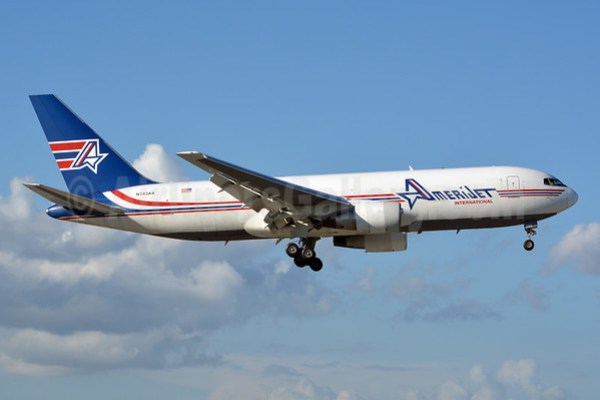
AmeriJet announces a new West Coast cargo hub at Reno, Nevada

AmeriJet International, Inc. (Fort Lauderdale/Hollywood and Miami) has announced its U.S. growth plan, including agreements with the Rickenbacker and Reno airports for the development of two domestic air cargo hubs in Ohio and Nevada.

On July 7, AmeriJet will begin daily operations between its new hubs providing long-haul air freight service connecting eleven cities coast to coast for intercontinental and domestic freight.

Amerijet’ s Pamela Rollins, Sr. V.P. Business Development said, “Amerijet’ s dedicated B767 wide body cargo planes will operate exclusively between these hubs and will provide our customers with additional options for expedited and heavyweight domestic freight. We believe this product fills the need for select services once the mainstay of companies such as Burlington Air Express, Kitty Hawk, Emery and other all cargo carriers who did not survive the economic turmoil of the last decade. Our new freighter service is ideal for shipments moving on long-haul lanes over 1,500 miles, especially those in need of time-critical and high-value, temperature controlled or hazardous material shipments.”

“This exciting new coast-to-coast freight service will benefit both businesses and consumers that count on efficient and cost-effective supply chain solutions,” said Elaine Roberts, President & CEO of the Columbus Regional Airport Authority, which operates Rickenbacker International Airport. “Rickenbacker is well-equipped and perfectly positioned to meet Amerijet’s needs as a key hub for this service and we look forward to building a strong, successful partnership with them.”

“Amerijet’s selection of Reno-Tahoe International for its west coast operation is amazing news for our airport and our community,” Marily Mora, President/CEO of Reno-Tahoe International Airport, said. “Their unique, cost-effective business model, that will blend air cargo with trucking, is a perfect fit for our growing list of distribution centers. We are proud to welcome Amerijet, and their CEO Dave Bassett, to our community.”

Rollins further added “This service connects Seattle/Tacoma, San Francisco, Los Angeles, Phoenix and Reno on the west coast with Columbus, Chicago (O’Hare), Detroit, Philadelphia, Newark and Atlanta on the east coast with 1-2 day service. Our customers are going to benefit from late local cut-off times, typically between 7-9pm and early recovery times, including Saturdays. This new network will also connect to our Miami Hub providing our customers with a faster and cost effective way to seamlessly move their freight between our domestic and international routes.”

AmeriJet International, Inc. is fullโ€service multiโ€modal transportation and logistics provider, offering U.S. Domestic and International, scheduled allโ€cargo transport via land, sea, and air. Amerijet connects over 30 major cities in the U.S. with more than 600 destinations worldwide, providing global transportation solutions for customers throughout the Americas, Mexico, the Caribbean, Europe, Asia, and the Middle East.

Copyright Photo: Jay Selman/AirlinersGallery.com. Formerly operated by Delta as a passenger aircraft, converted Boeing 767-232 (F) freighter N743AX (msn 22218) approaches the runway at the Miami International Airport (MIA) cargo hub.

AmeriJet International:ย AG Slide Show