Air France (Paris) last night (December 1) introduced the Airbus A380 on the Paris (CDG)-Miami route as planned. Miami International Airport (MIA) issued this statement:
Miami International Airport kicked off the final month of the year on a grand scale yesterday (December 1), welcoming Air France’s Airbus A380-800 superjumbo jet to Miami for the first time. The world’s largest passenger aircraft touched down at 6:04 p.m., making Air France just the second airline to offer A380 service at MIA in the process. The French flag carrier will offer seasonal service on the popular Miami-Paris route through March 27, 2015 with the new aircraft.
The inaugural arrival was greeted with a water cannon salute by Miami-Dade Fire Rescue and arriving passengers were treated to gift bags from the Greater Miami Convention & Visitors Bureau. Officials from the Miami-Dade Aviation Department (MDAD), Air France and the French government then joined passengers waiting to board the inaugural departure flight to Paris for a ceremonial ribbon-cutting and commemorative cake.
Air France’s version of the double-decker aircraft has ample capacity to meet high passenger demand during the busy winter travel season. The aircraft is arranged in a four-class, 516-seat configuration, comprised of La Première (First), Business, Premium Economy and Economy classes, and also features a bar for passengers to enjoy. The A380 represents a gain of 133 seats over the 383-seat Boeing 777-300ER aircraft that normally operates on the route. Daily Miami-Paris service on the Air France A380 is scheduled to arrive at MIA at 6:05 p.m. and depart for Paris Charles de Gaulle Airport at 8:55 p.m. from Gate J-17 in the airport’s South Terminal.
German flag carrier Lufthansa was the first airline to offer A380 service at MIA, launching Miami-Frankfurt flights in June 2011. MIA will welcome additional Airbus A380 service in 2015 when longtime airline partner British Airways begins twice-daily Miami-London (Heathrow) service on the superjumbo.
Copyright Photo: Christian Volpati/AirlinersGallery.com. Airbus A380-861 F-HPJC (msn 043) departs from Paris (CDG).
Emirates (Dubai) is launching three new Airbus A380 destinations in three days.
Hitting the high notes first is the San Francisco flight, where Emirates has been flying since 2008. The Bay City is home to the renowned San Francisco Symphony, which Emirates first started sponsoring in 2011.
Kicking off second is Milan, home of AC Milan, the world famous football team which Emirates has sponsored since 2007.
Since Emirates launched flights to the city in 2000, the airline has flown 3.1 million people on the route, that’s enough to fill the San Siro stadium 38 times.
Emirates launched its daily service to Houston in 2007, and since then has flown over 1.2 million people on the route. Known as the “Energy Capital of the World” Houston is the last of the trio to take off that week on 3rd December. Between them, the three flights will have travelled 61,784 kilometres to and from Emirates’ A380 hub in Dubai.
With these three up-gauges Emirates’ A380 route network will total 33 destinations, spanning from Auckland in the East to Los Angeles in the West.
Emirates now has 55 A380s in its fleet, one third of all A380s currently in the skies.
According to the airline, “It’s been a busy year for the Emirates A380 program with 11 of these new double-decked aircraft joining the fleet. The airline has also launched nine new A380 destinations in the past 12 months, including Mumbai, Frankfurt, Dallas/Fort Worth and Kuwait. Glasgow, Manila, Tehran and Vienna have also seen the Emirates A380 touchdown on their tarmac for a one off showcase in 2014.
Over 32 million passengers have now enjoyed the Emirates A380 experience and many of these are repeat customers, thanks to the airline’s unique on-board product. Emirates A380 features its signature First Class Suites, 14 luxurious private cabins, giving passengers the most exclusive inflight experience which includes access to the world’s only onboard ShowerSpas. Another world first on the Emirates A380 is the On-Board Lounge where First Class and Business Class passengers can socialise at 40,000 feet. In addition all Emirates A380s offer wi-fi throughout and the largest selection of movies in the sky, with ice Digital Widescreen screening 500 films – that’s nearly one film per passenger.
Emirates’ San Francisco service will operate daily as EK225 departing Dubai at 0850 hrs arriving at San Francisco International Airport at 1250 hrs the same day. The return flight, EK226, will depart San Francisco at 1530 hrs and arrives in Dubai the following day at 1925 hrs.
Emirates flight EK91 leaves Dubai at 1540 hrs and lands at Milan Malpensa Airport at 1935 hrs. The return flight EK92 departs Milan at 2120 hrs and arrives back at Concourse A, the home of the Emirates A380 and the world’s first purpose-built facility for the aircraft at Dubai International Airport at 0625 hrs the following day.
Emirates’ daily flight EK211 to Houston will depart Dubai at 0930 hrs and arrives at 1605 hrs. The return flight, EK212, takes off from George Bush Intercontinental Airport at 1825 hrs and lands in Dubai at 1905 hrs the next day.
Copyright Photo: SPA/AirlinersGallery.com. Airbus A380-861 A6-EDQ (msn 080) departs from London (Heathrow).
Scandinavian Airlines-SAS (Stockholm) has announce a new codeshare agreement with Etihad Airways (Abu Dhabi). Etihad Airways is building an alliance of carriers.
Here is the official announcement:
SAS and Etihad Airways, the national airline of the United Arab Emirates, are set to begin codeshare operations and provide customers with enhanced travel options between Scandinavia and the UAE.
The agreement, which is subject to regulatory approval, will strengthen both carriers by enabling them to offer greater connectivity to and from a number of key European cities. SAS is Etihad Airways’ 47th airline partnership globally and its 22nd in Europe. For SAS, Etihad is the 23rd codeshare partner and the third with strong presence in the Middle East.
Both airlines will also develop and sign a Frequent Flyer agreement, which will benefit the members of Etihad Airways’ Etihad Guest and SAS’ EuroBonus loyalty programs.
The deal will see SAS place its SK code on Etihad Airways’ flights between Abu Dhabi and Brussels, Düsseldorf, Frankfurt, Rome, Milan, Zurich, Geneva and London Heathrow.
In turn, Etihad Airways will place its EY code on SAS-operated flights from these European destinations, excluding Brussels, onto SAS’ hubs in Copenhagen, Oslo, and Stockholm.
The EY code will also be placed on flights beyond Copenhagen to Billund and Ålesund; beyond Oslo to Ålesund, Kristiansand, Trondheim, and Stavanger; and beyond Stockholm to Umeå, Sundsvall, and Östersund.
Top Copyright Photo: SPA/AirlinersGallery.com. SAS’ Boeing 737-705 LN-TUF (msn 28222) arrives in London (Heathrow).
Scandinavian Airlines aircraft slide show:
Etihad Airways aircraft slide show:
Bottom Copyright Photo: Gerd Beilfuss/AirlinersGallery.com. Another view of Etihad Airways’ first Airbus A380 at Hamburg (Finkenwerder). The pictured A380-861 F-WWSS (msn 166) will become A6-APA on delivery.
QANTAS Airways (Sydney) and American Airlines (Dallas/Fort Worth) have expanded their joint business, enabling QANTAS customers to codeshare on an additional nine American Airlines services including to four new destinations – Kona, Lihue and Maui in Hawaii and Richmond, Virginia.
Effective from November 27, the QANTAS codeshare on American Airlines will extend to the following nine services.
Los Angeles – Lihue (LIH)
Los Angeles – Kona (KOA)
Los Angeles – Maui (OGG)
Los Angeles – Atlanta (ATL)
Los Angeles – San Antonio (SAT)
Los Angeles – Tampa (TPA)
Dallas/Fort Worth – Richmond (RIC)
Dallas/Fort Worth – Tucson (TUS)
Dallas/Fort Worth – Albuquerque (ABQ)
QANTAS operates nonstop QANTAS A380 services between Sydney and Dallas/Fort Worth. QANTAS upgraded its three per week services from Sydney to Honolulu from a Boeing 767-300 to an Airbus A330, which will increase to four per week from December 20, and from January 21 next year the QANTAS Melbourne to Los Angeles service will increase from a daily service to ten flights per week.
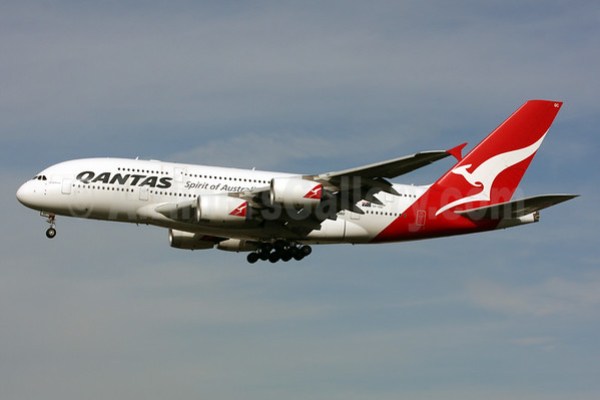
Copyright Photo: SPA/AirlinersGallery.com. Airbus A380-842 VH-OQD (msn 026) departs from London (Heathrow).
Emirates Group (Dubai) has announced its first half results for 2014:
The Emirates Group has announced its half-yearly results which show steady performance and growth, despite a challenging business environment marked by ongoing health pandemic concerns, regional conflicts, and weakening global markets.
The Emirates Group revenues reached AED 47.5 billion (US$12.9 billion) for the first six months of its 2014-15 fiscal year, up 12% from AED 42.3 billion (US$11.5 billion) from the same period last year.
Net profit for the Group rose to AED 2.2 billion (US$607 million) an increase of 1% over the last year’s results.
The Group’s cash position on September 30, 2014 was at AED 16.1 billion (US$4.4 billion), compared to AED 19.0 billion (US$5.2 billion) as at March 31, 2014. This is due to ongoing investments mainly into new aircraft and other airline related infrastructure projects.
“As the biggest operator at Dubai International, we also took the biggest hit to our bottom line from the 80-day runway upgrading works. However, we had anticipated it and made meticulous plans to minimise impact operationally and commercially for both Emirates and dnata. The success of these plans can be seen in our overall growth during this six-month period in spite of the challenge,” said His Highness (HH) Sheikh Ahmed bin Saeed Al Maktoum, Chairman and Chief Executive, Emirates Airline and Group.
He added: “It is those external threats that we cannot anticipate or directly manage, such as the global economic malaise, the Ebola outbreak, currency fluctuations, and regional conflicts, that could negate our efforts and plans. These issues appear to be piling up, impacting commercial aviation and travel, but show no signs of speedy resolution. Therefore it is critical that we stay agile as we grow. The ability to adapt and act quickly will determine our continued success.
Moving forward, we will keep a watchful eye on these challenges, but continue to focus on our long-term goals and invest in the infrastructure of both Emirates and dnata.”
In the past six months, the Group continued to develop and expand its employee base, increasing its overall staff count by 5% to over 79,000 compared with March 31, 2014.
During the first six months of the fiscal year Emirates received 13 wide-body aircraft – 6 Airbus A380s, 7 Boeing 777s, with 11 more new aircraft scheduled to be delivered before the end of the financial year (March 31, 2015).
Emirates also expanded its global route network by launching services to four new destinations – Abuja, Chicago, Oslo, and Brussels, exponentially increasing the number of city-pair flight options that it provides to customers across the globe with each new city served.
Operating the world’s largest fleet of A380s and the largest fleet of Boeing 777s, Emirates continues to provide ever better connections for its customers across the globe with just one stop in Dubai. Emirates flies to 146 destinations in 83 countries as of 30 September, up from 137 cities in 77 countries last year.
Against the backdrop of unprecedented external challenges which led the airline to suspend the highest number of routes in a year and temporarily ground part of its fleet due to the runway closure, and despite a strong performance of the US dollar against other major currencies impacting revenues, Emirates continues to make a profit. In the first half of the 2014-15 fiscal year, Emirates net profit is AED 1.9 billion (US$514 million), up 8% from the same period last year.
On average, fuel prices only softened marginally and towards the end of the six-month period. Fuel remained a large component of the airline’s cost, accounting for 38% of operating costs compared with 39% during the first six-month period last year.
In the first half of its financial year 2014-15, Emirates reported continued business growth, both in terms of capacity on offer and traffic carried. Capacity measured in Available Seat Kilometres (ASKM), grew by 6.5%, whilst passenger traffic carried measured in Revenue Passenger Kilometers (RPKM) was up 9.8% with Passenger Seat Factor increasing and averaging at 81.5%, compared with last year’s 79.2%.
Emirates carried 23.3 million passengers between 1 April and 30 September 2014, up 8.4% from the same period last year. The volume of cargo uplifted was up by 5.4%, a remarkable growth and performance against the market trend.
Emirates revenue, including other operating income, of AED 44.2 billion (US$ 12.0 billion) was higher by 11% compared with AED 39.8 billion (US$10.8 billion) recorded last year, reflecting strong passenger and cargo demand.
In other news Emirates Engineering marked another milestone when the team performed its first 3C-Check on an Airbus A380 (above), a major overhaul that restores the airline’s first A380 aircraft to near pristine condition.
In a round-the-clock operation taking 55 days, two teams of highly specialised engineers stripped the entire interior of the double-decked aircraft to the bare metal hull, inspected and overhauled every single part, and then put the plane components back together again (see video below).
The check was completed with a rigorous test flight before being put back into regular service, in this case, carrying passengers to Brisbane and Auckland.
“The aircraft has been fully overhauled during its 3C-Check. We return it in a pristine condition, just as it originally left the factory,”
Colin Disspain. “It’s like having a brand- new A380 again.”
Emirates was the first airline to place an order for the iconic A380, and is today the world’s largest operator of this efficient and spacious twin-deck aircraft.
The airline’s first A380 (registration A6-EDA – Echo Delta Alpha) (top above) was delivered in June 2008, and deployed on the airline’s inaugural A380 flight from Dubai to New York.
Flight hours, landings and aircraft age determine the due date for a 3C-Check. In this case Echo Delta Alpha had flown an impressive 20 million km, the equivalent of almost 27 return trips to the moon. It has completed over 3,000 take-offs and landings, carrying over 1.2 million passengers safely across the globe.
Months of meticulous planning led up to the C-Check on Echo Delta Alpha. Even though the experienced team of engineers have performed hundreds of C-Checks on the various aircraft of the Emirates fleet, this check was out of the ordinary simply because of the tremendous size of the A380. Operated until a few hours before the check, Echo Delta Alpha was towed into one of the Emirates Engineering hangars at Dubai Airport. Purpose-built for the A380, each hangar is as large as two football fields.
In the first 12 days of the check, over 1,600 parts were removed from the cabin interior including 475 Economy and Business Class seats, 14 First Class private suites, 16 galleys, 2 bars, 2 showers, floor panels and even parts of the cockpit. Every part was inspected and – where required – replaced.
A major part of the operation was the removal of two of the aircraft’s pylons which connect the engine with the aircraft’s wing. Each pylon holds a massive engine which weighs an impressive 6.7 tonnes.
The last two weeks were dedicated to putting all parts back in place with all teams on a tight schedule.
Echo Delta Alpha is one of Emirates’ fleet of 232 aircraft, including 55 A380s. Operating the biggest A380 route network of any commercial airline worldwide, Emirates currently serves 31 airports on 5 continents. To date, the airline’s fleet of A380 aircraft has carried 27.5 million revenue passengers, made over 68,800 trips and covered more than 405 million kilometres.
Its Dubai-Los Angeles route is the world’s longest commercial A380 flight in operation, and its Dubai-Kuwait route is the world’s shortest. By the end of this year, the number of destinations served by an Emirates A380 will increase to 33, with the addition of San Francisco from December 1 and Houston from December 3.
Video below: Emirates overhauls its first Airbus A380:
Finally Emirates will restart passenger flights to Erbil in northern Iraq from November 16, 2014.
Emirates will resume with two weekly flights to Erbil, served by an Airbus A330-200 aircraft in a 3-class configuration. This will increase to four weekly flights from December 4, 2014.
Top Copyright Photo: Gerd Beilfuss/AirlinersGallery.com. The first Emirates Airbus A380, the pictured A380-861 (msn 011) was delivered on July 28, 2008.
British Airways (London) will introduce the Airbus A380 on the London (Heathrow)-Miami route on October 25, 2015. The new type will be operated on the route twice-daily.
Today, British Airways made it official with this announcement:
British Airways today announced that Floridians planning to travel to Europe next year will have the chance to experience British Airways’ new state-of-the-art Airbus A380 superjumbo. From October 2015, the premium British airline will offer two daily A380 services from Miami International Airport to London Heathrow, with onward connections to more than 100 destinations.
The largest commercial airliner in the sky, British Airways’ A380 can accommodate up to 469 customers across two decks and four cabins.
The First cabin features 14 luxurious suites with 30 percent more personal space than the previous generation. Customers in First will be able to enjoy a la carte dining or try the A380 exclusive five course taster menu.
97 Club World (business class) seats that convert into full flat beds
The popular World Traveller Plus (premium economy) cabin will have 55 seats and 303 seats will be available in World Traveller (economy).
The new A380 route to Miami is part of British Airways’ plans to enhance the usage of facilities in Terminal 3 and Terminal 5 by combining its operations in two terminals and moving out of Terminal 1.
In the coming 12 months, flights to 20 British Airways destinations, including Miami, will change terminals at Heathrow and by the middle of October 2015 all of the airline’s services will depart from either its flagship home of Terminal 5 or the main oneworld alliance Heathrow base in Terminal 3.
Copyright Photo: Airbus A380-841 G-XLEF (msn 151) taxies at London (Heathrow).
Singapore Airlines Group (Singapore Airlines, Scoot, SilkAir and Singapore Airlines Cargo) (Singapore) reported its net profit in the first half was down by $157 million (a decline of 55.5%) year-on- year to S$126 million ($97.7 million US).
The group issued this full statement:
GROUP FINANCIAL PERFORMANCE
First Half 2014-15
The Group earned an operating profit of $171 million in the first half of the 2014-15 financial year, an improvement of $2 million (+1.2%) over the same period last year.
Group revenue was down $154 million (-2.0%) to $7,587 million, mainly due to lower incidental revenue stemming from reduced compensation pertaining to changes in aircraft delivery slots [see Note 2], and lower income from the lease of aircraft, due to the expiry of leases to Royal Brunei Airlines. Passenger revenue was lower year-on-year (-0.4%), notwithstanding a 1.4% increase in traffic, as a result of yield declines (-1.8%) amid the competitive operating environment and depreciating revenue-generating currencies, led by the Australian Dollar and Japanese Yen. Cargo revenue fell 1.6%, driven by a capacity cut (-3.8%), though this was partially compensated for by better yields and higher load factor.
Group expenditure at $7,416 million declined $156 million (-2.1%) over the previous financial year. Fuel costs after hedging fell $107 million, attributable to lower volume uplifted (-3.2%), the weaker US Dollar against the Singapore Dollar, and a 0.4% decline in jet fuel price after hedging.
Note 1: The SIA Group’s unaudited financial results for the half year and second quarter ended 30 September 2014 were announced on 6 November 2014. A summary of the financial and operating statistics is shown in Annex A. (All monetary figures are in Singapore Dollars. The Company refers to Singapore Airlines, the Parent Airline Company. The Group comprises the Company and its subsidiary, joint venture and associated companies).
Note 2: The settlement agreement was reached in Q1 FY1314 and $92 million was recognised in the first half of FY1314, of which $59 million pertained to change in prior years. $34 million compensation was recognised in the first half of FY2014-15.
Group net profit in the first half was down $157 million (-55.5%) year-on- year to $126 million. The share of results of associated companies fell $154 million, largely attributable to the Group’s share of Tiger Airways’ loss of $129 million, which included material charges relating to the sublease of surplus aircraft and sale of Tigerair Australia. The commencement of equity accounting for Virgin Australia from the second quarter further contributed to the weaker results (-$16 million). Exceptional items accounted for a loss of $10 million in the first half, compared to a net exceptional gain of $22 million last year [see Note 3]. These were partly offset by higher gains on disposal of aircraft, spares and spare engines (+$31 million).
The Parent Airline Company’s operating against the corresponding period last year. Revenue was down $151 million (-2.4%), arising from reduced incidental revenue [see Note 2] and passenger revenue. The fall was nearly offset by a $148 million (-2.4%) reduction in expenditure, due to lower fuel costs after hedging, and stringent cost management. Unit ex-fuel cost was down 3.9% year-on-year.
SIA Engineering’s operating profit declined $19 million (-33.9%). Total revenue fell by $4 million (-0.7%) as a result of lower airframe and component overhaul revenue, offset in part by higher fleet management revenue. Expenses rose by $15 million (+2.8%), primarily as a result of an increase in subcontract services.
SilkAir’s operating profit declined $17 million (-77.3%), as weaker yields (-5.0%) put a drag on revenue and capacity injection (+3.7%) pushed operating expenditure up.
SIA Cargo’s operating loss narrowed by $37 million from last year. With better capacity management, yields and load factor were up 1.9% and 0.2 percentage points, respectively.
Note 3: Exceptional items in the first half of FY1415 pertained to the Parent Airline Company’s provision for settlement with plaintiffs in the Transpacific Class Action ($11 million), SIA Cargo’s additional impairment on two marked-for-sale B747-400F aircraft ($7 million), partly offset by additional gain on sale of Virgin Atlantic Limited (VAL) to Delta Air Lines, Inc. ($7 million), and partial refund of fine on appeal from the Korean Fair Trade Commission ($1 million). Exceptional items in the first half of FY1314 was $22 million, mainly pertaining to gain on sale of VAL ($339 million), partially offset by SIA Cargo’s impairment on four B747-400 aircraft removed from operation ($293 million) and SFC’s impairment loss on its assets with the closure of its Maroochydore operations ($24 million).
Second Quarter 2014-15
Group operating profit for the second quarter improved $45 million (+51.7%) to $132 million.
Group revenue was almost flat at $3,905 million. Passenger revenue increased marginally, as higher passenger carriage was largely offset by a 0.9% decline in yields. Cargo revenue was down 0.5% on the back of lower capacity (-4.1%), but was mitigated by improved yields (+2.8%).
Group expenditure declined $41 million (-1.1%) to $3,773 million. Fuel costs before hedging fell $115 million, partially offset by a loss on fuel hedging, compared to a hedging gain in the same quarter last year (+$76 million).
Group net profit was down $70 million (-43.5%) year-on-year to $91 million. This was largely attributable to weaker results from associated companies (-$138 million), partly mitigated by higher operating profit (+$45 million), and higher gains on disposal of aircraft, spares and spare engines (+$35 million).
FIRST HALF 2014-15 OPERATING PERFORMANCE
The Parent Airline Company’s passenger carriage (in revenue passenger kilometres) increased marginally by 0.1%, while capacity (in available seat-kilometres) dipped 0.2% during the first half of the financial year. As a result, passenger load factor improved by 0.2 percentage points to 79.8%.
SilkAir recorded a 0.4 percentage-point increase in passenger load factor to 69.7%, as its 4.2% growth in traffic outpaced capacity injection of 3.7%.
SIA Cargo reduced its capacity (in capacity tonne-kilometres) by 3.8%. Airfreight carriage (in load tonne-kilometres) declined by 3.4%. Consequently, cargo load factor improved 0.2 percentage points to 62.2%.
No. 05/14 6 November 2014 Page 4 of 6
INTERIM DIVIDEND
The Company is declaring an interim dividend of 5 cents per share (tax exempt, one-tier), amounting to $59 million, for the half-year ended 30 September 2014. The interim dividend will be paid on 27 November 2014 to shareholders as of 18 November 2014.
FLEET AND ROUTE DEVELOPMENT
The Parent Airline Company took delivery of two Airbus A330-300s in the second quarter. As at September 30, 2014, the operating fleet of the Parent Airline Company comprised 105 passenger aircraft – 57 Boeing 777s, 29 Airbus A330-300s and 19 A380-800s, with an average age of 7 years.
During the quarter, SilkAir took delivery of two Boeing 737-800 aircraft, sold one Airbus A320-200 and decommissioned another A320-200 in preparation for return to lessor. As at September 30, 2014, its operating fleet comprised 26 aircraft – 14 Airbus A320-200s, six A319-100s and six Boeing 737-800s.
There was no change to Scoot’s fleet during the July-September quarter, comprising six Boeing 777-200s.
SIA Cargo operated a fleet of eight Boeing 747-400 freighters at September 30, 2014, the same as the previous quarter. It suspended freight operations to Lagos from July 29, 2014, and added services to Amsterdam, Brussels and Delhi in September to cater to seasonal demand.
In the Northern Winter season (October 26, 2014 – March 28, 2015), the Parent Airline Company will increase capacity to Auckland with daily Airbus A380 services, replacing the smaller Boeing 777-300 ER. To cater to peak period demand, three additional weekly services will be operated to Melbourne and Sydney, and two additional weekly services will be operated to Brisbane and Christchurch, from the end of November 2014 to January 2015. In addition, three weekly services will be operated to Sapporo from December 2014 to mid-January 2015. As part of a service restructuring to the Middle East, flights to Cairo and Riyadh have been suspended from October 2014. SilkAir suspended its twice-weekly services to Solo with effect from October 26, 2014. From December 12, 2014, it will begin daily services to Denpasar. Together with the Parent Airline Company, a total of five daily trips will be served between Singapore and the city, subject to regulatory approval. This will bring the combined network of both airlines to 99 cities in 35 countries.
OUTLOOK
The operating landscape for the airline industry remains competitive and challenging, as an uncertain global economic climate and geopolitical concerns persist.
Demand is generally flat, and yields will remain under pressure amid intense competition from other airlines and promotional activities in weaker markets.
Airfreight demand has seen a moderate recovery in recent months, with demand projected to be stronger in the third quarter as a result of the traditional peak period in the lead-up to Christmas. However, overcapacity in the airfreight market is expected to continue to put pressure on yields.
While there has been a reprieve from cost pressures arising from the decline in fuel prices in recent months, there is concern that the decline reflects a slow- down in major economies in the world which could ultimately hurt travel demand.
The Group will continue to track market movements closely and make appropriate adjustments to capacity, while practising cost discipline in all business areas. With a strong balance sheet, the Group is well positioned to meet the challenges ahead.
Earnings per share for 1H 2014/2015 has declined to $0.107 from $0.24 (y/y) which represents a sharp drop of 55%. Similar for Q2 2014/205 which EPS has declined to 7.7 from 13.6 (y/y) which translates to a 76% decline.
This poor performance has been contributed by its subsidiaries’ contribution towards the SIA Group’s operating profit where we see poor performance in SIA Engineering & SilkAir (both decline drastically by 33.9% and 77.3% respectively from 1H 2013/2014 to 1H 2014/2015.)
Going forward, SIA Group is likely to see downside pressure on its bottom-line due to intense competition from budget airline operators and economic risks such as the spread of Ebola that will hamper international travel.
Technically, SIA is still trading in a multi-year sideways configuration since Nov 2011 and in order to see a change of trend to the upside, it needs to break above the key resistance at 10.92
Emirates (Dubai) has announced it is planning to launch a fourth daily service from its home and hub, Dubai International Airport to John F. Kennedy International Airport (JFK) in New York commencing on March 8, 2015.
The new service, flight EK 207 will depart Dubai at 14:50 hours and arrive in JFK at 20:35 hours. The return flight, flight EK 208 will depart JFK at 16:30 hours and arrive in Dubai at 13:15 the following day.
Thanks to Emirates’ code-share agreement with JetBlue Airways (B6) the new fourth daily service will allow good connectivity with JetBlue flights to points across the United States and Caribbean. At JFK, JetBlue operates from Terminal 5, while Emirates operates from the adjacent Terminal 4, allowing for fast and easy connections between flights.
Emirates and JetBlue’s partnership dates back to 2010 and has deepened over the subsequent four years, moving from an interline agreement to incorporating bilateral code-sharing, terminal co-location in Boston, and reciprocal benefits for each airline’s frequent flyers.
The fourth JFK service will be operated with one of Emirates’ fleet of Airbus A380 aircraft featuring 14 First Class Private Suites, 76 Business Class lie-flat beds and 399 Economy Class seats on the main deck. Its upper deck features Emirates’ iconic On-Board lounge for premium passengers and two unique Shower Spas for First Class passengers. All passengers on-board can enjoy access to up to 1,800 channels of films, TV shows, music and games through ice, the airline’s award-winning inflight entertainment system.
Emirates first flew to New York in June 2004 and since then has flown over 4.5 million passengers on the route. It currently operates two other nonstop services between DXB and JFK operated by Airbus A380 aircraft, and one service which routes via Milan, operated by a US-built Boeing 777. Passengers travelling in First Class and Business Class on Emirates-operated flights, as well as Skywards Platinum and Gold members, have access to the Emirates Lounge at JFK.
Read the analysis by the Wall Street Journal: Emirates, Etihad and Qatar Make Their Move on the U.S.: CLICK HERE
Copyright Photo: Ken Petersen/AirlinersGallery.com. Airbus A380-861 A6-EDA (msn 011) taxies at John F. Kennedy International Airport (JFK) in New York.
Emirates aircraft slide show:
Video: Flying the Airbus A380 in Economy from Dubai to New York:
QANTAS Airways (Sydney) has implemented its new and improved inflight entertainment program giving customers more choice and variety and more regular and in-depth news coverage as a result of its new partnership with Sky News, Foxtel and Fox Sports.
QANTAS customers will be able to view a complete package of news, sport, entertainment and lifestyle programs with the partnership marking the start of a comprehensive transformation of Qantas’ inflight entertainment programming.
QANTAS is the only Australian airline to give its customers an inflight entertainment solution on every aircraft no matter what cabin they are traveling in.
New inflight entertainment features:
More news – QANTAS customers will enjoy multiple daily news bulletins on international and domestic flights seven days a week.
More exposure – A new international Australian news service called Australia Channel will broadcast live to Qantas’ international network of lounges so customers returning home will be able to watch the latest news, sport and business updates from Australia. Domestic customers will also enjoy this service.
More sport – Fox Sports content will be on offer for customers including highlights packages, interviews and documentaries.
More variety – A Foxtel Picks channel will showcase a library of lifestyle, drama, food, sport and entertainment programming from the likes of The Lifestyle Channel, Fox8, Showcase, the History Channel and Comedy Channel.
More content – Customers can expect more volume in popular categories including double the number of new releases and blockbusters, kid’s and drama content. Four times more business programming.
More music – Customers can now listen to a greater selection of music with triple the number of albums added each quarter.
QANTAS has also engaged Stellar Entertainment, a full-service content service provider, offering world-class IFE. The partnership has already seen QANTAS double its number of new releases and blockbusters, adding 100 hours of additional content.
Bottom Copyright Photo: SPA/AirlinersGallery.com. Airbus A380-842 VH-OQC (msn 022) arrives in London (Heathrow).



You must be logged in to post a comment.