Tag Archives: Everett

The Boeing 787 is granted extended 330 minutes ETOPS operations by the FAA

Boeing (Chicago and Seattle) has released this statement about extended ETOPS for the 787:

The U.S. Federal Aviation Administration (FAA) has approved additional extended operations (ETOPS) for the Boeing 787 Dreamliner. The move will allow 787s to be operated up to 330 minutes from a landing field and signals continued confidence in the airplane’s technical capabilities.

Dreamliners have been allowed to operate up to 180 minutes away from a landing field since they were introduced into service in 2011. Granting of the expanded operational permission will allow airlines to introduce additional routes after they meet the proof of capabilities requirements and receive approval from their own regulatory agencies for such operations.

ETOPS operations will make the 787 even more efficient in operations as they enable more direct flight paths, which can save thousands of pounds of fuel and reduce carbon emissions.

More than 1,030 787s have been ordered by 60 customers to date. Boeing has delivered 146 Dreamliners to 19 customers.

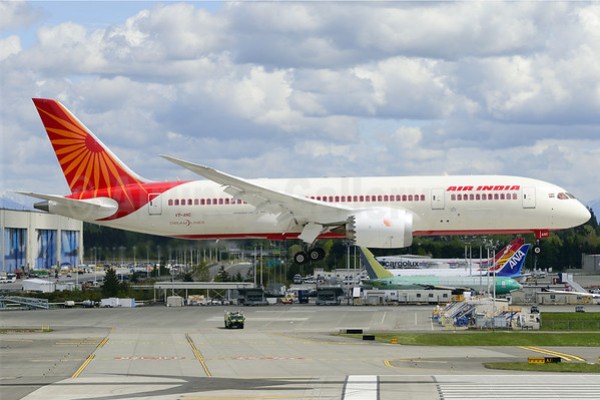
Copyright Photo: Steve Bailey/AirlinersGallery.com. Boeing 787-8 VT-ANC (msn 36274) in Air India colors lands at Boeing’s facility at Paine Field near Everett, Washington. VT-ANC is one of the earlier models and remains undelivered.

Air India:ย AG Slide Show

Norwegian pleads to allow its Norwegian Air International subsidiary to operate to the USA

Norwegian Air Shuttle (Norwegian Long Haul) (Norwegian.com) (Oslo) is arguing before the DOT and public opinion, citing an editorial by USA Today, to allow its Irish subsidiary Norwegian Air International (NAI) (Dublin) to operate its Boeing 787 Dreamliners on low-fare flights to the United States. Several unions of other airlines are arguing against this approval process. Norwegian issued this statement:

Citing the airline’s “discount ticket prices” that give “passengers a reason to celebrate,” the USA Today has endorsed Norwegian Air International (NAI)’s application to begin flying from the United States. The USA Today argued that U.S. Department of Transportation โ€“ which has delayed approval of NAI’s application for months โ€“ could provide a major boon to consumers by approving NAI’s application and introducing competition into the transatlantic flight market. The full editorial is available here:

Read the editorial from USA Today: CLICK HERE

The editorial noted that NAI is able to offer fares far below those of U.S. legacy carriers because NAI is more efficient than its competitors. The airline is using 787 Dreamliners, which “provide big savings on fuel costs.” Further, NAI “steers clear of high-cost, congested airports.”

The editorial further criticized opposition to NAI for running ads that “try to cast NAI as a lawbreaker while implying that safety is being compromised.” The editorial clearly states, however, that NAI’s opposition “lacks any proof” that NAI will not follow the highest safety standards and all U.S. laws.

The USA Today made clear that it believes that “unless the critics can prove that [NAI] is doing something unsafe or illegal, the U.S. government should let NAI fly.”

Meanwhile, the Association of Flight Attendants-CWA continues to oppose NAI and issued this statement:

Association of Flight Attendants-CWA (AFA), was joined by the European Transport Workers’ Federation (ETF) as well as the International Transport Workers’ Federation (ITF) in calling on the United States Department of Transportation (DOT) to deny an application for a foreign air carrier permit submitted by Norwegian Air International (NAI).

AFA, ETF and ITF once again spotlight the unfair labor practices established by NAI in their mission to enter the U.S. aviation market. NAI’s business plan is crafted to circumvent worker protections by evading international labor laws, creating unfair competition with EU and U.S. carriers and threatening to degrade labor standards both in the U.S. and in Europe.

Veda Shook, AFA International President stated: “AFA remains committed to a healthy and robust global aviation marketplace that provides career opportunities and good jobs for workers across the world. Competition and growth are essential to our industry but we must remain dedicated to promoting strong labor standards. Skirting international laws in order to gain unfair advantage cannot be tolerated. We call on Secretary Foxx to deny NAI’s current application before such labor practices become the norm in international aviation, triggering a race to the bottom.”

Franรงois Ballestero, the ETF Civil Aviation Political Secretary commented: “The attempt of Norwegian Air to import cheap labor from Asia by employing non-European cabin crew on its long-haul routes are an attack on working conditions of the existing workers. The ETF is committed to fight against social dumping and we urge the DOT to put an end to these unfair practices. And we are not alone in our concerns: the Norwegian Minister of Transport and Communications recently raised his concern to the European Commission about the challenges facing European aviation that are created by fragmented operations between multiple countries.”

Gabriel Mocho Rodriguez, ITF Civil Aviation Secretary added: “The practice of establishing subsidiaries and registering vessels under flags of convenience in order to avoid oversight and slash costs has long been a feature of the maritime industry. The results are well known: lower safety standards, sometimes shocking working conditions, little protection for workers. The ITF is well known for fighting these abuses. For decades we have been warning that the flags of convenience model could be copied in the aviation sector. Just last month, our cabin crew committee decisively rejected the outsourcing and flagging out practices of NAI. The AFA together with the IAM (International Association of Machinists and Aerospace Workers), TWU (Transport Workers’ Union) and APFA (Association of Professional Flight Attendants), supported that resolve and are actively lobbying the U.S. government and urging it to prevent those unacceptable practices being imported into the US. The ITF will continue to support their effort.”

The ETF represents more than 250,000 civil aviation workers all over Europe, including 80,000 cabin crews.

The ITF represent more than 650,000 civil aviation workers all over the world, including nearly 100,000 Flight Attendants in the United States.

Copyright Photo: James Helbock/AirlinersGallery.com. Boeing 787-8 EI-LNB (msn 35305) is pictured at Paine Field in Everett.

Norwegian:ย AG Slide Show

Norwegian signs a contract for three additional Boeing 787-9 Dreamliners, loses $137.6 million in the first quarter

Norwegian Air Shuttle (Norwegian Long Haul) (Norwegian.com) (Oslo) has entered into an agreement for the delivery of three new long-haul Boeing 787-9 Dreamliners. Two of the aircraft will be delivered in 2016 and one in 2017.

Norwegian continues to expand its international operations and has agreed to also lease two 787-9 Dreamliners. Norwegian will put two of the planes in service in 2016 and one in 2017. Today, Norwegian has five long-haul type Dreamliner 787-8 in its fleet and another three on order. In addition, Norwegian has already placed an order for six 787-9s. With this new contract, Norwegian in 2018 will have a long-haul fleet of 17 long-haul 787s.

Facts about Boeing 787-9 Dreamliner:

Holds up to 20 percent more passengers than 787-8
Six meters (20 feet) longer than the 787-8
Significantly greater cargo capacity than the 787-8
Eight percent less fuel per seat than today’s version, which also gives the corresponding reduction in environmental emissions

In other news, Norwegian announced a quarterly loss before taxes of -813 million NOK ($137.6 million). Quarterly earnings were affected by additional costs for hiring of crews and a weak Norwegian crown.

During the first quarter, the revenue increased to 3.55 billion Norwegian kroner, an increase of 22 percent compared to the same quarter last year.

9 million passengers flew with Norwegian representing growth of 24 percent. The traffic growth (RPK) was at 50 percent, which is also linked to each Norwegian passengers now fly much longer than they did a year ago.

The figures also show strong output growth with an increase of 48 percent (ASK). The load factor was 77 percent in the first quarter, up one percentage point compared to the same quarter the year before. Adjusted with extra costs and a weak currency decreased costs (CASK) by nine percent in the first quarter.

Extra costs associated with long-haul operations accounted for 78 million NOK. These costs included the leasing of aircraft, additional fuel and the cost of hotels, food and drink to passengers affected by technical and operational problems with long-distance business.

During the first quarter, Norwegian phased in five new Boeing 737-800s and a Boeing 787-8 Dreamliner. ย With the Dreamliner (EI-LNE) that was delivered last week, Norwegian now has a total of five long-haul aircraft in service and 12 on order.

Copyright Photo: Duncan Kirk/AirlinersGallery.com. The first, the pictured 787-8 EI-LNA (msn 35304) displays the likeness of Sonja Henie on the tail.

Norwegian:ย AG Slide Show

Delta’s board authorizes a $2 billion share repurchase program and a 50% increase in dividends

Delta Air Lines‘ (Atlanta) Board of Directors have announced the next phase of the company’s plans to return capital to shareholders, including a 50 percent increase to its dividend and a new share repurchase authorization. The Board has authorized a new $2 billion share repurchase program, to be completed no later than Dec. 31, 2016. In addition, beginning in the September 2014 quarter, the company’s quarterly dividend will increase to $0.09 per share from the current $0.06 per share. Together, these two programs are expected to return an additional $2.75 billion to shareholders through 2016.

“Delta has deployed its strong cash flows to drive value for owners by strengthening its balance sheet through debt and pension reductions while also returning a significant amount of cash back to shareholders,” said Daniel Carp, chairman of Delta’s Board of Directors. “The Board is furthering our long-term commitment to Delta shareholders by substantially increasing our dividend and also providing a flexible vehicle to return additional cash to shareholders through the $2 billion share repurchase program. This next phase of our shareholder return program reflects the Board’s confidence in Delta’s ability to sustain and improve upon its already strong financial performance.”

Balanced Approach to Capital Deployment

In an investor presentation this morning, Delta updated its progress against the balanced capital deployment plan announced by the company in May 2013. With its financial performance and cash flows having exceeded the targets under that plan, Delta announced new plans to further drive shareholder value by accelerating the company’s efforts to reduce debt levels, address its pension obligations, and return cash to shareholders.

Debt: Delta ended the March 2014 quarter with $9.1 billion of adjusted net debt, a reduction of $2.6 billion since the end of 2012 and nearly $8 billion since the company began its debt reduction efforts in 2009. The company expects to reach $7 billion of adjusted net debt in 2015, two years ahead of its originally stated goal, and $5 billion of adjusted net debt by the end of 2016.
Pension: For 2013 and 2014, the company contributed nearly $1 billion each year to its defined benefit pension plans, through a combination of $700 million in required minimum funding and $250 million of incremental funding. This pension funding level, combined with higher interest rates and returns on pension assets, helped lower the company’s unfunded pension liability by 25 percent to just over $10 billion. The company plans to maintain its current $1 billion annual funding level through 2020, with a goal of achieving 80 percent funded status by that date.

Cash returns to shareholders: The company is on track to return $700 million to shareholders by early June 2014, through $200 million of dividends and completing its original $500 million share repurchase authorization more than two years ahead of its June 30, 2016 expiration date. The new repurchase authorization and increase to the quarterly dividend approved by Delta’s Board of Directors are expected to return an additional $2.75 billion to shareholders through 2016.

Repurchases under Delta’s program may be made through a variety of methods, which may include open market purchases, privately negotiated transactions, block trades, or accelerated share repurchase transactions in compliance with applicable regulatory guidelines, including Securities and Exchange Commission Rule 10b-18. Purchases will be made subject to market and economic conditions, applicable legal requirements, and other relevant factors. Delta had approximately 853 million shares of common stock outstanding as of March 31, 2014.

Bloomberg Businessweek article on Delta’s quest for a billion dollars in baggage fees!: CLICK HERE

Copyright Photo: Nick Dean/AirlinersGallery.com. Boeing 777-232 LR (Longer Range) N706DN (msn 30440) climbs away from the runway at Paine Field near Everett, WA with the snow-capped Olympic Mountains in the background.

Delta Air Lines:ย AG Slide Show

Boeing delivers the 75th Boeing 747 to Lufthansa

747-8I DLH #1498-RC034

Lufthansa (Frankfurt) and Boeing (Chicago and Seattle) celebrated the delivery of the German airline’s 75th 747 on Wednesday (April 30).

Lufthansa is the launch customer for the 747-8 Intercontinental jetliner and took delivery of the first one in April 2012. The airplane delivered Wednesday is Lufthansa’s 13th 747-8 Intercontinental, namely 747-830 D-ABYO (msn 37841). The airline currently flies the 747 to 22 destinations in 10 countries. Over the years, Lufthansa has ordered a total of 81 747s.

Lufthansa’s first 747 โ€“ a 747-100 โ€“ was delivered in 1970. The airline was also the first to order the 747-200 Freighter.

The 747-8 has accumulated 120 orders for passenger and cargo versions, 68 of which have been delivered.

Top Copyright Photo: Boeing. This poor-quality publicity photo shows D-ABYO departing from Paine Field.

Lufthansa:ย AG Slide Show

Bottom Copyright Photo: Bruce Drum/AirlinersGallery.com. It all started with the Boeing 747-130. The pictured Boeing 747-130 D-ABYA (msn 19746) at New York (JFK) was delivered new to LH as the first 747 on March 10, 1970.

Jet Airways Boeing 777-300 operates over Germany for 30 minutes without ATC radio contact

Jet Airways‘ (Mumbai) flight 9W 117 from London (Heathrow) to Mumbai flew over the busy German airspace ย without radio contact on March 13, five days after Malaysia Airlines flight MH 370 disappeared. Boeing 777-35R VT-JEG (msn 35163) was flown for 30 minutes without positive radio contact from the cockpit crew.

Both pilots, who failed to notice they had lost air traffic control radio contact, were suspended by the company.

Read the full report from the Economic Times: CLICK HERE

Previously the airline on February 12, 2014 had inaugurated flights from the new international integrated terminal T2 at Mumbaiโ€™s Chhatrapati Shivaji International Airport on this route to London Heathrow.

Jet Airways’ flight 9W 118 from Mumbai to London Heathrow became the first international flight to take off at 1320 from India’s most new, modern and spacious Terminal 2.

Copyright Photo: Nick Dean/AirlinersGallery.com. Sister ship Boeing 777-35R ER N834BA became VT-JEL (msn 36563) on delivery.

Jet Airways:ย AG Slide Show


Air New Zealand’s first Boeing 787-9 is rolled out of the paint shop at Everett


Boeing (Chicago and Seattle) yesterday (April 5) rolled out of the paint hangar the first 787-9 Dreamliner (ZK-NZE, msn 34334) to be delivered to launch customer Air New Zealand (Auckland), revealing the carrier’s new-look livery. The airplane, painted in a distinctive black color scheme, features the iconic official New Zealand Fern Mark.

This 787-9 is the first airplane to feature the distinctive black version of Air New Zealand’s new-look livery design, with the white version having been gradually rolled out across the airline’s domestic fleet in recent months. While the majority of Air New Zealand’s fleet will eventually feature the white version, a limited number will feature the signature black version.

Air New Zealand plans to have the airplane begin service on its Auckland-Perth route later this year. Air New Zealand has 10 787-9s on order.

The 787-9 will complement and extend the 787 family. With the fuselage stretched by 20 feet (6 m) over the 787-8, the 787-9 will fly up to 40 more passengers an additional 300 nautical miles (555 km) with the same exceptional environmental performance โ€” 20 percent less fuel use and 20 percent fewer emissions than similarly sized airplanes.

Twenty-six customers from around the world have ordered 405 787-9s, accounting for approximately 39 percent of all 787 orders.

Air New Zealand issued this statement:

The aircraft, which will soon become the first 787-9 in commercial operation, rolled out of Boeingโ€™s paint hangar on Saturday evening April 5 ย and will join the Air New Zealand fleet mid year.

The 787-9 is the first Air New Zealand aircraft to feature the distinctive black version of the airlineโ€™s new-look livery. The white version of the livery has been gradually rolled out across the airlineโ€™s A320 domestic fleet in recent months.

The paint job took five days to complete and was done by 12 painters using around 350 liters of paint.

Air New Zealandโ€™s new livery features the New Zealand Fern Mark, the use of which is authorised by Tourism New Zealand and New Zealand Trade and Enterprise. While the majority of the airlineโ€™s fleet will eventually feature the white version of the design a limited number will feature this signature black version.

This aircraft is the first of ten 787-9 Dreamliners to join Air New Zealandโ€™s fleet. Air New Zealand is the global launch customer for the 787-9 which is 20 percent more fuel efficient than the aircraft itโ€™s replacing. The 787-9 will operate the Auckland โ€“ Perth route from October 15, 2014 and to both Tokyo and Shanghai from November.

Copyright Photo: Bernie/Leighton/AirlinersGallery.com.

Video: Air New Zealand. The building of the first ANZ 787-9:

Images below: Air New Zealand. The 2013 livery has two versions:

Air New Zealand 787-9 (13-black fern)(Flt)(ANZ)(LR)

Air New Zealand 787-9 (13-silver black fern)(Flt)(ANZ)(LR)

Air New Zealand:ย AG Slide Show


Kenya Airways takes delivery of its first Boeing 787, arrives in Nairobi today


Kenya Airways (Nairobi) and Boeing (Chicago and Seattle) yesterday (April 4) celebrated the delivery and flyaway of the Kenyan flag carrier’s first 787 Dreamliner. Boeing 787-8 5Y-KZA (msn 35510)ย departed Paine Field in Everett for a 7,800 nautical mile (14,456 km) nonstop flight to Kenya Airways’ home base in Nairobi at Jomo Kenyatta International Airport.

This delivery is the first of nine 787 Dreamliners set to join Kenya Airways’ fleet. The deliveries of additional 787s, along with 777-300ER (Extended Range) airplanes, forms part of the East African carrier’s 10-year strategic plan called “Project Mawingu.” The plan is focused on increasing the airline’s fleet size from 44 airplanes to 107 by 2021 and destinations from the 62 to 115. Currently the Nairobi-based carrier operates an all-Boeing long-haul fleet of six 767-300 ERs, four 777-200ERs and one 777-300 ER.

Kenya Airways’ first 787 is scheduled to begin flying regionally within Africa (Mombasa and Johannesburg) in the coming weeks, before beginning long-haul service to Paris (CDG) in early June. Currently the “Pride of Africa” serves destinations across Africa, Asia, Europe and the Middle East. To date, more than 130 Dreamliners have been delivered to 17 customers worldwide.

Top Copyright Photo: Royal S. King/AirlinersGallery.com. 5Y-KZA is beautifully captured at Paine Field near Everett before the delivery.

Kenya Airways 787-8 5Y-KZA arrives in Nairobi on 4.5.14 (Kenya)(LR)

Kenya Airways:ย AG Slide Show

Bottom Copyright Photo: Kenya Airways. 5Y-KZA lands in Nairobi on April 5.ย CEO Dr. Titus Naikuni carries the Kenyan flag and walks towards H.E Uhuru Kenyatta for the hand over of the aircraft.


Videos:


Turkmenistan Airlines takes delivery of the first of two new Boeing 777-200 LRs

Boeing (Chicago and Seattle) has delivered a 777-200 LR (Longer Range) (777-22K LR EZ-A778, msn 42296) passenger aircraft to Turkmenistan’s national flag carrier, Turkmenistan Airlines (Ashgabat). The airplane is the first of two new 777-200 LRs Turkmenistan Airlines has on order. The delivery coincided with the opening of a new terminal at the Ashgabat International airport.

Previously Turkmenistan took delivery of the pictured 777-22K LR EZ-A777 (msn 39548) on August 31, 2010.

Turkmenistan Airlines’ fleet modernization plan started in 1992 when the airline became the first in the Commonwealth of Independent States to order airplanes from Boeing. The airplane will join Turkmenistan’s fleet of airplanes, which currently include seven 717-200s, three 737-300s, four 737-700s, five 737-800s and four 757-200s.

Copyright Photo: Nick Dean/AirlinersGallery.com. EZ-A777 departs from Paine Field near Everett, WA.

Turkmenistan Airlines:ย AG Slide Show

The FAA and Boeing complete their joint review of the 787’s critical systems

The U.S. Federal Aviation Administration (FAA) and Boeing (Chicago and Seattle) have completed a comprehensive review of the 787’s critical systems. The joint review, initiated in January 2013, included an examination of the processes for the design, certification and production of the 787-8. The review’s findings validate the integrity of the airplane’s design and confirm the strength of the processes used to identify and correct issues that emerged before and after the airplane’s certification.

The review concludes that the 787 meets the intended high level of safety expected by the FAA and Boeing. The report includes recommendations aimed at further strengthening the FAA and Boeing’s processes.

“We welcomed the opportunity presented by this joint review of the 787 and its in-service performance,” said Boeing Commercial Airplanes President and CEOย Ray Conner. “The findings validate our confidence in both the design of the airplane and the disciplined process used to identify and correct in-service issues as they arise. I am grateful for the hard work of the joint review team and for its recommendations, which will allow us to further improve our processes as we move forward.”

The review team outlined four recommended improvements for Boeing. Three of the recommendations focus on improving the flow of information, standards and expectations between the company and its suppliers. Boeing has already taken significant steps to implement these recommendations.

The fourth recommendation encourages Boeing to continue implementing and maturing the gated processes for development programs.

“Gated process” refers to the disciplined criteria followed as a new airplane model is developed. This ensures a sufficient level of maturity is gained before a program proceeds to key milestones such as design completion, production start and entry into service.

Boeing has made a range of improvements to its airplane development processes since the start of the 787 program. These efforts included a restructuring last year to bring all commercial airplane development programs under one umbrella organization.

Copyright Photo: Brandon Farris/AirlinersGallery.com.

Welcome to the AG Slide Show:ย AG Slide Show