Monthly Archives: July 2012

United Airlines to operate to Jackson Hole, Wyoming from both Newark and San Francisco

United Airlines (Chicago) is planning to serve the ski area of Jackson Hole, Wyoming next winter with nonstop service from both the Newark and San Francisco hubs according to Trib.com.

Read the full article: CLICK HERE

Copyright Photo: Brian McDonough. Boeing 737-724 N24715 taxies to the runway at Fort Lauderdale/Hollywood.

United Airlines:ย 

Spirit Airlines’ second quarter net profit rises by 35.4% to $35.3 million

Spirit Airlines‘ (Fort Lauderdale/Hollywood) ultra low-fare business model continues to work for the carrier. The companyย reported second quarter 2012 financial results.

  • Net income, excluding special items, for the second quarter 2012 increased 35.4 percent to $35.3 million, or $0.49 per diluted share, as compared to pro forma second quarter 2011 net income.1GAAP net income for second quarter 2012 was $34.6 million, or $0.48 per diluted share.
  • For the second quarter of 2012, the Company grew its operating margin, excluding special items, by 1.5 points to 16.3 percent as compared to second quarter 2011.1ย Operating margin on a GAAP basis was 15.9 percent for the second quarter of 2012.
  • Adjusted EBITDAR margin for the second quarter 2012 was 27.6 percent, up 1.7 points year-over-year.
  • Spirit ended the second quarter 2012 with $415.0 million in unrestricted cash.

(1) See “Reconciliation of Adjusted Net Income to GAAP Net Income” table below for additional information.

Revenue Performance

For the second quarter 2012, Spirit’s total operating revenue was $346.3 million, an increase of $70.4 million, or 25.5 percent, compared to second quarter 2011 on a capacity increase of 16.5 percent.

Total revenue per available seat mile (“RASM”) increased to 12.25 cents, up 7.7 percent compared to the second quarter 2011, driven by total operating yields which increased 9.1 percent year-over-year to 14.44 cents.

Passenger flight segment (“PFS”) volume grew 18.8 percent year-over-year in the second quarter 2012 with total revenue per PFS of $132.53, an increase of 5.7 percent as compared to the second quarter 2011. Spirit has continued its strategy to offer low base fares while increasing revenue from non-ticket sources. Average non-ticket revenue per PFS for the second quarter 2012 increased 18.6 percent year-over-year to $51.47 and average ticket revenue per PFS for the quarter decreased 1.1 percent year-over-year to $81.06.

Cost Performance

Total operating expenses in the second quarter 2012 were $291.2 million, up 20.9 percent compared to the same period in 2011, primarily due to expenses associated with increased flight volume. Other expense drivers included higher airport and crew-related costs as a result of network scope changes, and passenger re-accommodation costs associated with a greater percentage of flight cancellations.

Cost per available seat mile excluding special items and fuel (“Adjusted CASM ex-fuel”) for the second quarter 2012 was 6.05 cents, an increase of 11.8 percent year-over-year. Average stage length for the second quarter 2012 decreased 3.2 percent compared to the second quarter 2011, contributing an estimated 1.8 percentage points of the 11.8 percent year-over-year increase in Adjusted CASM ex-fuel. Other primary drivers of Adjusted CASM ex-fuel included start-up costs related to Spirit’s preventative seat maintenance program and passenger re-accommodation costs associated with flight cancellations.

Start-up costs related to the Company’s seat maintenance program were approx $3 million in the second quarter. The Company estimates it will incur additional start-up costs related to this program of about $4.5 million in the second half of 2012.

Selected Balance Sheet and Cash Flow Items

At the end of the second quarter 2012, Spirit had $415.0 million in unrestricted cash and cash equivalents and no restricted cash balance. As of June 30, 2012, the Company had no debt on its balance sheet and total shareholders’ equity of $527.3 million.

During the second quarter, the Company had capital expenditures of $9.4 million which included the purchase of one spare engine, paid $7.4 million in pre-delivery deposits (“PDPs”) for future deliveries of aircraft and spare engines, had $10.7 million of PDPs returned related to aircraft delivered in the quarter, and paid $11.8 million in maintenance reserves, net of reimbursements. In addition, during the second quarter, the Company paid $26.9 million to its pre-IPO stockholders under the terms of a Tax Receivable Agreement.

Fleet

Spirit took delivery of two A320s in the second quarter, ending the quarter with 42 aircraft in its fleet. Spirit expects to take delivery of two additional A320s before year-end 2012.

Second Quarter 2012 and Other Current Highlights

Recently added/announced new service between (service start date):

– Denver and Chicago (5/3/12) – Dallas/Fort Worth and Houston (9/20/12)
– Denver and Dallas/Fort Worth (5/3/12) – Chicago and Tampa (11/8/12)*
– Denver and Fort Lauderdale (5/3/12) – Chicago and Phoenix/Mesa (11/8/12)*
– Denver and Las Vegas (5/3/12) – Minneapolis/St. Paul and Fort Lauderdale (11/8/12)*
– Dallas/Fort Worth and Myrtle Beach (5/3/12) – Minneapolis/St. Paul and Fort Myers (11/8/12)*
– Dallas/Fort Worth and Tampa (5/3/12) – Dallas/Fort Worth and Fort Myers (11/8/12)*
– Atlantic City and Atlanta (5/17/12)* – Boston and Fort Myers (11/8/12)*
– Latrobe/Pittsburgh and Orlando (5/17/12) – Dallas/Fort Worth and New Orleans (1/24/13)
– Minneapolis/St. Paul and Chicago (5/31/12) – Dallas/Fort Worth and Oakland (4/25/13)
– Minneapolis/St. Paul and Las Vegas (5/31/12) – Dallas/Fort Worth and Los Angeles (4/25/13)
– Dallas/Fort Worth and Toluca/Mexico City (6/21/12) – Dallas/Fort Worth and Minneapolis/St. Paul (4/26/13)
– Dallas/Fort Worth and Detroit (6/21/12) – Dallas/Fort Worth and Philadelphia (4/26/13)
– Dallas/Fort Worth and San Diego (6/21/12) – Dallas/Fort Worth and Latrobe/Pittsburgh (6/14/13)
– Dallas/Fort Worth and Portland, Oregon (6/21/12) – Dallas/Fort Worth and Los Cabos, Mexico**
– Dallas/Fort Worth and Baltimore/Washington (9/6/12) – Dallas/Fort Worth and Cancun, Mexico**
– Fort Lauderdale and Baltimore/Washington (9/6/12) – San Diego and Los Cabos, Mexico**
*Seasonal service only
**Spirit has filed with the U.S. Department of Transportation (“DOT”) to begin nonstop service between Dallas/Fort Worth and Los Cabos, Mexico and between San Diego and Los Cabos, Mexico. Schedules will be announced upon receipt of necessary governmental approval. The DOT has recently approved Spirit’s application to begin nonstop service between Dallas/Fort Worth and Cancun, Mexico and schedules will soon be announced.

Copyright Photo: Michael B. Ing. Airbus A319-132 N508NK Climbs away from Los Angeles International Airport dressed in the 2004 livery.

Spirit Airlines:ย 

Frontier Airlines announces nonstop flights between Denver and South Bend starting on October 11

Frontier Airlines (2nd) (Denver) today announced new nonstop service between its Denver, Colorado (DEN), hub and South Bend, Indiana (SBN), with four weekly nonstop flights beginning on October 11, 2012.

Following is the schedule for Frontierโ€™s South Bend service:

Denver-South Bendย (beginning Oct. 11, 2012)

Route Departs Arrives Frequency Aircraft
DEN-SBN 7:02 p.m. 11:33 p.m. Tue/Thur/Sat/Sun A319
SBN-DEN 10:07 a.m. 10:50 a.m. Mon/Wed/Fri/Sun A319

The new service will operate on 138-seat Airbus A319 aircraft.

Copyright Photo: Michael B. Ing. Airbus A319-111 N938FR with Misty, the Arctic Fox, on the tail, climbs away from Los Angeles International Airport.

Frontier Airlines:ย 

American Airlines outlines its upgraded fleet and interiors plans

American Airlines (Dallas/Fort Worth) today has outlined its fleet plans and upgraded interiors plans.

Here is the full statement:

“American Airlines continues plans to enhance and modernize travel with today’s announcement of customer-pleasing interiors onboard its more than 200 new narrowbody deliveries from Airbus and Boeing – these are a part of the previously announced order for 460 new aircraft.

“We intend to be the only airline to offer a three-class service and the first to offer fully lie-flat First and Business Class seats on transcontinental flights with our Airbus A321 transcontinental aircraft,” said Virsab Vahidi, American’s Chief Commercial Officer. “By using the A321 aircraft with three classes of service and outfitted with fully lie-flat premium class seats, all-aisle access in First Class, and state-of-the-art amenities, we will be able to continue providing an industry-leading premium experience on transcontinental routes, while significantly reducing costs through improved fuel efficiency.”

As previously announced, American plans to take delivery of 130 current generation Airbus aircraft from the A321 and A319 variants and up to 100 Boeing 737-800s through 2017. American plans to configure some of the A321s for use on transcontinental flights and intends to use the remaining A321s, as well as all of the A319s and new Boeing 737-800s to retire aging aircraft in its existing fleet.

Designed in partnership with James Park Associates (JPA), the overall design, trim and finish of these aircraft will reflect the look and feel of the new American and will complement the interior design scheme of the airline’s highly anticipated Boeing 777-300 ERs and redesigned 777-200 ERs to provide customers with a more consistent experience between aircraft types.

In addition to modern interiors, these aircraft will also keep customers connected with inflight Wi-Fi throughout the aircraft; entertained with in-seat entertainment at every seat; and fully charged with individual 110-volt universal AC power outlets and USB jacks at every seat. Plus, Main Cabin Extra seating, installed on all new deliveries beginning in August 2012 on the Boeing 737-800, will offer the option of more legroom and priority boarding privileges.

All of these new deliveries also incorporate the latest improvements to reduce fuel burn which helps American continue on the path toward reducing its carbon footprint.

A321 Transcontinental

The First Class cabin (see below) will be outfitted with 10 fully lie-flat seats in a 1-1 configuration, giving every seat direct aisle access โ€“ a feature that no other domestic airline offers. Customers can individually adjust any component of the fully lie-flat seat, designed by Sicma, including the seat back, head rest and leg rest. The seats feature a large tray table and work surface and an individual storage unit for stowing personal items. Seat controls have a more intuitive design for optimum customer comfort and simplicity.

The Business Class cabin will be outfitted with 20 fully lie-flat seats, designed by BE, in a 2-2 configuration. In the Main Cabin the seats will be designed by Recaro and arranged in a 3-3 configuration. The option to enjoy more legroom is available with 36 Main Cabin Extra seats and the aircraft also offers 36 Main Cabin seats. More details about the Business Class and Main Cabin seats will be provided at a later date.

To ensure customers traveling from coast to coast have access to the latest in inflight entertainment, American plans to outfit the entire aircraft with seat-to-seat chat, live text news and weather updates, 3-D moving maps, airport maps, connecting gate information, and more.

For customers traveling in the premium class cabins, a complimentary inflight entertainment selection of up to 75 movies, more than 150 TV programs, more than 350 audio selections and up to 15 games will be available on a 15.4-inch HD-capable touchscreen monitor positioned in each seat. Boseยฎย QuietComfortยฎย 15 Acoustic Noise Cancellingยฎย headsets will be available.

In the Main Cabin, every seatback will have an 8.9-inch HD-capable touchscreen monitor with an assortment of movies, TV programs, games and audio selections.

American intends to take delivery of these aircraft beginning in November 2013 through 2014. The A321 transcontinental aircraft will replace American’s existing fleet of Boeing 767-200s and fly between New York’s John F. Kennedy International Airport (JFK) and San Francisco International Airport (SFO), and JFK and Los Angeles International Airport (LAX).

A321, A319 and Boeing 737-800

The remaining A321s, as well as all of the A319s and 100 Boeing 737-800 new deliveries, will enrich the inflight experience with modern technology and entertainment options for customers traveling throughout the United States.

American intends to replace its fleet of domestic Boeing 757-200s and DC-9-82/83s (MD-80s) with A321s, A319s and Boeing 737-800s โ€“ all with leather seats, Wi-Fi and in-seat inflight entertainment throughout the aircraft. These aircraft will have a two-class cabin configuration, Main Cabin Extra seating and 110-volt universal AC power outlets at every seat.

Similar to the innovative inflight entertainment capabilities of the A321 transcontinental aircraft, American also plans to give customers onboard these aircraft access to seat-to-seat chat, weather updates, 3-D moving maps, airport maps, connecting gate information and more.

For customers traveling in the First Class cabin, a complimentary inflight entertainment selection of up to 75 movies, more than 150 TV programs, more than 350 audio selections and up to 15 games will be available on a 12.1-inch HD-capable touchscreen monitor positioned in each seat. Customers in the Main Cabin will also enjoy an assortment of movies, TV programs, games and audio selections on 8.9-inch HD-capable touchscreen monitors in each seat.

These aircraft will be delivered beginning with the A319s in July 2013, followed by the Boeing 737-800s in October 2013 and the A321s in the second quarter of 2014. American is still evaluating the specific markets these aircraft will serve.

American’s new narrowbody deliveries are part of a series of investments the airline is making to renew its fleet and an integral piece of the plan to transform it into the youngest fleet among the major U.S. airlines in the next five years. For example, in May American announced plans to redesign its fleet of 777-200 ERs to offer fully lie-flat Business Class seats with all-aisle access, Main Cabin Extra seating, Wi-Fi and in-seat entertainment throughout the aircraft. American also announced plans to refresh up to half of its fleet of 767-300 ERs to include fully lie-flat Business Class seats with all-aisle access and Main Cabin Extra seating. American also has orders for 10 Boeing 777-300E Rs that are anticipated for delivery beginning later this year.

American’s fleet renewal efforts serve to modernize and enhance the fleet in order to emerge from the restructuring process a stronger, new American.”

Top Copyright Photo: Michael B. Ing. Boeing 737-823 N937AN departs from Los Angeles International Airport.

American Airlines:ย 

Bottom Copyright Photo: American Airlines. The Airbus A321 First Class Cabin. According to the airline, “When you travel between New York’s JFK and San Francisco International Airport, and between JFK and Los Angeles International Airport, you’ll appreciate that American plans to be the only carrier to offer you a three-class cabin, plusย fully lie-flatย First and Business Class seats including all-aisle access from every First Class seat on our Airbus A321 Transcontinental aircraft. These planes will also offer the option of four to six more inches of legroom withย Main Cabin Extraย seating.”

Ryanair cuts flights at Madrid and Barcelona due to the Spanish departure tax increases

Ryanair (Dublin) is cutting its presence at both Madrid and Barcelona in response to the Spanish departure tax increases.

The company issued the following statement:

“Ryanair has confirmed deep cuts to its flights at Madrid and Barcelona this winter in response to the Spanish Government doubling airport departure taxes at both Madrid and Barcelona El Prat airports on July 1. From November, Ryanair will make the following reductions in Madrid and Barcelona:

ย Madrid:
ยทย ย 3 aircraft cut (from 14 to 11);
ยทย ย 11 routes cancelled;
ยทย ย 24 route frequency cuts;
ยทย ย 252 weekly flights cut;
ยทย ย 1.3 million passengers lost (from 5.3 million to 4 million);
ยทย ย 1,300 local jobs lost (ACI).
Barcelona El Prat:
ยทย ย 2 aircraft cut (from 13 to 11);
ยทย ย 4 routes cancelled;
ยทย ย 22 route frequency cuts;
ยทย ย 240 weekly flights cut;
ยทย ย 1 million passengers lost (from 5.4 million to 4.4 million);
ยทย ย 1,000 local jobs lost (ACI).
Ryanair cuts are the unavoidable response to the Spanish Government’s doubling of airport taxes at both Madrid and Barcelona El Prat airports.ย These extortionate tax increases are particularly damaging to Spanish tourism, jobs and the economy at a time when Spanish youth unemployment stands at an alarming 50%.”
Copyright Photo: Ariel Shocron. Boeing 737-8AS EI-EBM prepares to touch down at Madrid.
Ryanair:ย 

QANTAS Airways introduces a new “You’re the reason we fly” commercial

QANTAS Airways (Sydney) has introduced a new television campaign called “You’re the reason we fly”. The airline is collecting pictures of Australians that will end up on an Airbus A380 and a Boeing 737-800.

The airline issued the following statement:

“QANTAS on July 20 launched the next phase of its advertising campaign including a television commercial following a successful teaser campaign and featuring music by Australian artist Daniel Johns.

QANTAS Executive Manager Marketing Mr Lewis Pullen said the response to the teaser campaign had exceeded expectations with over 60,000 entries, 200,000 unique visitors to qantas.com/you and 16,000 downloads of the mobile app in just over two weeks.

โ€œWe opened the QANTAS Hub on July 2 and we had over 20,000 Australians sign up to participate on the first day. It was a pleasing response; particularly given we raised our target of $100,000 for Mission Australia on the first day of the campaign,โ€ said Mr Pullen.

โ€œWe have also selected hundreds names to go on the side of an Airbus A380 and Boeing 737-800 the new decals will be unveiled in coming months,โ€ said Mr Pullen.

โ€œOver the past few weeks we have been progressively building the end frame to our television commercial and we now have over 25,000 photos of Australians that form the QANTAS logo in a mosaic tile. This will air on Sunday night and will feature an original piece of music created by Australian artist Daniel Johns titled Atlas.โ€

The television commercial takes the viewer on an aerial tour canvassing scenes of Australians going about their everyday activities and ends with a portrait of the faces, supporting the narrative โ€˜Australians fly for many different reasons, we fly for one, youโ€™re the reason we flyโ€™.

The soundtrack Atlas was recorded by Daniel Johns in conjunction with the Australian Chamber Orchestra and is the first piece of commercial work undertaken by the artist. Daniel Johns said creating Atlas has been a unique experience for him.”

Copyright Photo: Micheil Keegan. Boeing 737-838 VH-VZT lines up to land at Perth, Western Australia.

QANTAS Airways:ย 

Here is the video:

China Airlines becomes the first Asian airline to join the Pacific Greenhouse Gases Measurement project

China Airlines (Taipei) has dedicatedย one of its Airbus A340-300s for climate monitoring analysis, becoming the third airline after Lufthansa and Air France. China Airlines will be followed by Cathay Pacific later this year.

The company has issued the following statement:

“The first China Airlines (CAL) A340-300 equipped with IAGOSย  (In-service Aircraft for a Global Observing System) instruments was officially unveiled on June 26. The aircraft livery combines an image of a flight attendant with environmental motifs, emphasizing CAL’s active contribution to global environmental protection as part of its corporate social responsibility. Through the new airplane, CAL invites passengers to participate in ecology preservation through green energy and environmental protection.

In support of the “Pacific Greenhouse Gases Measurement Project” being run jointly by Taiwan’s Environmental Protection Administration (EPA), the National Science Council and the National Central University, CAL’s Airbus 340-300 aircraft with the identity number B-18806 has been installed with the IAGOS instrument. CAL is therefore the first Asian airline to join the PGGM (Pacific Greenhouse Gases Measurement) project to monitor greenhouse gases and the first to operate an IAGOS-equipped aircraft for taking atmospheric measurements on trans-Pacific routes.

The IAGOS instrumentation is installed in the avionic compartment underneath the cockpit on the CAL A340-300 passenger aircraft. A sampling port extending from fuselage collects data on atmospheric gases, water vapor, ozone, carbon monoxide and nitrogen oxide during each flight. The collected data is automatically transmitted by satellite to the European research center after landing, providing the global scientific community with valuable data for research on global warming and climate change. The EPA and the National Central University will also combine the data collected by CAL with observations from FORMOSAT-3 satellite, ground weather stations and sea observations to analyze the sources and vectors of air pollution. The information can be used as a reference when formulating air pollution control policy.

The CAL climate observation aircraft has made its maiden return trip to Hong Kong. The aircraft will mainly operate on the Taipei-Vancouver route in the future to facilitate the recording of atmospheric data over the Pacific. The official name of the project “PGGM-Pacific Greenhouse Gases Measurementยจ is painted on the nose of the aircraft while both sides of the fuselage will display “The Official Airline for Climate Monitoringยจ. The aircraft livery itself features the Earth cradled by a flight attendant to inspire passengers to protect the environment. CAL’s President, Huang-Hsiang Sun has set this year as “Eco Year “. Apart from actively promoting a green quality policy and corporate environmental management, CAL is continuing to introduce more eco-friendly services through paperless electronic operations, use of local food ingredients, recycling and reuse items. CAL hopes these initiatives will inspire more passengers to take part in energy saving.

In 2011 the EPA presented CAL with an award for outstanding performance under the “Energy Conservation and Carbon Reduction Action Markยจ. In the following year, CAL also won “Super Green” Judge’s Award as well as the First Prize in the transportation category of the third “2012 Green Brand Survey” conducted by Business Next magazine. The awards all served to recognize CAL’s long-term support for the environment. CAL is now also promoting e-Check In, mobile electronic boarding passes, self-printed boarding passes, KIOSK services and self-printed luggage tags. The e-services will help CAL achieve the goal of paperless operations and CAL is now the most effective airline at implementing electronic operations in Taiwan.”

Top Copyright Photo: Manuel Negrerie. Airbus A340-313X B-18806 (msn 433) taxies at the Taipei base with the special stickers.

Hot New Photos:ย 

China Airlines:ย 

Bottom Copyright Photo: China Airlines.

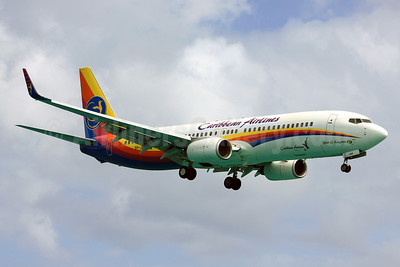
Caribbean Airlines is forced to remove the Air Jamaica brand

Caribbean Airlines (Port of Spain) is now modifying its aircraft that were painted in the Air Jamaica brand.ย The Trinidad and Tobago Civil Civil Aviation Authority (TTCAA) has mandated Caribbean Airlines must drop the Air Jamaica brand because of the conditions of their Air Operators Certificate (AOC). The first casualty is the pictured Boeing 737-8Q8 9Y-JMA (msn 30645) “Spirit of Kingston” (above) which is now sporting Caribbean Airlines titles on the Air Jamaica 2011 livery. The airliner previously had Air Jamaica titles (below).

Caribbean Airlines had previously adopted a “two brands, one airline” marketing strategy to mainly keep alive the Air Jamaica brand, especially for the Jamaican market. Because the aircraft were intermingled between markets, this order is likely to finally kill the Air Jamaica name.

Top Copyright Photo: Nigel Steele.

Caribbean Airlines:ย 

Air Jamaica:ย 

Bottom Copyright Photo: Reinhard Zinabold.

Air New Zealand to remove its blue-turquoise tail from its livery

Air New Zealand (Auckland) is further reducing the “color” in its “color scheme”. According to this report by the airline via its “The Flying Social Network”, the flag carrier will remove its blue and turquoise tail combination next year to a very unexciting black tail with its traditional white Koru logo. The black titles are being updated with a new font style. The rest of fuselage is a boring all-white.

Current logo:

Read the full story: CLICK HERE

Top Copyright Photo: Michael B. Ing. Air New Zealand has been gradually reducing “color” in its livery with each change. The most recent change was to remove the “Pacific Wave” fuselage accent marks from the original 1996 color scheme. Previously the 1996 color scheme update had removed the blue and turquoise fuselage cheat lines of the more colorful 1973 livery. Boeing 747-475 ZK-SUH arrives at Los Angeles in the basic 1996 livery minus the Pacific Wave fuselage marks which were removed in 2008.

Air New Zealand:ย 

View the 1973 livery: CLICK HERE

Bottom Copyright Photo: Micheil Keegan. Did the special All Blacks color scheme influence the carrier to go a very basic black and white livery? Airbus A320-232 ZK-OAB (msn 4553) arrives at Auckland.

Hainan Airlines to fly to Chicago next year with Boeing 787 Dreamliners

Hainan Airlines (Haikou and Beijing) has received approval to start a new route next year from Beijing nonstop to Chicago (O’Hare) with Boeing 787 Dreamliners. The route will interline with partner American Airlines. The airline has 10 787-8 Dreamliners on order.

Read the full story from the WSJ: CLICK HERE

Hainan Airlines:ย